
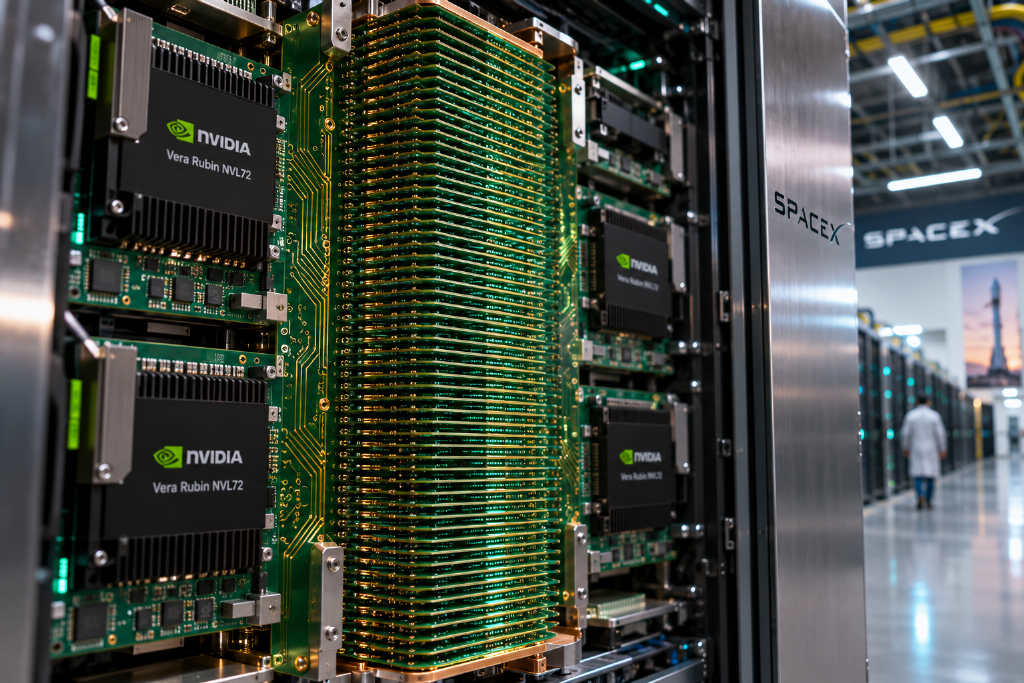
SpaceX is developing a custom AI rack called Kessel that replaces the NVLink copper cable modules used for high-speed GPU connections with a large passive printed circuit board, semiconductor research firm SemiAnalysis disclosed on November 11.
The design is based on Nvidia’s Vera Rubin NVL72 system and is intended for ground data centers as well as future orbital computing facilities. SpaceX plans to buy chip packages directly from Nvidia, then procure circuit boards and other system components from other suppliers, bypassing Nvidia’s existing L6 compute-board supply model.
A smaller Kyber-style rack with 72 GPUs
According to the architecture disclosed by SemiAnalysis, Kessel retains the configuration of Nvidia’s Vera Rubin NVL72, codenamed Oberon: 72 Rubin GPU packages, 18 compute trays and nine NVLink switch trays.
Nvidia’s official NVL72 specifications call for four Rubin GPUs and two Vera CPUs in each compute tray. That gives the full system 72 GPUs and 36 CPUs, joined through Nvidia’s high-speed NVLink interconnect into a large computing unit.
The principal change is physical layout. A conventional Vera Rubin NVL72 uses copper cable cartridges as the high-speed communication backbone between GPUs and switches. Kessel places the compute and switch trays back-to-back on opposite sides of a central board, sending high-speed signals directly through the printed circuit board (PCB) midplane.
SemiAnalysis described the architecture as a 「mini Kyber」. Kyber is Nvidia’s planned next-generation rack architecture for the larger Rubin Ultra system. Kessel applies a similar design to a smaller 72-GPU compute domain, with the aim of reducing the manufacturing difficulty of a large circuit board.
The challenge of an 84-layer PCB
Replacing copper cables with an exceptionally high-layer-count PCB is Kessel’s central technical challenge. SemiAnalysis said the SpaceX design uses an 84-layer M10-grade copper-clad laminate (CCL), while Nvidia’s original Kyber plan called for an M9 substrate with as many as 156 layers.
Kessel has approximately 46% fewer PCB layers than Kyber. It still requires higher-grade M10 material with ultra-low signal loss to handle the GPUs’ high-bandwidth transmission needs.
Making the board smaller does not resolve every manufacturing issue. As layer counts rise, signal integrity, alignment between layers, drilling precision and material quality all have a significant effect on yields. Defects inside the board can be difficult to repair and may force an entire expensive PCB to be scrapped.
In July this year, SemiAnalysis reported that manufacturing problems with Kyber’s large PCB midplane had delayed Nvidia’s mass-production plans by more than 12 months, affecting the NVL576 platform’s launch schedule. Kessel’s 84-layer design seeks a balance between performance, manufacturing feasibility and cost within a smaller GPU compute domain.
Buying chip packages and integrating the system
The procurement model is another departure. SemiAnalysis said SpaceX plans to purchase GPU and other chip packages directly from Nvidia rather than rely on Nvidia-supplied L6 compute boards. SpaceX would select suppliers for the remaining components and lead the hardware integration itself.
L6 generally refers to a board-level product whose main components have already been assembled. Buying at the chip-package level would allow SpaceX to decide on the PCB design, suppliers, system layout and other hardware specifications.
The approach could reduce some intermediate integration costs and allow designs tailored to SpaceX’s own data centers. It would also leave the company with more responsibility for system validation, quality control, reliability testing and supply-chain coordination.
Orbital ambitions and an unconfirmed rack order
Hardware specifications circulating in the market suggest Kessel could be a compact NVL72 designed for inference. Along with replacing conventional NVLink cables with a custom PCB midplane, the design rearranges the compute trays and switches and simplifies the high-speed GPU interconnect. SpaceX is also said to be customizing power and cooling modules.
Kessel is intended not only for ground data centers but also for future deployment in orbit. Orbital computing facilities face tighter constraints on weight, size, power, cooling and maintenance than ground-based facilities. Replacing complex copper cabling with an integrated PCB midplane connecting compute and network components could theoretically simplify some assembly work. Whether it can reduce launch weight or improve reliability in orbit remains unproven.
Research newsletter FundaAI claimed in early November that SpaceX had ordered 6,000 space-specific racks from a server original design manufacturer (ODM) for 2027. If every rack used a 72-GPU configuration, the total would be 432,000 GPUs.
SpaceX has not officially confirmed the size of the order, and there is no evidence that all of the racks use the Kessel design. The claim remains an estimate and report from a supply-chain research organization.
A separate related ABMedia article refers to the possibility of SpaceX’s space computing capacity reaching 5 GW in 2028 and names Foxconn, Auras Technology and Elite Material as supply-chain companies identified by a foreign institution.



