
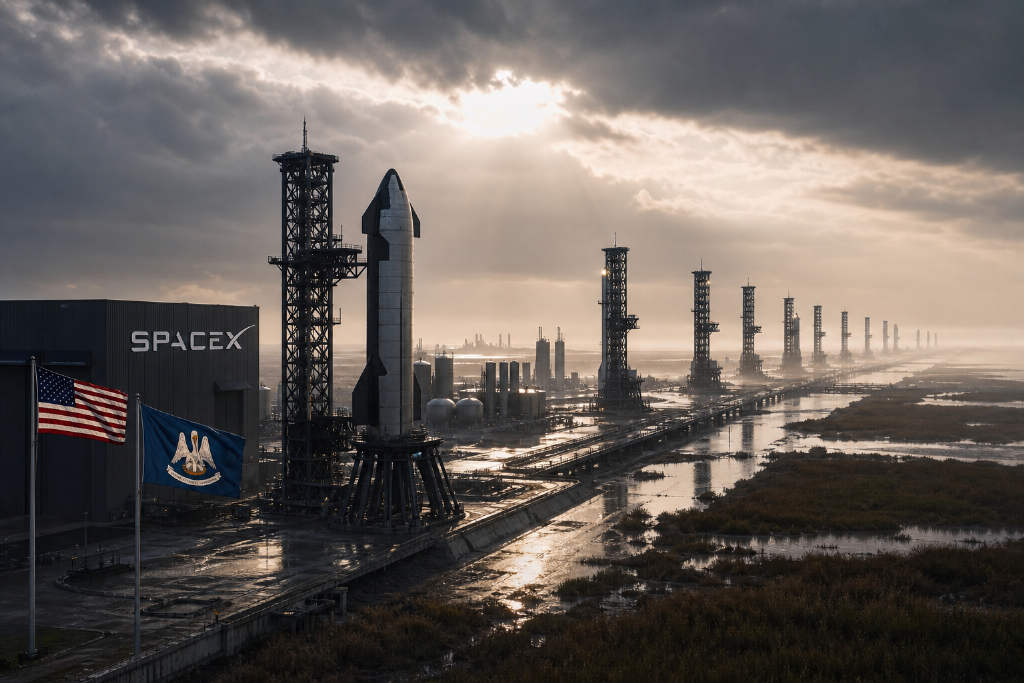
Morgan Stanley said in an August 25 research report that SpaceX’s planned 10-pad Starbase LA site in Louisiana could imply a Starship launch tempo far above what the market currently expects. The report sets a $300 price target and an Overweight rating for SpaceX, against a current share price of $137 cited in the article.
The TechFlowPost article was written by Rita. It says Morgan Stanley views the setup as a chance for investors to revisit SpaceX at a level near its IPO-equivalent price, while the company’s fundamental momentum is stronger than it was at listing.
Starbase LA would add 10 launch pads
SpaceX has announced a $100 billion Starbase project in the Louisiana wetlands with 10 planned launch pads. Construction is scheduled to begin in 2027, with a first flight targeted for 2029. Morgan Stanley says the market has not fully grasped the scale of Starship. Even without counting the new base, the bank’s 2040 launch forecast would require only eight pads, while SpaceX is now planning 15.
Starbase LA is planned on a former ExxonMobil property in Vermilion Parish. The site would include five launch complexes, with two pads each, for a total of 10 pads. It would also include propellant production facilities, a power plant, vehicle processing facilities, and employee housing. The project is expected to create 3,000 direct jobs. Louisiana Governor Jeff Landry took part in the announcement.
The article says this would become SpaceX’s fourth launch facility and its largest, with the capacity to support thousands of launches a year and play a central role in scaling Starship missions.
Including Louisiana, and adding Pad 1 and Pad 2 at Starbase Texas, LC-39A at Kennedy Space Center, and SLC-37A and SLC-37B at Cape Canaveral, SpaceX has now planned a total of 15 launch pads.
Why Louisiana
Morgan Stanley groups the Louisiana decision into four reasons.
- Launch trajectory: Louisiana expands access to polar orbits, which the article says is critical for orbital computing.
- Natural gas: Louisiana is the third-largest natural gas producing state in the U.S., and each Starship launch requires more than 1,000 tons of liquid methane.
- Political hedging: The article says Texas and Florida are facing bipartisan pushback tied to data centers and AI, so a multi-jurisdiction footprint gives SpaceX more negotiating flexibility.
- Government incentives: Over the past year, Louisiana has put together a large incentive package for SpaceX, including aerospace facility sales tax rebates, expanded industrial tax exemptions, liability protections for aerospace entities, and state-assisted land transfers.
Starship as the main scaling engine
Morgan Stanley describes Starship as the ultimate scaling driver for SpaceX. The article says Starship can carry more than five times the payload of Falcon 9 and is designed for full reusability, while Falcon 9 is only partially reusable.
The report compares reusable rockets to an elevator to space. In the same way elevators changed how Manhattan was built, it argues that low-cost reusable launch systems can reshape infrastructure in orbit, on the Moon, and beyond.
According to Morgan Stanley’s framework, SpaceX is aiming to cut launch costs from a historical average of $18,500 per kilogram to below $200 per kilogram. The bank expects Starship to reach roughly $500 per kilogram by 2030 and below $200 per kilogram by 2035.
The report says the key path runs through Ship recovery and reuse. SpaceX has already caught the Super Heavy booster three times and reused it twice, while physical recovery of Ship is expected by the end of 2026. Morgan Stanley says the main issue is not recovery by itself, but turnaround time.
In its model, the bank assumes Ship will have a lifespan of about two flights between 2027 and 2029, meaning one reuse. That rises to 17 flights by 2035 and 43 by 2040. For the booster, the report says getting above 30 reuses would take eight years, broadly in line with Falcon 9’s historical reuse pace.
The article also says that even if Ship is not reusable early on, Starship can still cut internal launch costs sharply through scale alone. Morgan Stanley expects SpaceX to start launching Starlink on Starship by late 2026 or in 2027.
How the $300 target is built
Morgan Stanley uses a sum-of-the-parts approach to reach its $300 target price. As presented in the article, the bank assigns $8 to the Space business, $118 to Connectivity, $8 to X and Grok, and $165 to Enterprise AI, with a 50% execution risk discount already applied to that AI segment.
At the current $137 share price, the article says the implied multiple for Enterprise AI is only in the very low single digits, while the upside from orbital AI is priced at close to zero.
The report also includes a sensitivity case. For every additional 1 gigawatt of nominal compute power, using assumptions of $50 per watt and a 70% incremental margin, and capitalizing it at 10x EBITDA, the share price could increase by $27. The article says that equals about 20% of the current share price. Morgan Stanley estimates AI compute at 4.9 gigawatts by the end of fiscal 2027, while the company’s target is close to 10 gigawatts.
Florida’s final Falcon 9 Starlink launch
The article says SpaceX has completed the last Falcon 9 Starlink launch from Florida. All future Florida Starlink missions will shift to Starship. A single Starship launch has 25 times the downlink capacity of Falcon 9, according to the article, so a smaller number of launches could offset the decline in Falcon 9 launch frequency.
Morgan Stanley says that move shows the company’s commitment to a Starship transition and stands out as a key signal for understanding SpaceX’s long-term value.
Disclosure in the source article
The original piece states that it is a整理与解读 of a third-party Morgan Stanley report dated August 25, 2026, combined with public market information. It also says that the ratings, target price, earnings forecasts, and related judgments cited in the piece are the views of the broker’s analysts and represent only that institution’s position, not the publisher’s, and do not constitute investment advice.
The article ends with a risk notice saying market decisions should be made independently and the piece should not be used as a basis for buying or selling securities.
