

After the Cerebras project delivered an approximately 300% return in May, MSX marked a second full-cycle Pre-IPO case on the night SpaceX went public. Late on June 12 Beijing time, SpaceX (SPCX) officially began trading on Nasdaq in what the source described as the largest IPO in history. The stock reached an intraday high of $176, while the company’s market capitalization briefly moved above $2.3 trillion.
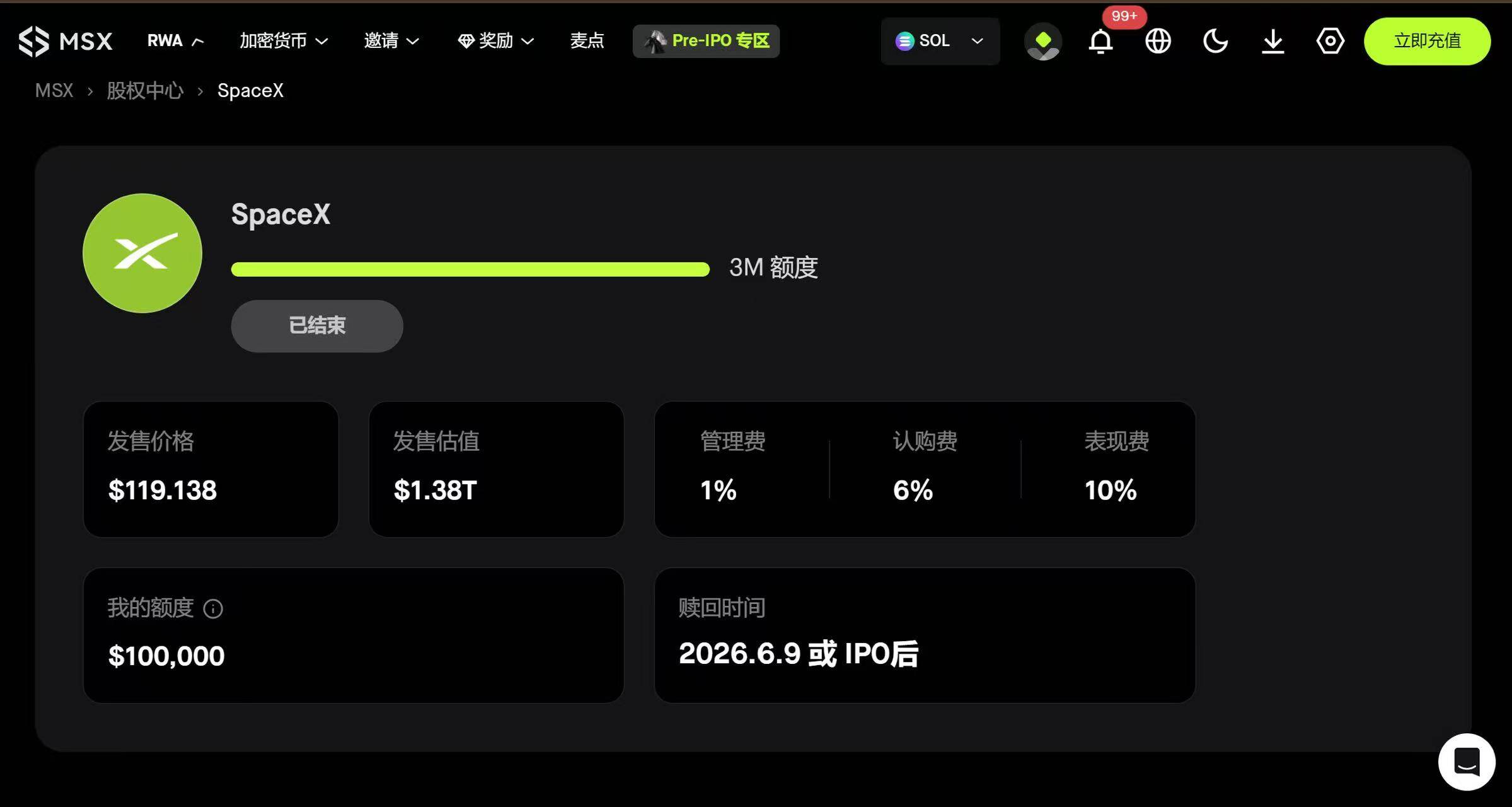
A $119 U Entry Meets Public-Market Pricing
For MSX, the SpaceX listing was the key settlement point for the SpaceX Pre-IPO project it launched in March. At the beginning of March, MSX opened the participation channel for the product at a subscription price of 119 U, adjusted after the stock split conversion, corresponding to an offering valuation of about $1.38 trillion. With SpaceX’s public listing, MSX users completed a three-month path from participating in a private-market asset to facing public-market pricing.
Based on SPCX.M’s first-day after-hours closing price of $166.85, the asset was up about 40% from MSX’s early subscription price of 119 U. Based on the intraday high of $176, the increase was close to 48%. The SpaceX result followed the Cerebras case in May and provided another full verification of the Pre-IPO product model described by MSX.
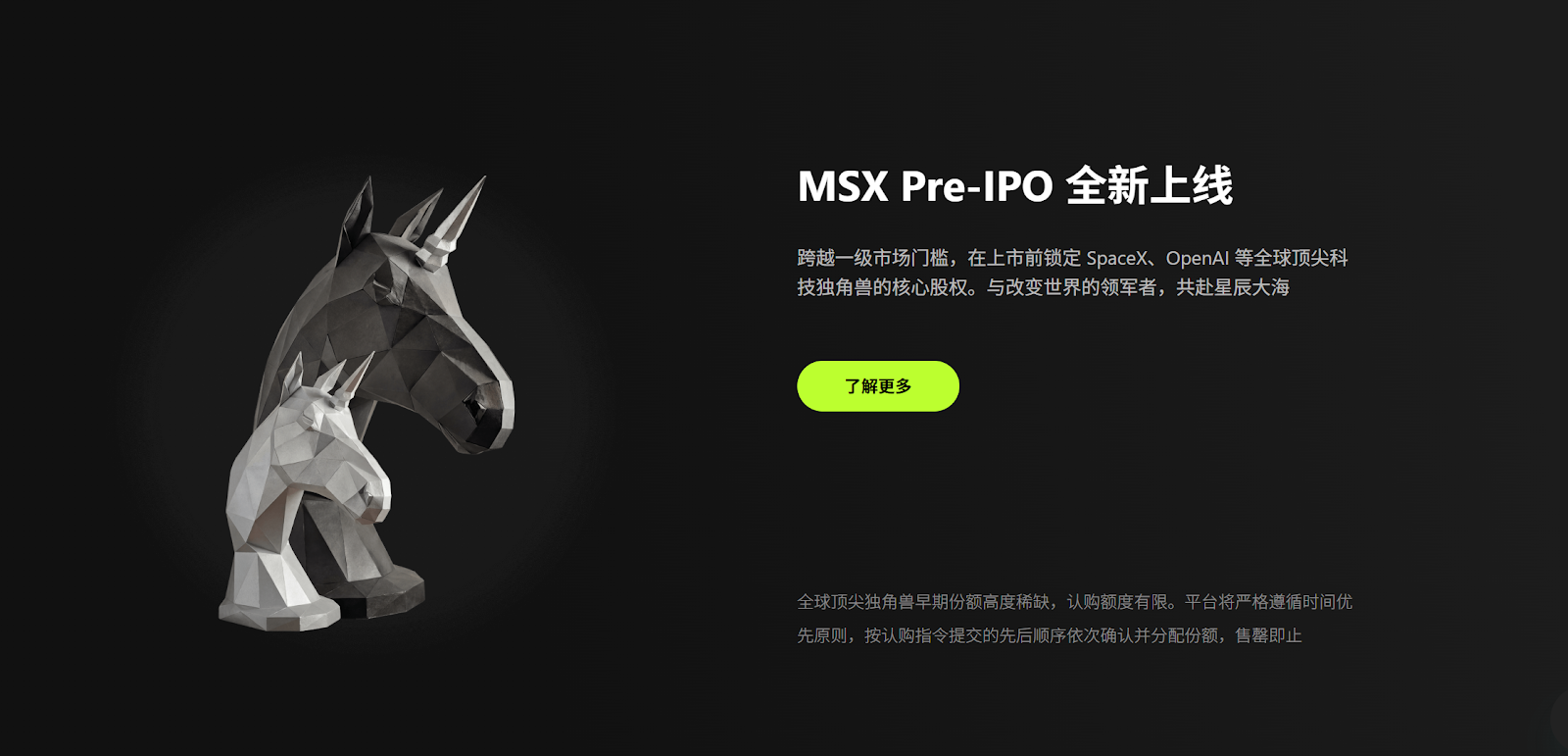
For a long time, access to equity in top unlisted companies has mainly been concentrated among institutional investors, private equity funds, and a small number of high-net-worth individuals. Ordinary investors have generally been able to participate only after a company completes its IPO, and then at secondary-market prices. The core value of Pre-IPO products lies in moving that participation window earlier, into the growth phase before a company lists.
From Subscription and Redemption to Spot Trading
MSX launched its Pre-IPO section for ordinary users on March 2. After that, more similar products appeared in the market. The central question raised by the SpaceX case is not only whether users can see a popular target earlier, but whether a platform can complete the full loop after the target officially lists: subscription, holding, listing, trading, and monetization.

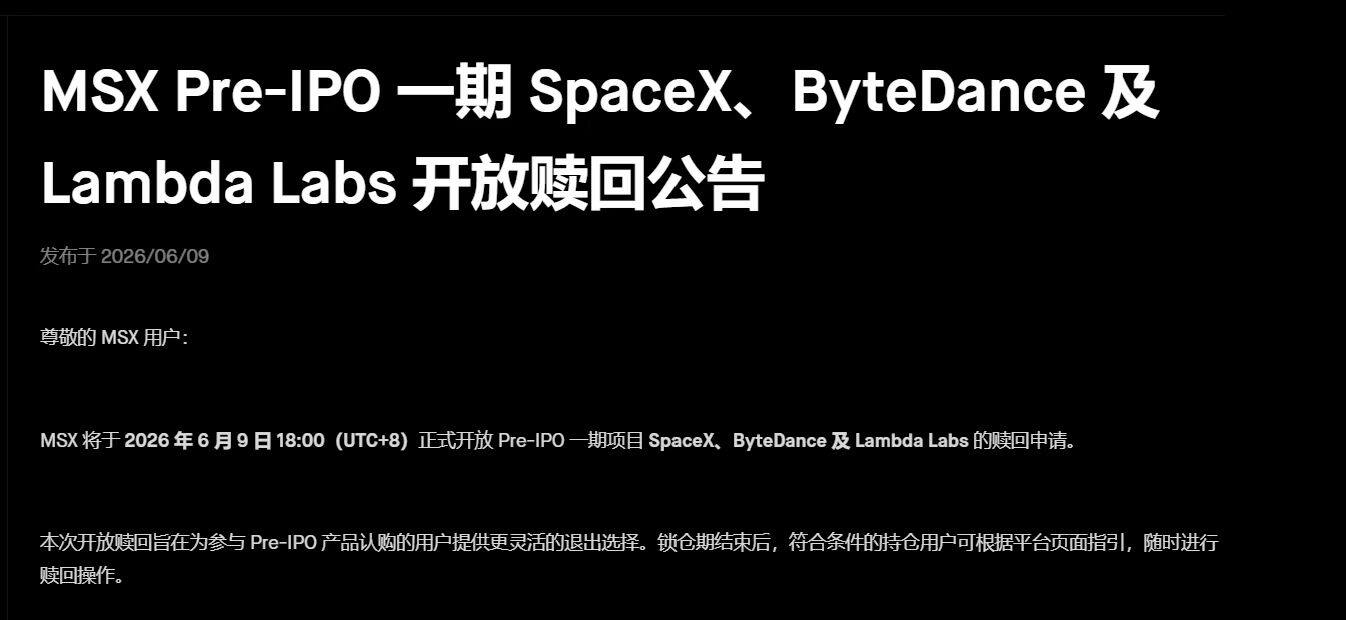
The SpaceX project presented that route in several steps. On March 2, users were able to subscribe to SpaceX Pre-IPO shares on the MSX platform at 119 U, with the asset recorded on-chain in token form. From subscription to the IPO, users could view their holdings on the MSX platform, with the asset status visible throughout the process. On June 9, MSX opened redemption applications for the first phase of Pre-IPO projects, including SpaceX, ByteDance, and Lambda Labs, giving users who subscribed to the products a more flexible exit option.
On June 12, SpaceX listed on Nasdaq and opened sharply higher, with an after-hours closing price of 166.85 U, about 40% above the MSX subscription price. MSX also listed SPCX.M spot trading at the same time. Tokens held by Pre-IPO users were directly converted into tradable spot assets, allowing users to place sell orders without waiting for a lock-up period to end.
The listing also acted as a stress test for the tokenized Pre-IPO sector. According to the source, some platforms that relied on third-party tokenized allocation delivery channels failed to obtain SpaceX allocations during settlement. Several platforms refunded part or all of users’ subscription funds around the listing. In this context, the SpaceX project’s progression showed that MSX’s Pre-IPO product was not simply a “conceptual share,” but a mechanism built around subscription, holding, redemption, listing, spot trading, and stablecoin settlement.
For users, this point matters more than the short-term price increase alone. The main difficulty in a Pre-IPO product is not only whether an investor can buy the asset, but whether there is a clear asset conversion and exit route after the target company lists.
The Second Answer After Cerebras
The SpaceX case was MSX’s second key delivery after Cerebras. To understand that sequence, the timeline goes back one month. On May 14, 2026, Cerebras (CBRS), described in the source as an “Nvidia challenger,” listed on Nasdaq at an issue price of $185. Its opening price once doubled, and it closed the session up about 68%.

Outside the public market, MSX users who entered earlier recorded a more striking result: about 300% in two months. On March 2, MSX had launched its first Pre-IPO product lineup, covering four popular targets: Cerebras, SpaceX, ByteDance, and Lambda Labs. Users participated in the CBRS Pre-IPO subscription at 100.35 U.
When Cerebras listed on Nasdaq on May 14, MSX also launched CBRS.M spot trading on the same day. The assets held by Pre-IPO users therefore gained a subsequent trading and exit route. Based on the first-day high after listing, the comprehensive return for participating users once exceeded 300%. The source framed the May Cerebras result as the first answer sheet for on-chain Pre-IPO, and the June SpaceX listing as the second.
The two consecutive deliveries showed that MSX’s Pre-IPO model was not based on the isolated performance of one project. Instead, the platform is positioning the product around high-quality global primary-market assets and building an on-chain participation mechanism that can be repeated and verified.
A Test for On-Chain Access to Primary Assets
From Cerebras to SpaceX, the consecutive completion of MSX Pre-IPO products is reshaping how the market looks at on-chain access to primary assets. Over the past three months, since MSX introduced its Pre-IPO product in early March, almost all major trading platforms have started to build products around popular unlisted companies. Their implementation logic differs, but the underlying goal is the same: to meet user demand for early access to high-quality assets.
In actual execution, however, Pre-IPO is not as simple as providing a subscription entrance. The real test for a platform is whether it can continuously screen targets with long-term value and clear listing expectations, obtain real and effective asset allocations, design transparent participation rules, and connect pricing, conversion, trading, and settlement after the target officially lists.

The consecutive execution of Cerebras and SpaceX within two months tested all of those capabilities. It is also the key distinction between a Pre-IPO product and a simple synthetic asset or price-guessing product: when the target lists, converts, or is redeemed, users need a clear and executable path.
For users, a low-threshold participation entrance is important, but the ability to complete the loop from subscription to exit determines the actual quality of a Pre-IPO product. After the SpaceX case, MSX said its Pre-IPO reserve of targets is still expanding. The platform will continue screening high-quality primary assets around AI, frontier technology, and other high-certainty sectors, while refining asset authenticity, rule transparency, user rights protection, and post-listing connection mechanisms. The stated purpose behind MSX’s tokenized U.S. stocks and Pre-IPO product system is to help users access high-quality global assets.