



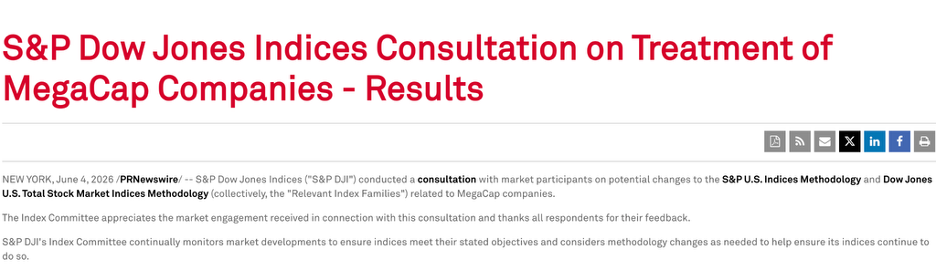
SpaceX entered the Nasdaq-100 on July 7, 2026, using Nasdaq’s revised 15-trading-day fast-track rule. The S&P side went the other way. After a public market consultation, the S&P Dow Jones Indices committee rejected any proposal that would have built a similar shortcut for SpaceX and left its strict profit rule untouched: positive GAAP net income in the latest quarter and positive cumulative GAAP net income over the last four straight quarters. By that rule, SpaceX may not make the S&P 500 before 2027.
So the same company is staring at three separate clocks across the S&P 500, the Nasdaq-100, and FTSE Russell. That is the whole point here. This split is not about the market suddenly arguing with itself. It comes from three sets of rules. Different books, different outcomes. If investors want to make sense of these headline events—and understand why every index rebalance can bring both upside and danger—they have to start with the basics: how index methodology works, who decides whether a company gets in, and when that decision actually hits the market.
Index methodology is public because credibility is the product
An index, in this framing, is a product built on trust. If fund managers are going to pay licensing fees and launch ETFs linked to it, the market has to believe the rules are real and consistent. That is why the methodologies behind major benchmarks are not locked away like trade secrets. They are public documents. Anyone can read them.
That also helps explain why names like S&P Dow Jones Indices, Nasdaq, and FTSE Russell still dominate. Their selection rules are open. Their track records are long. And their benchmarks have been tested again and again over time. The article’s argument is blunt: when investors look at an ETF, the first question should not be how much it went up before. It should be whether the index underneath it actually tracks the market it claims to track, and whether its methodology matches standard industry practice.
The source article says it pulled together methodology documents from the official websites of several major indexes, including the S&P 500 and the broader S&P U.S. index family, the Nasdaq-100, the Dow Jones Industrial Average, and the Hang Seng TECH Index.
Four building blocks sit behind most index methodologies
Construction: deciding what gets in and what stays out
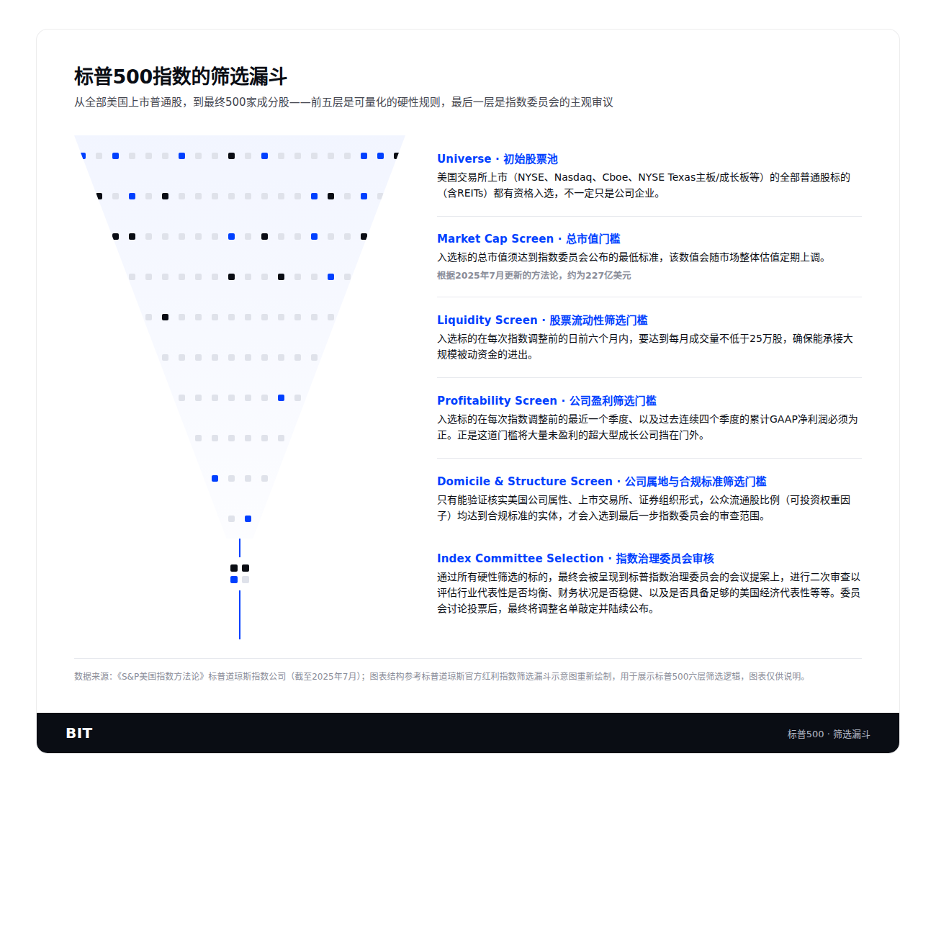
First comes construction. This is the filter. It decides which securities make it in and which do not. Common screens cover market capitalization, company headquarters, trading currency, liquidity, and financial measures like price-to-earnings ratios or dividend yield.
In the S&P 500 case, SpaceX missed the profitability test described in the article. The company needed positive GAAP net income in the latest quarter and positive cumulative GAAP net income across the prior four consecutive quarters. It did not clear that bar. So it stayed out.
Weighting: indexes tracking the same market can behave very differently
The second piece is weighting. This decides how much each constituent moves the index as a whole. Standard methods include market-cap weighting, float-adjusted market-cap weighting, equal weighting, fundamental weighting, and factor weighting.
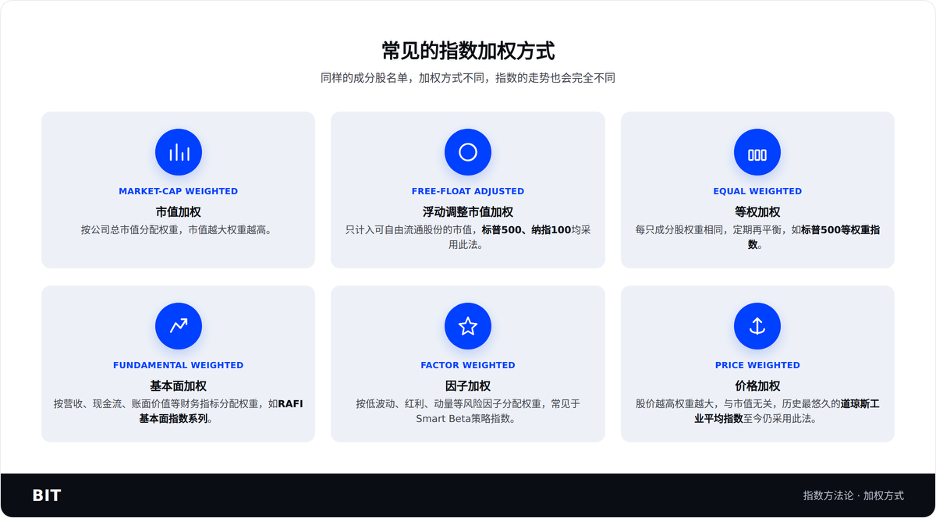
And this part matters a lot. Two indexes can target the same market and still wind up looking and performing differently because the weighting method is different. The S&P 500 uses float-adjusted market capitalization, counting only shares available for public trading. Bigger companies with larger free floats get more influence. The S&P 500 Equal Weight Index goes the other way, giving all 500 constituents the same weight and rebalancing on a regular schedule. The Dow Jones Industrial Average, one of the market’s oldest benchmarks, still uses price weighting, where higher-priced stocks have more sway regardless of the company’s total market value.
Calculation: how raw stock data becomes an index level
The third piece is calculation. This is where raw constituent data turns into a quoted index level. The article lays out the logic pretty plainly: the market value of a single stock equals share price multiplied by shares outstanding used in the calculation, total index market value equals the sum of all constituents, and the index level equals that combined value divided by the index divisor.
The divisor is a technical setting meant to turn a huge market value number into something readable and trackable. When companies go through stock splits, dividends, spin-offs, or other corporate actions, the divisor gets adjusted so those events do not create fake jumps in the index level. Those adjustments are usually made after the close. Keeps continuity intact between one session’s close and the next session’s open.

Rebalance review: an index is not a permanent list
The fourth piece is rebalance review. An index is never built once and forgotten. It gets checked on a regular schedule, often quarterly or yearly. During that review, companies that no longer fit the rules can be removed, stronger new names can be added, and free-float data can be refreshed to better reflect the tradable share base.
Names usually leave for familiar reasons. They stop meeting eligibility standards. They get pushed out by higher-ranked companies. Or they are hit by mergers, privatizations, delistings, or similar corporate events. The article says the final decision on the S&P list is made by the S&P Index Committee, made up of full-time managing directors inside S&P Dow Jones Indices. No public company executives. No outside independent members. The committee works inside a published rules framework, but it does not publicly reveal the step-by-step reasoning behind each inclusion or exclusion call. That is one big reason every announced rebalance gets watched so closely.
Why markets care so much about who gets included
On May 12, 2025, S&P Dow Jones Indices announced that Coinbase would join the S&P 500 on May 19, making it the first cryptocurrency company to enter the index. Coinbase shares rose 8.8% in after-hours trading after the announcement. In the article’s view, getting into the S&P 500 has become a symbolic milestone for founders and investors who treat it as formal recognition from mainstream finance.
The piece also points to an image posted by Coinbase’s official X account, @coinbase, on May 13, 2025, with the caption: "First they ignore you, then they laugh at you, then they add you to the S&P 500."

At the same time, MicroStrategy—also a well-known market name and a holder of a large amount of Bitcoin—did not qualify. The article says the company posted a $4.2 billion GAAP net loss in the first quarter of 2025, which kept it below the S&P 500 cutoff.
Look at the numbers and the article’s argument is pretty direct: Coinbase did not get in because the "crypto concept" was hot. It got in because it produced a real first-quarter net profit of $65.6 million and 24% year-over-year revenue growth. MicroStrategy, by contrast, stayed outside because the profit rule still applies even when a company has a powerful market story.
Index inclusion does not automatically mean a stock must rise
According to the methodology cited in the article, the S&P 500 makes quarterly adjustments on the third Friday of March, June, September, and December each year. On the effective date, passive funds tracking the benchmark must buy the companies coming in and sell the ones going out. That rule-driven trading can mean flows in the tens of billions of dollars, and sometimes more than $100 billion, according to the article’s description.
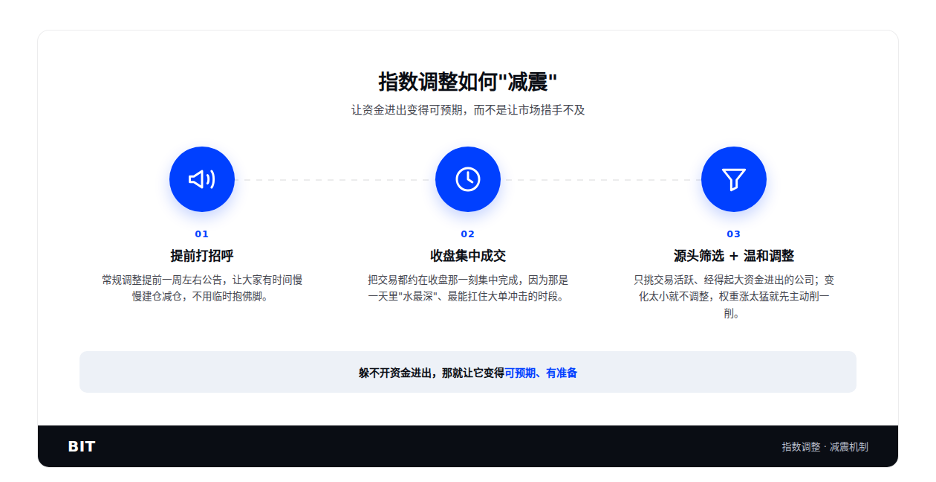
Even then, the mechanics are meant to help a huge benchmark like the S&P 500 adjust without needless disruption. Market swings often get worse not because the rules exist, but because traders pile into the theme once an index change is announced. That crowding can make it look like index inclusion guarantees upside. It does not.
The article uses Reddit as the example. On August 14, 2026, S&P Dow Jones Indices said Reddit would join the S&P 500 before the market open on August 18. The stock surged as much as 15% in after-hours trading after the announcement. But the article says the move was more tangled than simple passive buying.
A meaningful chunk of that gain came from short covering. At the time, about 13% of Reddit’s free float had been sold short, based on the figures cited in the piece. Once the index addition was announced, those bearish positions were forced to buy shares back, creating a technical rally that had nothing to do with passive index funds. Active managers may also have built positions ahead of the effective date, expecting the rebalance. By the time passive money actually arrived on August 18, much of the price move had already been taken in.
What the “S&P 500 Index Effect” research found
The article says index inclusion can lift longer-term capital flows and liquidity, while the visibility that comes with the S&P 500 can also act as a public stamp of approval on a company’s broader standing. Still, it points to academic research suggesting that index membership by itself does not create value out of nowhere.

The Federal Reserve Bank of New York studied companies added to the S&P 500 from 1989 to 2009. It found that firms admitted to the index had often already shown stronger momentum before inclusion, and that a large share of their gains after entry reflected that existing strength continuing, not value created only by joining the index.
The report was later widely cited as evidence for the "S&P 500 Index Effect" and became one of the most common empirical references in arguments over whether index inclusion itself can produce extra value.
Reference links listed in the source article
- S&P Dow Jones Indices Consultation on Treatment of MegaCap Companies – Results: https://press.spglobal.com/2026-06-04-S-P-Dow-Jones-Indices-Consultation-on-Treatment-of-MegaCap-Companies-Results
- S&P 500 and S&P U.S. Indices Methodology (Chinese): https://www.spglobal.com/spdji/zh/documents/methodologies/methodology-sp-us-indices-chinese.pdf
- S&P 500 and S&P U.S. Indices Methodology (English): https://www.spglobal.com/spdji/en/documents/methodologies/methodology-sp-us-indices.pdf
- Nasdaq-100 Methodology: https://indexes.nasdaq.com/docs/Methodology_NDX.pdf
- Dow Jones Industrial Average Methodology: https://www.spglobal.com/spdji/en/documents/methodologies/methodology-dj-averages.pdf
- Hang Seng TECH Index Methodology: https://www.hsi.com.hk/static/uploads/contents/en/dl_centre/methodologies/IM_hsteche.pdf
- S&P Dow Jones Indices announcement on Reddit joining the S&P 500 dated August 13, 2026: https://www.spglobal.com/spdji/en/documents/indexnews/announcements/20260813-1484396/1484396_avb54wbs.pdf
- Federal Reserve Bank of New York staff report, The S&P 500 Index Effect (Staff Report No. 484): https://www.newyorkfed.org/research/staff_reports/sr484.html
Risk disclosure in the source
The source says this material is for informational and educational reference only and does not amount to investment advice, an offer, or an invitation to buy or sell any financial product. Any indexes, ETFs, securities, and market views mentioned are there only to explain index construction and the mechanics of passive investing, not to recommend or endorse anything. Historical performance and market reactions to index changes are not future results. Investing carries risk, and the prices of securities and ETFs can move. Investors may lose some or all of their principal and should make decisions carefully based on their own circumstances. Related services and products remain subject to the laws, regulations, supervision, and geographic restrictions of the relevant jurisdiction.