

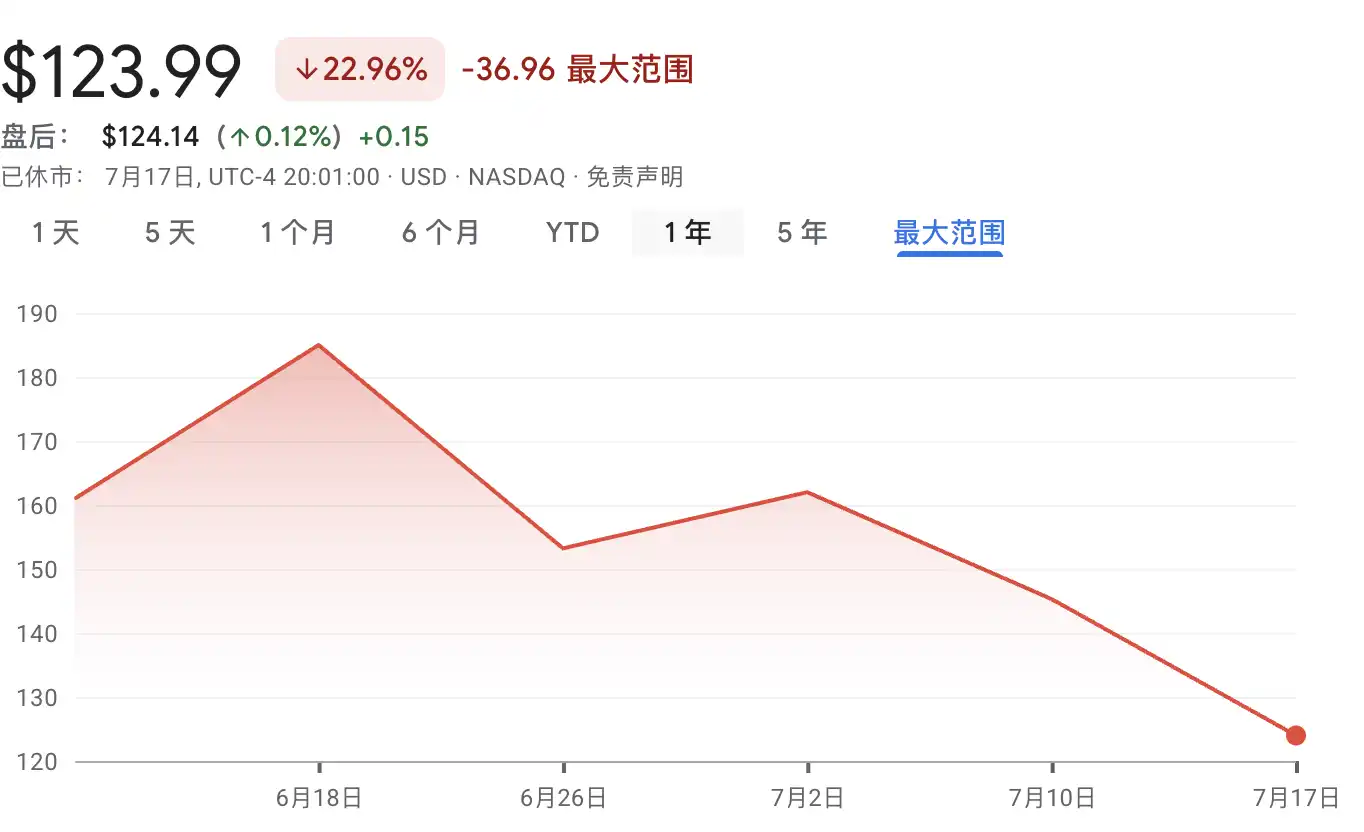
SpaceX shares extended their slide on Friday, falling 5.4% to $123.99 and pulling the company’s market capitalization down to $1.63 trillion. The stock is now below its $135 IPO price. From the $2.64 trillion valuation SpaceX reached on June 16, its third trading day after listing, more than $1 trillion in market value has been wiped out.
The latest drop followed an aborted Starship mission after an engine problem forced the company to halt the launch attempt. The company, founded by Elon Musk, is now facing its toughest valuation test since going public.
Starship launch setback triggers fresh selling
On Thursday, SpaceX scrubbed the Starship launch after some of the rocket’s engines failed to ignite. Musk later said on X that the company will replace two Raptor engines and that the next launch attempt may be delayed until early next week.
SpaceX said it will try again. In a Friday note to clients, Raymond James analyst Brian Gesuale wrote that even with a delay, a successful launch next week would cut the gap between two Starship flights from 221 days to less than 60 days.
Gesuale initiated coverage on SpaceX on July 7 with a strong buy rating and an $800 price target. That is the highest target on Wall Street and implies roughly 545% upside from Friday’s close. He also wrote, “These kinds of anomalies will continue to come with Starship’s aggressive development path — an unavoidable cost of pushing reusable capability, payload capacity, Starlink V3 deployment, and faster progress toward future NASA Artemis missions.”
Joe Gilbert, a portfolio manager at Integrity Asset Management, said, “The timing of the launch failure is not ideal for the company narrative, but failure is an inherent risk in that narrative. Investors are cutting positions and reassessing valuation, optimism is slowly fading, and that is also compressing valuation multiples that had been elevated.”
Starship remains central to the business case
According to SpaceX’s IPO prospectus released in June, the company has invested more than $15 billion in Starship development. The rocket sits at the center of SpaceX’s plans to build space data centers, expand the Starlink satellite communications network, and eventually support crewed Moon and Mars missions.
Clear Street analyst Greg Pendy said, “Any meaningful schedule slip would directly affect the scale-up of Starlink and direct-to-cell service, because cheaper launch costs are critical to faster satellite deployment.”
Royal Bank of Canada analysts Ken Herbert and Jonathan Atkin said in a report that the cost savings tied to Starship would be a key catalyst for unlocking SpaceX’s broader ambitions, including its so-called orbital computing business. At the same time, they warned that a reusable launch cadence is “critical.” The two analysts wrote, “We understand that the path to de-risking is non-linear, and we believe investors may also have to accept that non-linear pace.”
Wall Street stays positive, but structural pressure is building
Even after the recent selloff, Wall Street remains broadly bullish on SpaceX. According to data tracked by Bloomberg, more than 80% of analysts rate the stock a buy or equivalent. The average price target stands at $235.34, implying about 90% upside from current levels.
Still, the market is dealing with several structural pressures. SpaceX joined the Nasdaq 100 earlier this month, and insider lockups are set to expire over the coming months, which means more shares could gradually come to market.
Mark Malek, chief investment officer at Siebert Financial, said, “Given the coming lockup expirations, many investors may have revisited their original investment case, while potential buyers who stayed on the sidelines are waiting for a lower entry point. As valuation moves back toward a more reasonable range, the odds of that opportunity showing up are fairly high.”
Questions spread beyond SpaceX
According to The Wall Street Journal, SpaceX is in talks to sell computing capacity to the U.S. Department of Defense. The report briefly lifted the shares. The company has already signed similar agreements with Alphabet’s Google and Anthropic PBC.
The stock’s continued decline also poses a potential test for the current wave of AI-linked IPOs. Artificial intelligence was a core part of SpaceX’s IPO narrative, with the company pitching space data centers as a strategic entry point into a market it sized at about $26.5 trillion.
The record IPO generated sizable fees for major Wall Street banks and helped push equity underwriting revenue to its highest quarterly level since 2021. Now that SpaceX has fallen below its offer price, investor doubts are deepening over whether richly valued technology listings can maintain strong post-IPO performance.