

SPCX reverses the tone after a mixed first-day finish
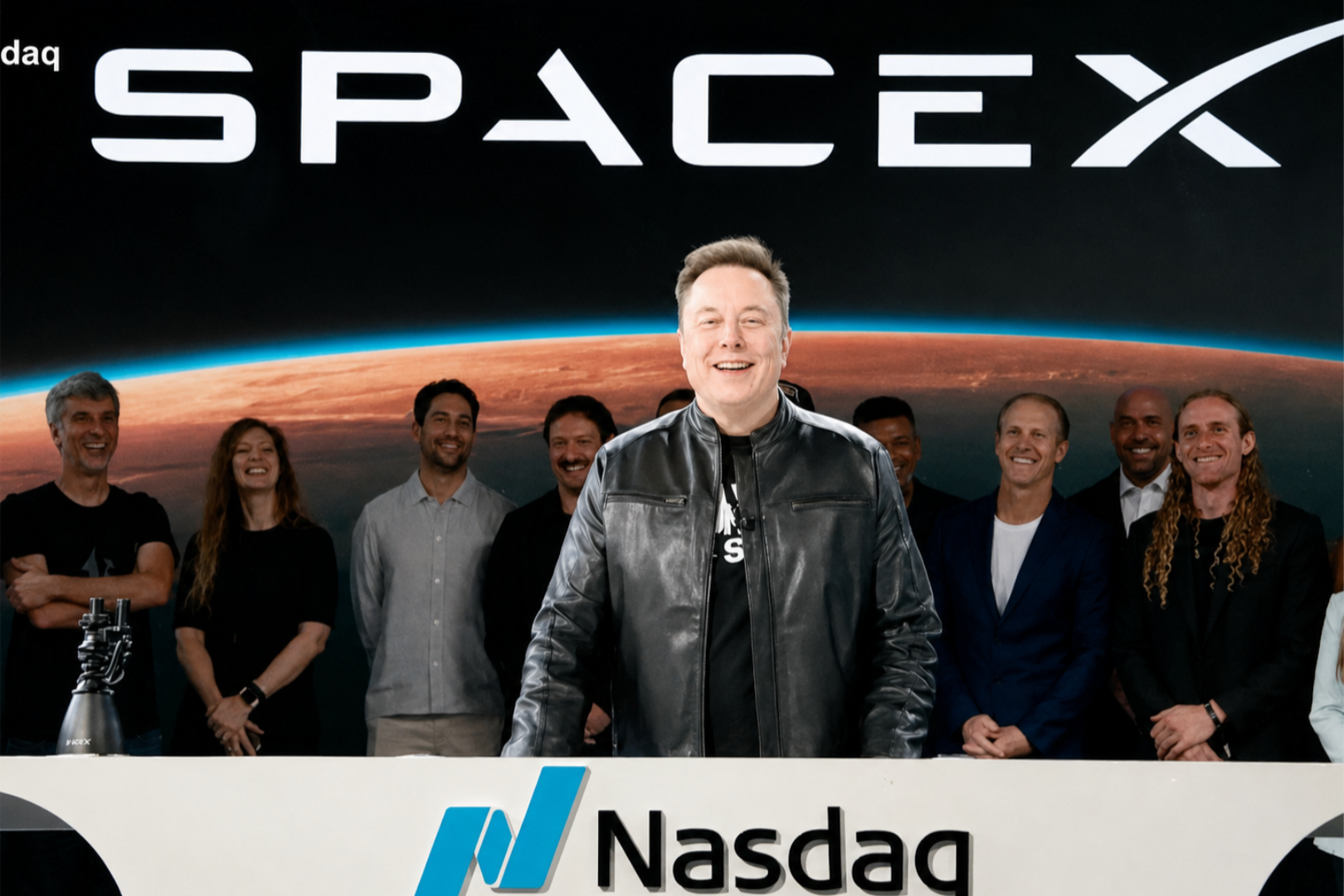
SpaceX ended its first day of trading last Friday at $160.95, giving the company a market capitalization of $2.1 trillion. The listing still marked the largest IPO in U.S. stock-market history, but the closing result did not satisfy all of the expectations built up before the debut. Research firm CFRA went as far as assigning SPCX a “sell” rating, suggesting that Elon Musk’s Mars narrative drew applause but did not convince every investor at the opening stage.
That changed sharply on Monday. According to Gate U.S. equity market data, SPCX moved higher throughout the session after the opening bell and finished at $192.5, up 19.6%. The closing price was also the intraday high. SpaceX’s valuation rose to $2.519 trillion, making it the eighth-largest company in the world by market capitalization. Hyperliquid data showed SPCX trading above $214 in premarket activity, and the source article stated that the stock was highly likely to extend Monday’s gains after Tuesday’s U.S. market open, with its valuation set to move past seventh-ranked Amazon if that move continued.

U.S.-Iran agreement adds support to broader equities
On the macro side, the understanding reached between the United States and Iran was presented as an important positive development for U.S. equities this week, with SpaceX among the beneficiaries. On June 15, Trump announced that an agreement with Iran had been reached and that the Strait of Hormuz would be opened. Unlike earlier episodes described as unilateral verbal exchanges, this agreement was also acknowledged by the Iranian side. Iranian Deputy Foreign Minister Gharibabadi said on the same day that the text of the U.S.-Iran memorandum of understanding had been finalized and would be formally signed in Switzerland this Friday, June 19.
The agreement was also confirmed a second time by Iran’s president. U.S. Vice President Vance said the agreement reached by the two sides had already been signed electronically over the weekend, indicating that its terms had taken effect. The source described the chances of either side tearing up the agreement again as limited. After the news spread, U.S. stocks rose broadly at the open: the Dow Jones Industrial Average closed up 0.92%, the S&P 500 gained 1.65%, and the Nasdaq rose 3.07%.

Morgan Stanley said that a long-term agreement between the United States and Iran, together with a pullback in oil prices, would ease inflation pressure. The firm also said U.S. equities were shifting from a “one-legged market” into a healthier broad-based rally, with upward momentum no longer confined to the technology sector and gradually spreading to a wider range of cyclical industries.
Retail flows concentrate in SpaceX as the greenshoe expands the deal
From the perspective of market sentiment, SpaceX remained the single stock most aggressively pursued by retail money. Vanda Track data showed that on June 16, U.S. local time, the stock received about $93.8 million in net retail buying in one day. That represented roughly 73% of total retail net inflows into all U.S.-listed individual stocks that day. Put another way, for almost every $4 in incremental retail money flowing into the U.S. stock market, about $3 went into SpaceX.
With demand for SPCX so strong, SpaceX’s underwriters exercised the over-allotment option in the IPO, known as the greenshoe mechanism. They purchased an additional 83.33 million shares, bringing the total IPO issuance to 638,888,888 Class A common shares. The move raised the total financing size of the offering to $85.7 billion. According to the source, that scale exceeded almost all recorded over-allotment arrangements for technology-company IPOs.
Even with the greenshoe being exercised, reports cited in the source said that most eligible U.S. retail investors received only about one share in the SpaceX IPO subscription. Under such extreme supply-demand imbalance caused by a very low free float, concentrated retail buying was enough to move the share price significantly higher.
Options debate, institutional coverage and investor comments broaden the discussion
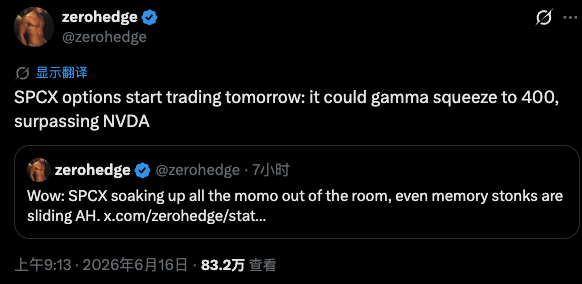
Influential financial media outlet zerohedge wrote on June 16 that once SPCX options begin trading, the stock could rise to $400 through a gamma-squeeze effect and surpass Nvidia. A gamma squeeze is an upward spiral driven by options market makers being forced to buy the underlying shares as prices rise. The source described the conditions as follows: SpaceX has an extremely low free float of 4.2%, retail buying enthusiasm is high, and retail investors who have not obtained SPCX shares may turn to relatively cheaper call options. If large amounts of capital rush into calls, market makers would need to keep buying SPCX spot shares to hedge risk, pushing the stock higher and creating a positive feedback loop. The 2021 surge in GameStop, or GME, was cited as one of the classic examples of this effect.

On June 15, before the U.S. market opened, Oppenheimer analyst Timothy Horan initiated coverage of SpaceX with an “outperform” rating and set a short-term price target of $190. After the Monday session, SPCX closed at $192.5, broadly in line with that Oppenheimer target.
On June 14, well-known entrepreneur, XPRIZE founder and early SpaceX investor Peter H. Diamandis wrote that SpaceX is the “railroad in orbit.” He said it would open up a multi-planet human civilization and create enormous wealth in the same way that railroads opened the American West in the 19th century. He also predicted that SpaceX and Tesla would merge within the next year and become the first $100 trillion company.

Diamandis added that over the past decade, whenever he freed up capital from other transactions, he invested that money in Bitcoin. Now, he said, whenever he has idle capital, he invests it in SpaceX. He acknowledged that the share price would decline when locked-up shareholders are able to sell shares and some shareholders cash out, but said he was not investing in SpaceX for quarterly share-price appreciation. His stated aim was to support the development of an off-Earth economy. On June 16, Silicon Valley investor Brad Gerstner said in the latest episode of the BG2 podcast that SpaceX is an asset institutional investors must buy and hold, because the company stands at the intersection of two major themes: the space economy and the expansion of artificial-intelligence computing power.