
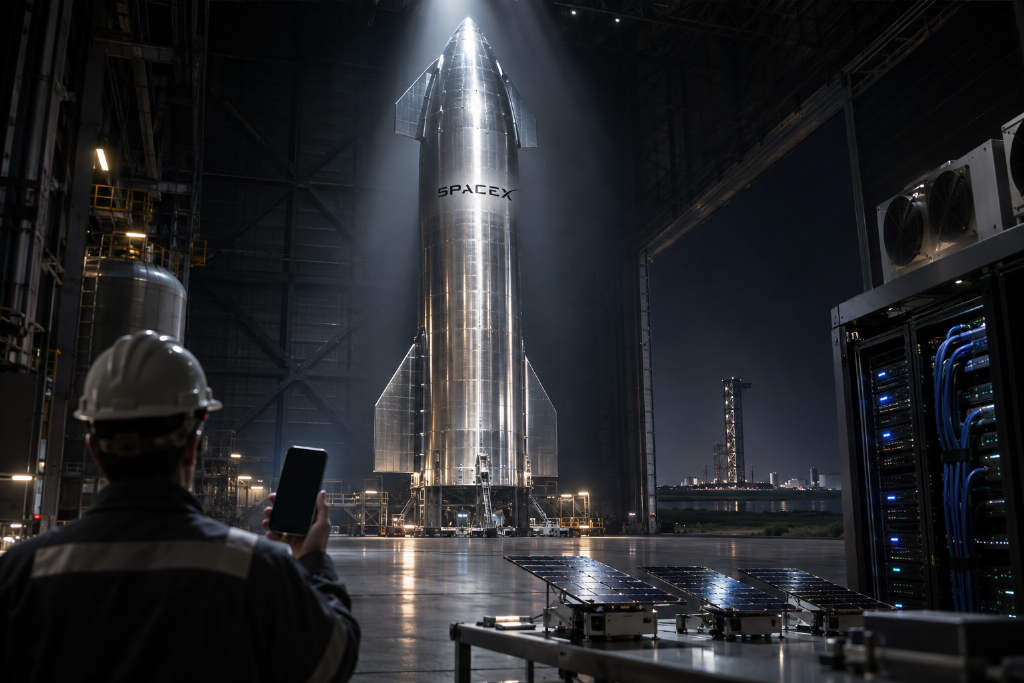
Sequoia Capital partner Shaun Maguire said on X that SpaceX is approaching a revenue breakout that could resemble Nvidia’s growth over the past three years, while most investors still underestimate the company.
Maguire published the view after a SpaceX earnings call, releasing what he described as a bottom-up financial model. He said the numbers in that model were "stunning" and added that he chose to publish the forecast while markets were gripped by macro fears tied to geopolitical uncertainty and inflation pressure. In his words, more than 90% of investors would probably see the projection as "crazy."
The three areas he says the market is missing
Maguire argued that the market is underpricing three core drivers: SpaceX’s talent density, its position as a low-cost supplier in AI compute infrastructure, and the historic moat created by Starship. He also highlighted Starlink’s unit economics as a major part of the case.
On the business mix, he said Direct to Cell could surpass Starlink in revenue in nearly every scenario by 2029 to 2030.
Talent density as an unseen barrier
Maguire described the SpaceX team as "the most elite team on Earth" and drew a sharp distinction between its culture and that of other Silicon Valley technology companies.
He said SpaceX combines extreme work intensity with an objective feedback system that leaves little room for internal politics: rockets either fly or explode. That hard physical feedback, in his view, has made it difficult for mediocre performers to survive inside the company and has produced unusually high talent density over 25 years.
He argued that this matters in the buildout of AI compute. Amazon, Google and cloud providers have some excellent people, he wrote, but at SpaceX, "every single person is excellent." He said building gigawatt-scale AI data centers is one to two orders of magnitude harder than the megawatt-scale CPU data centers of the past, and argued that SpaceX’s ability to solve "atomic-level" problems sets it apart. He cited turbine shortages, interstate power transmission and cross-border transport of large equipment as examples of challenges the team can handle.
Starship as a historic technical moat
Maguire devoted a large part of his argument to Starship, which he called the most complex system humans have ever built. He said it exceeds other recognized technical peaks, including advanced chip manufacturing, ASML’s EUV lithography machines and the International Thermonuclear Experimental Reactor.
His framework was simple: if a group of top-tier people had unlimited resources and tried to catch up to a frontier technology, how long would it take? In Starship’s case, he argued, the answer is longer than in any other field.
He pointed to the competitive timeline as support. SpaceX completed its first booster recovery in 2015, while competitors reached the same milestone about 10 years later. In his view, that gap is still widening as Starship advances, not narrowing.
He also said Starship’s supply chain is highly vertically integrated inside SpaceX, making the moat "hard to imagine" in depth.
A low-cost supplier position in AI compute
Maguire argued that in commodity markets, being the low-cost supplier is a strategically valuable position. He compared AI compute pricing more to oil production than to broadband during the dot-com era, saying gigawatt-scale AI capacity has much higher barriers to entry, tighter supply chains and longer build cycles.
His view is that even if compute costs fall to about $10 billion per gigawatt, SpaceX would still hold an edge as a low-cost and flexible operator. He said costs are unlikely to drop below $20 billion per gigawatt over roughly the next four years, and at that level he expects SpaceX’s unit capital expenditure to decline further as competition thins out.
He said his company-wide model runs through 2028 and treats revenue per gigawatt and capital expenditure per gigawatt as a pair of "coupled constants." If one falls, the other should fall proportionally, while total deployed gigawatts would rise and partly offset the revenue impact.
Starlink economics and the direct-to-cell outlook
Maguire also shared a set of figures to illustrate Starlink’s capital efficiency. He said the current Starlink constellation generates about $20 billion in annualized revenue and was built with roughly 400 Falcon 9 launches.
Because one Starship launch can theoretically carry about as much as 20 Falcon 9 launches, he argued that around 20 Starship launches could support $20 billion in annual revenue. That implies about $1 billion in annual revenue per launch, or roughly $5 billion in lifetime revenue per launch assuming a five-year life.
He said commercial Starship operations would sharply lower the cost of Starlink, direct-to-cell services and orbital compute, while expanding the addressable market. In his scenario work, Direct to Cell overtakes the core Starlink business in revenue by 2029 to 2030.
Orbital compute enters the long-range model
Maguire also said orbital compute should begin to show up meaningfully in the financial model from 2029. Over the next 10 years, he expects SpaceX’s degree of vertical integration in chips to resemble the position it holds in rockets today.
The views were published by Maguire on X. The original article was written by Zhao Ying and credited to Wallstreetcn.



