
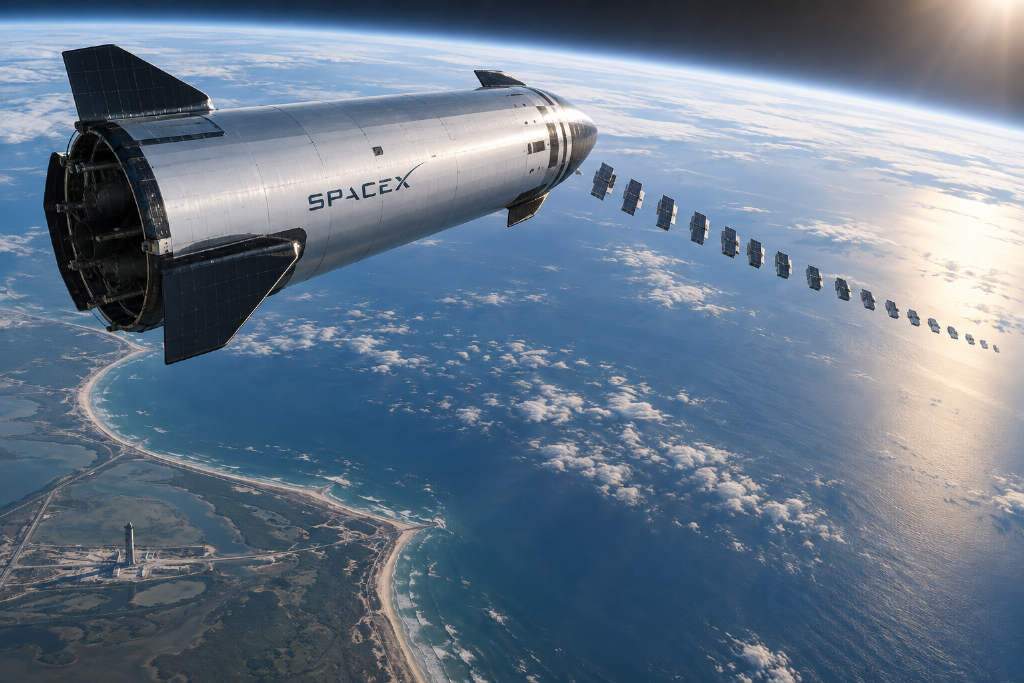
SpaceX’s Starship reached orbit for the first time on Sept. 28, a milestone flight that also saw the vehicle deploy 26 third-generation Starlink satellites before returning early and splashing down in the North Pacific.
According to ABMedia, Starship lifted off from Starbase in Texas at 8:48 p.m. Taiwan time on its 14th test flight. About half an hour later, it entered Earth orbit and released 26 Starlink V3 satellites, marking the first true orbital mission in the history of the Starship program.
SpaceX ended the mission ahead of schedule, but Starship still completed a splashdown in the North Pacific. The company later said on X, 「Splashdown confirmed. Congratulations to the entire SpaceX team on Starship’s first orbital flight!」
An engine shutdown briefly put orbital insertion in doubt
Space.com reported that the ascent was tense. One of the six engines on Starship’s upper stage shut down during flight, and SpaceX spokesperson Dan Huot at one point said the company would abandon the orbital attempt. Minutes later, he reversed that position and said, 「We’re not giving up yet,」 as flight controllers chose to press on.
Starship then performed a brief burn with a single Raptor engine and formally reached orbit about 25 minutes after liftoff.
The Super Heavy booster completed a controlled splashdown in the Gulf of Mexico about seven minutes after launch. Several engines shut down during the booster’s flight as well, but the recovery sequence was not affected. Elon Musk later posted on X: 「Starship’s first orbital flight was successful!」
All 26 Starlink V3 satellites were deployed
After reaching orbit, Starship released all 26 Starlink V3 satellites in roughly 30 minutes. Three of those satellites were equipped with cameras and are expected to film Starship’s heat shield tiles, giving engineers more data to improve the shield used during high-temperature reentry.
SpaceX had also deployed third-generation Starlink satellites during the 13th test flight in July, but that mission was suborbital and the satellites quickly fell back to Earth. This time, the payload became the first batch of Starlink V3 satellites to actually operate in orbit.
CNBC reported that a single Starship can carry 60 Starlink V3 satellites, about 20 times the payload capacity of a Falcon 9. It also said the new satellites generate twice the solar power of the previous generation and offer faster data transmission.
Mission was cut short after the first orbital checkpoint
The original plan called for Starship to remain in orbit for about 7.5 hours, with the full mission lasting nearly 10 hours and ending in a splashdown off the coast of Chile.
But according to Space.com’s live coverage, SpaceX evaluated Starship at the first orbital checkpoint and decided to bring it back early, shifting the landing zone to the North Pacific. The company has not given a specific reason for the early return.
ABMedia said Starship performed its deorbit burn at 11:04 p.m. Taiwan time, reentered Earth’s atmosphere at about 11:34 p.m., and was confirmed to have splashed down at 11:58 p.m.
Why orbit matters for SpaceX’s business
CNBC said Starlink is SpaceX’s largest business and, through the second quarter, its only profitable one. The network currently has about 11,000 satellites operating in orbit. The report also said SpaceX completed the largest IPO in history in June, reaching a valuation of about $2 trillion.
SpaceX President and COO Gwynne Shotwell said this month that the company plans to use Starship in 2027 to launch 「AI computing satellites」 and send a supercomputer into space. On the same day, CLSA initiated coverage on SpaceX stock with an 「outperform」 rating and a $250 price target.
Starship still has major technical milestones ahead before full operational use. The upper-stage Starship has not yet attempted recovery using the launch tower’s mechanical arms, and orbital refueling needed for Moon and Mars missions has not yet been demonstrated. ABMedia also cited an earlier report from Chain News saying SpaceX expects Starship could achieve full reusability in 2027.
For readers in Taiwan, Starlink service still cannot be applied for locally, but the pace of Starlink V3 deployment will affect how quickly the company expands its global low-Earth-orbit network.