
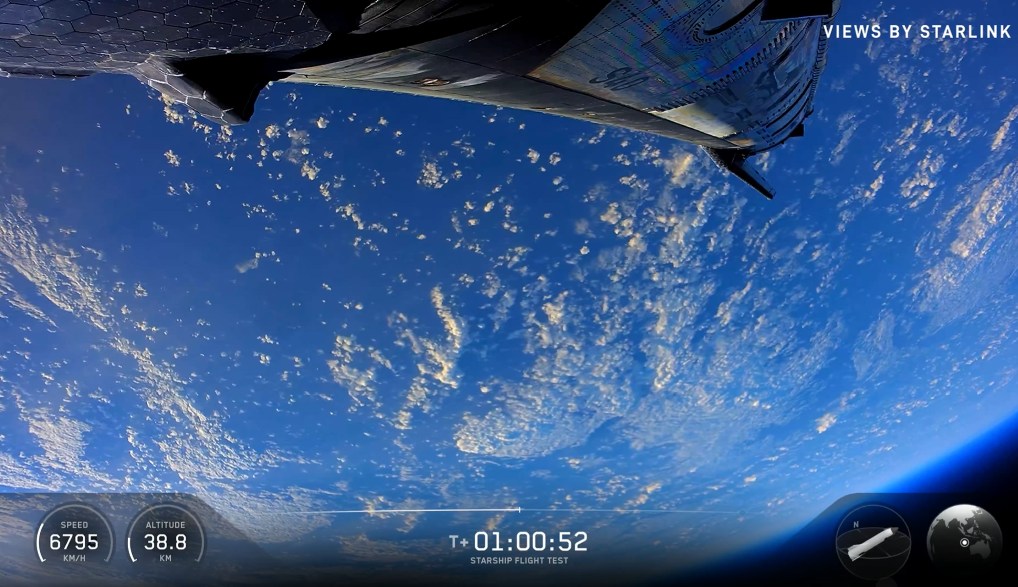
SpaceX on July 24, 2026 completed Starship Flight 13, a mission that checked off several major engineering objectives. The company carried out a return and splashdown of the Super Heavy booster in the Gulf of Mexico and, for the first time during the spaceflight phase, deployed 20 Starlink V3 satellites.
According to the source material, the satellites completed solar array deployment and laser link testing in a suborbital profile. They also captured external images of Starship’s heat shield using onboard cameras. The batch was then scheduled to reenter and burn up in the atmosphere about 20 minutes later, after finishing the planned validation work.
Flight 13 logged booster, engine, and reentry milestones
The core technical checks in Flight 13 covered both stages of the vehicle. After hot staging, the Super Heavy booster completed its boost-back sequence and made a controlled splashdown in the Gulf of Mexico. The Starship upper stage also conducted an in-space relight test of a single Raptor engine, a step aimed at validating orbital maneuvering capability.
The upper stage later performed a controlled reentry and splashdown in a designated area of the Indian Ocean. The report said the mission gathered a large amount of performance data for future work tied to full reusability.
20 production Starlink V3 satellites were released during the mission
Flight 13 was the first mission to carry and deploy 20 production-version Starlink V3 satellites. After separation, the satellites automatically unfolded their solar arrays and antennas, then used high-capacity laser inter-satellite links to establish network connections with ground stations and the existing Starlink constellation.
This was a suborbital test rather than an operational insertion. The source said the satellites reentered the atmosphere roughly 20 minutes after completing their assigned checks, but the mission still confirmed the feasibility of V3-era orbital deployment procedures.
V3 specifications point to a larger communications and compute push
The source described Starlink V3 as a major upgrade in both communications and computing architecture. Each V3 satellite was said to support 1 Tbps of downlink capacity and 160 Gbps of uplink capacity, more than 10 times the performance of the earlier V2 Mini generation.
It also said that, combined with larger solar arrays and high-speed laser links, the V3 platform forms a basis for a space-based data center model. With sufficient scale, that architecture could support orbital AI clusters equipped with artificial intelligence computing units.
Six camera-equipped satellites captured views of the heat shield
Beyond the high-resolution live video traditionally transmitted over the Starlink network, Flight 13 used six camera-equipped V3 satellites from the deployed group to film Starship’s heat shield from multiple outside angles in real time.
The source said this satellite-to-rocket monitoring setup improved the visual feed available during the broadcast and also supplied SpaceX engineers with richer diagnostic material for reentry analysis.