
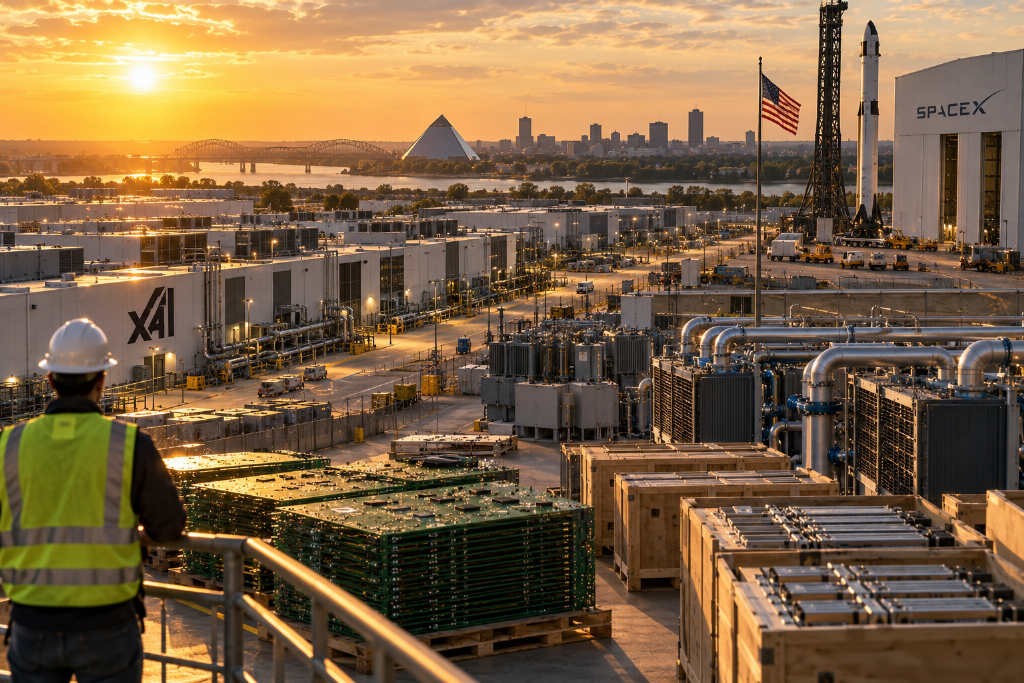
ABMedia, citing a Substack roundup by WK of an internal expert interview involving SpaceX and xAI, reported that the companies are pushing a much larger AI infrastructure buildout and may rely on an in-house supply chain to close gaps left by external vendors. The interview said the group wants to expand compute capacity tenfold to as much as 12GW by the end of 2027, with a longer-term target of 20GW in 2028.
Roadmap points to 10GW to 12GW by late 2027
According to the interview, the core procurement target is 10GW of compute, while the longer-range goal is 20GW. Current capacity was put at about 1.3GW. That is expected to rise to 2.3GW by December 2026, then to 4GW to 5GW in April to May 2027, and then to 10GW to 12GW in November to December 2027.
The interviewee described that schedule as highly aggressive. To stay on pace, the group is building its own capacity to supplement vendor supply and ease shortages.
US data centers are the focus, with Texas still not under construction
WK's summary said all of the data centers are planned for the US, with Memphis and Southaven as the main sites and a combined plan for 10GW to 12GW. In Texas, land and permits have already been secured, but construction has not begun.
On power, the group is said to be leaning primarily on gas turbines. In the Memphis and Mississippi area, the mix includes 3.6GW to 4GW from the grid, 4GW from gas turbines, 2GW from Tesla solar, and 2GW of Megapack backup.
About 60% of the first 10GW is slated for internal use
The interview said roughly 60% of the first 10GW will be used internally by xAI, SpaceX, and Tesla. The remaining 40% is expected to be opened to outside customers, specifically including Anthropic and Google.
It also said another new customer is not expected to be announced until November 2026. Even so, most of the compute is still expected to go toward internal Grok development, with the aim of optimizing Tesla Optimus and Robotaxi applications.
PCB, optical modules, transformers, and cooling hardware were identified as the main choke points
WK's summary said the biggest near-term pressure points are PCB, optical modules, transformers, and cooling hardware. The reasons given were shortages in raw materials, equipment, and labor. It added that supply of CCL and PCB is heavily dependent on mainland China and Taiwan.
To reduce the risk of supply disruption, the group has a 43-person supply-chain team and keeps a 20% to 40% inventory buffer for key hardware such as GPUs. The interviewee also said procurement of Asian components had previously been interrupted, and that geopolitical risk was part of the backdrop for the decision to strengthen internal supply capabilities.
From fiber to racks, the interview points to deeper vertical integration
On optical components, the interviewee said the company has already pushed ahead with cable production internally, while in-house fiber production is still being evaluated because Starlink itself also needs fiber. Current suppliers were named as Corning, Hengtong, and YOFC. The interviewee said demand for alternatives is rising as political conditions in 2027 could change.
The upstream side of optical transceiver modules was described as even more fragile. The interviewee said specialty materials such as indium phosphide, or InP, for lasers and DSP wafers are controlled by only a small number of suppliers, many of them in mainland China and Taiwan. The team said it remains confident in the current setup, but is preparing contingency plans for different scenarios.
Citrini researcher Jukan said SpaceX appears to be actively using reverse engineering to work around bottlenecks, including in racks, cooling units, and fiber, while trying to vertically integrate as many parts of the supply chain as possible.
Long-term plan includes ground, space, and lunar data centers
The interviewee also outlined a longer-range blueprint built around three pillars:
- a ground data center plan targeting 20GW of compute;
- the Star Mine space data center project, expected to launch in October to November 2027;
- a lunar data center plan, expected to send Optimus robots via Starship in 2028.
The interviewee said the fast expansion of ground-based data centers also serves as an R&D platform to identify and address supply-chain risks ahead of TeraFab in 2029. Under that plan, TeraFab would produce in-house ASICs and semiconductors for Optimus and Robotaxi, and those chips would be for internal use only.
The timeline is ambitious, and execution remains unproven
ABMedia said the interview again shows Elon Musk's ambitions in AI infrastructure and space. At the same time, the report noted that expanding compute capacity tenfold in 14 months would still be a major challenge, especially when it comes to land and energy infrastructure. The schedules for space and lunar data centers were also described as aggressive.
If this vertical integration strategy proves accurate, upstream suppliers in PCB, optical modules, cooling, and fiber could end up dealing with a buyer that is also becoming a competitor.