SpaceXSI has released Grok Voice 3.0, a new speech-to-speech model that it says is designed for real-time voice interactions. In a post on X published around 1 a.m. Taipei time on Oct. 15, the company described it as its latest voice model and said it combines low latency, customer service handling, and unchanged pricing on its API.
According to SpaceXSI, Grok Voice 3.0 scored 86.9 on the speech-to-speech index published by third-party evaluator Artificial Analysis on Oct. 13. The company said response latency is under one second, and the Voice Agent API price remains $0.08 per minute.
Launch comes after SpaceXAI was renamed SpaceXSI
SpaceXSI said Grok Voice 3.0 is its new speech-to-speech model, meaning it can listen to spoken input directly and answer with spoken output. The launch follows the company’s recent rebrand from SpaceXAI to SpaceXSI and the integration of subscription plans across X, Grok, and Cursor.
In its announcement, SpaceXSI highlighted three selling points: handling customer support calls, response time below one second, and lower cost than other frontier models. The move puts the company into the same real-time voice agent race where OpenAI and Google are competing.
Artificial Analysis ranked the model first overall
Using results cited by SpaceXSI from Artificial Analysis dated Oct. 13, Grok Voice 3.0 posted an overall speech-to-speech score of 86.9. That compares with 81.3 for Grok Voice 2.0, 83.2 for OpenAI GPT-Live-1 (Astra, Medium), and 82.6 for Google Gemini 3.8 Live.
Artificial Analysis also said on X that Grok Voice 3.0 debuted at the top of its index with a score of 86.9, while its latency performance was also competitive. Even so, the model did not lead every sub-test.
Sub-benchmarks show strength, but not across every category
SpaceXSI listed a 98.5% result on Big Bench Audio, a 94.8% task success rate, and a 97% score on Full Duplex Bench, which measures handling of pauses, interruptions, and turn-taking.
On τ-Voice, a test that simulates customer service calls with accents and background noise, Grok Voice 3.0 scored 71.6%. A comparison table compiled by CellCog placed that below GPT-Live-1, which scored 74.5%. SpaceXSI argued that its model reached a similar level with 40% lower latency.
In EVA-Bench, an enterprise voice agent benchmark from ServiceNow, Grok Voice 3.0 recorded the highest accuracy at 74%.
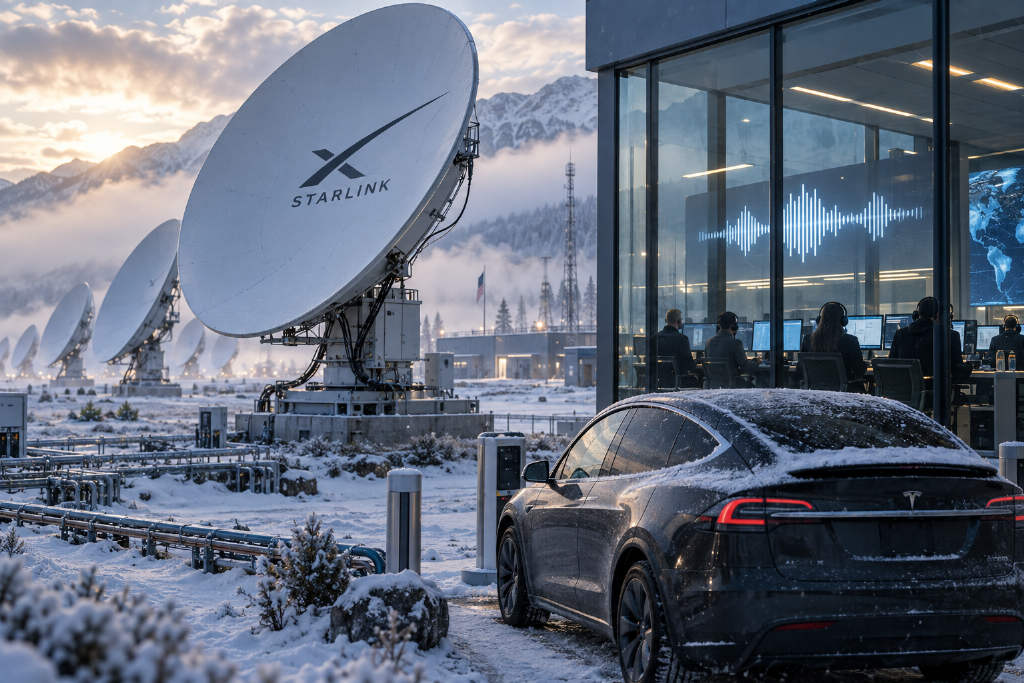
Starlink support is handling about 20,000 calls a day with the model
Beyond benchmarks, SpaceXSI disclosed operating data tied to deployment. The company said Starlink customer service uses Grok Voice to process about 20,000 inbound calls per day across multiple languages, and roughly 70% of those cases are resolved without a human agent.
For sales calls, SpaceXSI said one out of every four is converted into a purchase before the caller disconnects. It also said a single voice agent can complete identity verification, hardware troubleshooting, compensation issuance, and shipment of replacement equipment.
Tesla in-car voice interactions also run at large scale
SpaceXSI said Grok Voice 3.0 handles millions of conversations each day inside Tesla vehicles. Drivers can use voice commands to check calendars, reply to emails, order coffee, and book dinner without using their hands.
The company added that the same model powers Grok Bot voice mode. BlockTempo said the figures related to Starlink and Tesla usage were disclosed by SpaceXSI and could not be independently verified.
Pricing stays the same and developers are upgraded automatically
Grok Voice 3.0 is now available through the Voice Agent API at $0.08 per minute, or $4.8 per hour, the same price as Grok Voice 2.0.
Developer documentation from SpaceXSI shows that applications using the grok-voice-latest alias have already been switched to the new model automatically. Endpoints, parameters, and event formats remain unchanged. Grok Voice 2.0 has been marked deprecated.
Voice agents are becoming a new battleground after GPT-Live
The BlockTempo report said voice agents have become a new area of competition for enterprise customer service since OpenAI introduced full-duplex voice GPT-Live in July. For SpaceXSI, the significance of Grok Voice 3.0 is not limited to topping a benchmark. The company is also using large user bases from Starlink and Tesla as deployment environments while keeping prices flat to attract developers.
Still, figures such as the roughly 70% no-human-resolution rate remain company claims, and enterprises would need to assess real-world performance on their own before adoption.