
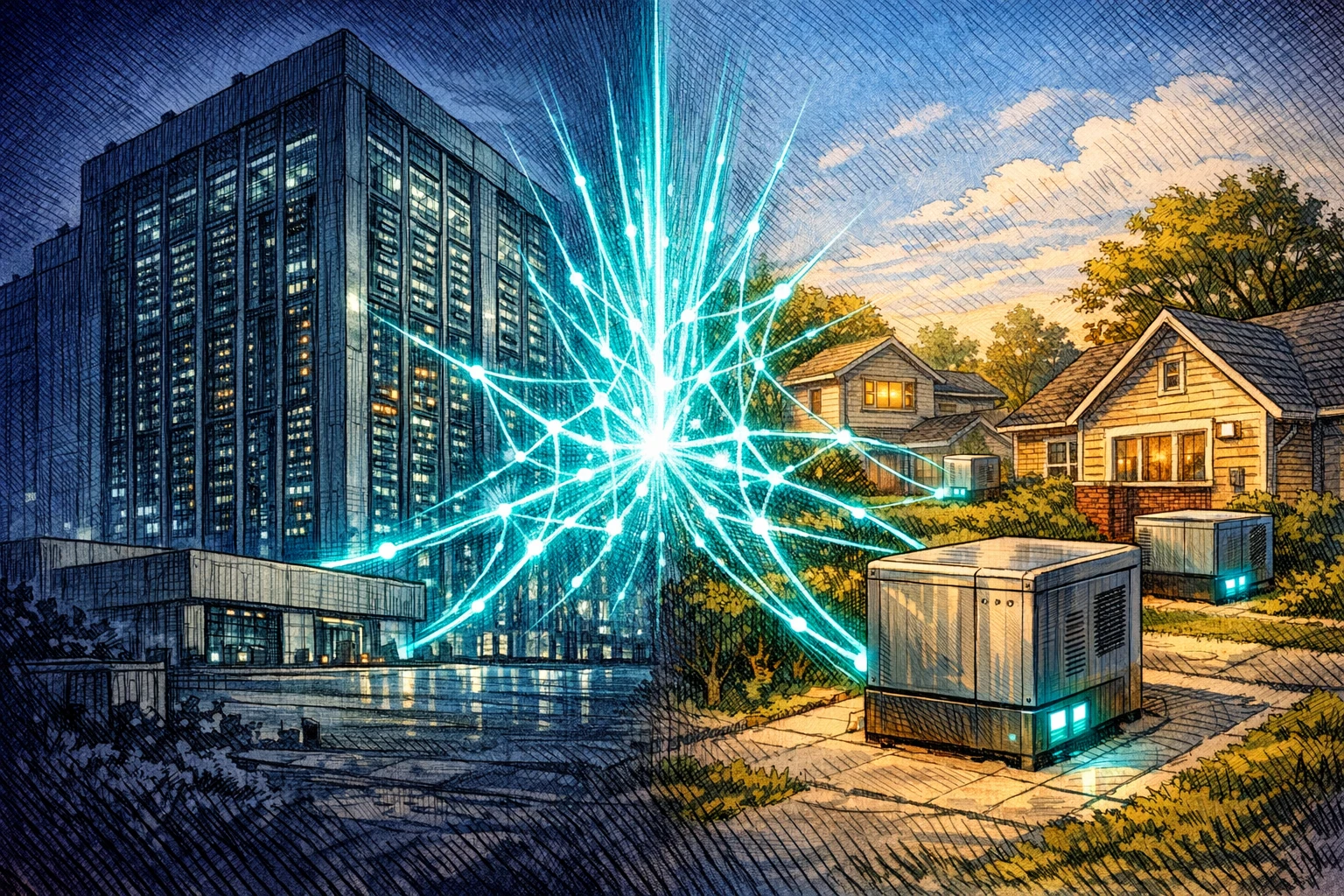
San Francisco startup SPAN has unveiled XFRA, a distributed data center model that places liquid-cooled edge compute nodes beside homes in the United States. Each unit carries an Nvidia RTX Pro 6000 Blackwell Server Edition GPU, and homeowners who host one would receive electricity subsidies, high-speed internet, and a backup battery. SPAN says an initial pilot has been completed, with a 100-home trial scheduled to begin this year.
Breaking a large data center into thousands of neighborhood units
The company’s pitch is simple: instead of building one massive facility, split compute capacity into many smaller boxes and install them near residential properties such as driveways or yards. SPAN argues that the conventional data center model is running into hard limits. According to the source material, a 100 MW facility can require dozens of hectares of land and access to stable power, while communities in several U.S. states have pushed back over noise, higher electricity costs, and water consumption.
Water use is another pressure point. Traditional sites commonly rely on evaporative cooling, and a mid-sized facility can consume millions of liters of water per day. Build times also remain slow. From site selection and approvals to infrastructure work, a new data center often takes three to five years before going live. SPAN’s answer is to deploy nodes alongside housing and use liquid cooling, reducing the need for standalone land parcels and heavy water demand.
Company says 8,000 nodes could cost one-fifth of a comparable facility
SPAN’s strongest claim is economic. In comments cited from a CNBC interview, the company said deploying 8,000 XFRA nodes would cost only one-fifth as much as building a traditional 100 MW data center delivering equivalent compute capacity. The nodes use Nvidia’s professional GPU designed for server workloads and large-scale parallel computing. Liquid cooling is also intended to keep operating noise within levels that are acceptable in residential settings.
Inference, cloud gaming, and streaming are the target workloads
SPAN is not presenting XFRA as a replacement for hyperscale AI training clusters. The network is aimed at AI inference, cloud gaming, and content streaming. The source notes that training large language models requires thousands of high-end GPUs such as H100 or B200 running in coordination for long periods, a segment still dominated by operators like Google and Microsoft. XFRA is trying to serve the demand that comes after training, when already-trained models are used to handle live requests.
Expansion plan points to 80,000 nodes after 2027
SPAN’s roadmap calls for scaling XFRA to 80,000 nodes starting in 2027, creating a distributed compute network of more than 1 GW across the U.S. That output is roughly comparable to a mid-sized nuclear power plant. The ambition is large.
The constraints are clear as well. Nodes placed in residential areas would depend on consumer-grade internet connections, where bandwidth and latency are less consistent than backbone networks in conventional data centers. Some low-latency inference use cases could run into obvious limits. Processing enterprise data on hardware located next to homes also raises questions around physical security, data sovereignty, and compliance. The source says SPAN has not yet disclosed how it will address those risks. Long-term homeowner participation is another variable, especially if equipment failures occur, noise exceeds expectations, or subsidy terms change.