

Transfer learning does not always need images, text, or audio as its source data. A paper published at ICML 2026 argues that even noise sampled from a Gaussian distribution, with no semantic meaning at all, can still improve learning in low-label settings.
The work is called Semi-Supervised Noise Adaptation, or SSNA. The team also introduced a Noise Adaptation Framework, or NAF, which builds discriminative class structure from randomly generated noise and transfers that structure to real target data. The paper is titled Semi-Supervised Noise Adaptation: Transferring Knowledge from Noise Domain.
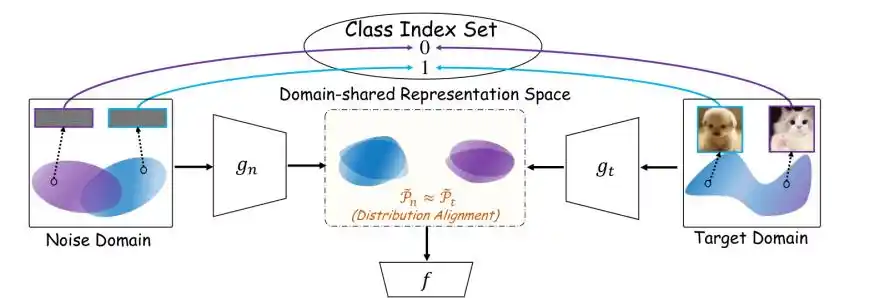
In the paper’s setup, the noise domain and the target domain are projected into a shared representation space and aligned at the class level.
With only four labeled examples per class and a ResNet-18 backbone, NAF improved accuracy over the standard supervised ERM baseline by 12.35 percentage points on CIFAR-10, 7.61 on CIFAR-100, 4.38 on DTD-47, and 2.74 on Caltech-101. The source code has been released.
Replacing a real source domain with noise
Conventional transfer learning usually depends on a source domain with abundant labels. In practice, that source data is not always available. Privacy, confidentiality, and copyright constraints can keep it from being shared. SSNA removes that assumption by replacing real source samples with noise generated from simple probability distributions.

The construction is straightforward. If a target task has C classes, the researchers first sample one mean vector for each class in a 1024-dimensional space and use the identity matrix as the covariance to define C Gaussian distributions. They then draw 50 noise vectors from each distribution. The noise domain uses the same class index set as the target domain, and each noise class is pre-assigned to one target class index, but that mapping carries no semantic information.
Those indices do not mean anything by themselves. Noise class 0 is not inherently “cat.” It is only fixed to one target class before training starts. What gets transferred is not visual knowledge about cats or dogs, but the discriminative structure formed inside the noise domain.
Samples from the same noise class are pulled together, while different classes are pushed apart. Once that structure is aligned with the target domain, it can provide cleaner decision boundaries for real target samples.
A small amount of target labels is still necessary
Noise can replace real source data, but it cannot replace target-domain labels altogether. The reason is simple: the noise comes from a different space, and the class indices are assigned manually. The model still needs a small number of labeled target examples to learn which real class a given noise class should align with.
On CIFAR-100, when the number of labeled examples per class was reduced to zero, ERM and NAF reached only 0.97% and 1.34% accuracy, both close to random chance. Once a small amount of labeled data was added back, NAF consistently outperformed ERM.
The paper’s conclusion is narrow but clear: in semi-supervised classification, a real source domain is not always required for positive transfer, but a small labeled bridge in the target domain still matters.
NAF breaks the objective into three parts
Built around the generalization bound derived in the paper, NAF splits training into three components.
Learning from the small labeled target set
A target encoder maps real samples into the shared representation space, and a classifier uses the labeled target samples to compute cross-entropy loss. This part is the same as standard supervised learning and serves as the bridge between noise classes and real classes.
Forcing noise to form class structure
A noise projector maps random vectors into that same representation space, and the classifier predicts the preset labels attached to the noise samples. Over training, same-class noise points cluster together while different classes separate.
Aligning the two domains
NAF also measures the distribution gap between the noise domain and the target domain. The alignment module is not tied to one implementation. After comparing several options, the paper uses Negative Domain Similarity, or NDS, as the default mechanism in experiments.
NDS compares both global means and class-wise means across the two domains and uses cosine similarity to pull them closer. Class means for unlabeled target samples are estimated iteratively with pseudo-labels generated by the model.
The paper states that the full objective corresponds to three terms: one for classifying the small labeled target set, one for classifying the noise samples, and one for aligning the distributions of the target and noise domains. The generalization bound is organized around the same three quantities: target-domain empirical error, noise-domain empirical error, and the distribution discrepancy between the two domains in the shared representation space.
From CIFAR to ImageNet, the gains persist
The main experiments cover eight vision datasets and one text classification dataset. Except for ImageNet-1K, the vision tasks use four labeled samples per class, with the rest treated as unlabeled data.
With ResNet-18, NAF delivered Top-1 gains over ERM of 12.35 percentage points on CIFAR-10, 7.61 on CIFAR-100, 4.38 on DTD-47, and 2.74 on Caltech-101.
The method also worked in fine-grained classification. Using ResNet-18, NAF improved over ERM by 8.94 points on CUB-200, 5.51 on Oxford Flowers-102, and 7.74 on Stanford Cars-196.
On the larger-scale ImageNet-1K benchmark, the researchers kept 100 labeled samples per class. NAF reached 37.10% accuracy, 0.99 percentage points above ERM.
On the AG News-4 text classification task, NAF with BERT posted 82.82%, compared with 78.64% for ERM, a gain of 4.18 percentage points.
NAF can also be plugged into existing semi-supervised methods. The paper tested it with UDA, FixMatch, FlexMatch, DebiasMatch, DST, LERM, and SA-FixMatch, and reported gains across the board. On CIFAR-10 after 20 training rounds, adding NAF improved UDA by 20.83 percentage points and FixMatch by 9.91 points.
The key is structure, not randomness
Ablation studies in the paper point to one factor: whether the classes in the noise domain form a separable structure.
The team first collapsed all noise classes into a single point. Once the noise domain lost its discriminative structure, NAF not only stopped helping but produced clear negative transfer. CIFAR-10 accuracy fell from 58.15% under ERM to 33.34%, while CIFAR-100 dropped from 42.24% to 6.79%.
Going in the other direction, when the distance between noise class centers was gradually increased, CIFAR-100 accuracy climbed from 43.80% to 49.78%. The result suggests that the easier the noise classes are to separate, the stronger the structural guidance they can provide.
The amount of noise mattered less. When the number of noise samples per class increased from 10 to 100, accuracy stayed near 50%. At 200, it declined slightly. The paper’s reading is that once a separable pattern exists, a relatively small amount of noise is enough.
The researchers also simplified the noise domain to one center point per class. Whether those centers were fixed or learnable, both settings still beat ERM. The learnable-center version performed better than the fixed one, but neither matched the full NAF setup.
In a transfer experiment from Amazon to Caltech-10, a real source domain still performed slightly better overall, but the noise source domain was enough to raise accuracy from 83.51% under ERM to about 88% to 89%. That gives the method a more practical position: when real source data is unavailable, synthetic noise may work as a low-cost substitute.
The paper also distinguishes SSNA from ordinary data augmentation. Data augmentation typically rotates, crops, interpolates, or generates samples near real data. SSNA instead builds an independent noise domain first and then aligns it with the target domain in representation space.
No semantics, but still transferable structure
The paper offers an unusual view of transfer learning: what helps a target task may not be the source data’s real-world semantics alone. The class structure that forms in representation space can itself be transferable knowledge.
That is the role NAF tries to exploit. It lets random noise form discriminative structure in a shared representation space, then uses a small set of labeled target samples to pass that structure onto real data. The reported results show that even when the source domain contains no real images, text, or audio, positive transfer can still appear if the right class structure is preserved.
Put differently, transfer learning may involve not only what data says, but also how data is organized in representation space. The paper presents that idea as a new research direction for settings where privacy restrictions, copyright concerns, or data access limits make real source domains hard to obtain.
Paper and code links
- Paper: https://arxiv.org/pdf/2606.00558
- Code: https://github.com/AIResearch-Group/SSNA
- Video explainer: https://www.bilibili.com/video/BV1UV7h61EvW/
- This article was credited to the WeChat public account QbitAI, with authorship attributed to the SSNA team.