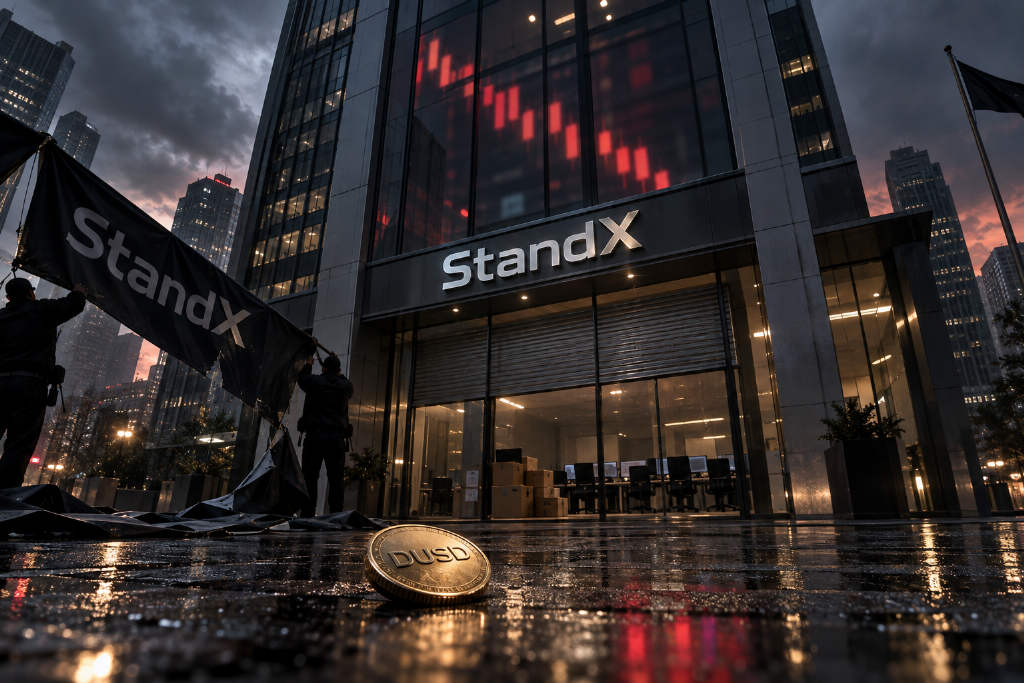
StandX, a perpetual futures DEX, said on Oct. 15 that it will not issue a token and will instead make a one-time DUSD airdrop to the community, while the platform will be wound down in stages. The announcement came two days after StandX started trading on Aspecta’s pre-market, where its implied fully diluted valuation briefly approached $350 million. After the news, the pre-market price of StandX on Aspecta fell about 98.8%.

CEO AG later wrote that StandX reached a TVL high of $200 million without outside capital, but still fell short of its goal of becoming one of the top three projects in the sector. He said the project could still launch a token based on its current fundamentals, but added that if it could not deliver long-term value, making money through a token launch and short-term speculation would mean “leaving the cost to users and the community.” Co-founder Justin, who had been largely silent for more than eight months, also posted that he was “sorry” he had not helped people make money.
A highly watched debut gave way to a shutdown plan
StandX initially attracted attention because of its team. Of the three co-founders, current CEO AG previously oversaw Binance’s entire futures business, Justin had been in charge of growth for Binance futures, and another co-founder came from Goldman Sachs’ trading systems team. In an earlier interview, a co-founder said the team joined Binance in March 2019, launched Binance futures six months later, and saw trading volume surpass BitMEX in the first half of the following year. That background helped StandX gain traction when it appeared a year ago.
On funding, official documents said the project was fully self-funded and did not take outside investment. Even so, longtime Discord users said StandX ran a KOL-only round about a year ago.
The size and valuation of that round were not disclosed, but several users described how the money was returned. X user @pinkkbuny said the agreement had always called for full principal repayment before TGE and that the user had already been repaid months ago. @Grampe466 said they had known since last year that the KOL round was being refunded in batches, with another batch returned this year. Another user, @QiYib5, who said they had participated, rejected claims of a coordinated push by KOLs and said the issue lay inside the team.

Roadmap delays piled up as core team communication faded
The roadmap moved back more than once. When DUSD launched in April 2025, perpetuals trading had been scheduled for July. In practice, alpha testing did not open until October, and mainnet only went live on Nov. 24. A market maker program had promised 5 million StandX tokens per month, yet the token was never issued. In May this year, the team had still said TGE could happen before year-end.
At the same time, key members went quiet. Before the shutdown announcement, Justin’s last original post dated back to Dec. 8, 2025, and his last public reply to users was on Feb. 5, 2026. There were no updates after that. AG’s latest post had stopped on Sept. 3, while official Discord announcements had not been updated after Sept. 28.
From mid-September, longtime users were already asking AG to address tokenomics. As refund rumors spread, community members repeatedly tagged admins in Discord for answers. The only response was a version of “please wait for the official announcement,” and moderators said they were working from the same line. The two co-founders broke their silence only on Oct. 15.
Crypto KOL Sea, paraphrasing a call with the team that day, said the project believed the time and opportunity cost of continuing were too high and that “a short pain is better than a long one.” Sea also said principal from the KOL round had been fully returned in April this year and that participants would receive a small additional DUSD airdrop based on contribution.
Points incentives were revised repeatedly, but conversion rules stayed unclear
StandX rewrote its points framework several times over the past year. In the pre-deposit phase, holding 1 DUSD counted for 1 point per day. In alpha, that rose to 1.2 points. During the Thanksgiving period after mainnet launch, it increased again to a 1.5x multiplier. On Dec. 10, 2025, trading points went live and were calculated retroactively. On the first day, combined with a 10% points bonus from Binance Wallet, StandX’s daily trading volume exceeded $81 million.

In January 2026, the platform introduced Maker Points, where orders left on the book for more than three seconds counted even if they were not filled. It later added Loser Points, which rewarded losses. After this burst of incentives, issuance tightened quickly. On May 24, trading, maker, and holding points were all cut in half. They were cut by another half on Aug. 10, which the team said would be the final adjustment. After two reductions, holding 1 DUSD counted for only 0.3 points per day.
Points became harder to earn, but the most important redemption terms were never spelled out. The points page on StandX’s website only showed the current rates and said the campaign was an acceleration phase toward “the next major milestone.” It did not disclose the total number of points, network-wide emissions, an end date for the campaign, or the share of token supply to be allocated to any airdrop.
Those questions never received a full answer. Under the shutdown notice, StandX will not issue a token. Instead, it will distribute DUSD in a one-time airdrop with no lock-up. Allocations will be based on pre-deposits, alpha activity, mainnet trading, market making, and referrals, and will be screened for sybil behavior and wash trading. The project said abnormal accounts may have allocations adjusted or canceled. It also said the airdrop will be funded by surplus assets on the project’s books and by AG personally, while all DUSD yield stops from Oct. 15.
TVL and open interest fell, while high turnover failed to translate into sticky positions
Capital had already started to leave before the final announcement. Citing DefiLlama data, the report said StandX’s TVL fell from a peak of $107 million in January to about $22.8 million on Oct. 15, a decline of 79%. After SIP-2 position yield went live in April, open interest climbed to as much as $72.1 million, then kept falling to $13.6 million.
Volume did not shrink at the same pace. StandX still posted $11.17 billion in volume over the past 30 days, with average daily turnover at roughly 27x. Because users could earn points by placing maker orders without getting filled, the cost of wash-like activity was kept low. The report said that kind of rule-driven volume did not retain genuine capital on the platform.

Peers completed TGE while newer projects moved in with clearer incentives
At the end of 2025, StandX was often discussed alongside Aster, Lighter, and edgeX. Communities broadly viewed them as projects worth following, and StandX was especially often compared with Aster because both were on BNB Chain.
Less than a year later, their outcomes had split apart. Aster completed TGE on Sept. 17, 2025. Lighter launched its token at the end of 2025. edgeX followed on March 31, 2026. StandX was the only one that remained stuck in the points phase before dropping the token plan altogether.
Projects that already launched tokens are now widening the gap through protocol revenue. DefiLlama data cited in the article showed that leading perp DEX Hyperliquid generated about $71.6 million in protocol revenue over the past 30 days, with open interest around $7.77 billion. HYPE rose from about $54 in late July to an all-time high of $97.96 on Sept. 23, a gain of about 80%.
Lighter, by contrast, used protocol revenue to buy back LIT. Over the past 30 days, revenue was about $4.85 million and open interest stood near $730 million. LIT climbed from about $2.2 in early August to around $5.3 in late September, up about 1.4x. In the report’s framing, real revenue and buybacks gave the market a pricing anchor.

Meanwhile, newer projects have been competing with different product structures and clearer token expectations. Variational uses a zero-fee RFQ model on Arbitrum and includes stocks and commodities in its contracts offering. It has already announced a TGE plan for the fourth quarter of 2026, and its daily trading volume is about $3.9 billion, above Aster. Arcus, incubated by dYdX Labs and linked with Robinhood Chain, focuses on 24/7 tokenized stock trading. Extended is pushing into its final pre-token trading competition with a prize pool totaling 250,000 USDC.
Against that backdrop, StandX sat in an awkward middle ground. Its points had already been halved twice. It lacked the protocol revenue profile of earlier movers and no longer had the same pull from its original incentive design.
Product differentiation was not enough to offset the pressure
The same pattern showed up in position data. According to DefiLlama figures cited in the report, as of Oct. 15, open interest at Variational, Arcus, and Extended stood at roughly $1.03 billion, $99 million, and $100 million, respectively. Each was already more than seven times StandX’s level, and each had grown over the past 30 days by about 24%, 462%, and 15%.
StandX’s own open interest was just $13.6 million, down 54% over the same period. Its 30-day trading volume of $11.17 billion still exceeded Arcus at $8.36 billion and Extended at $6.92 billion, but the edge was largely supported by turnover. Its trading volume in the latest 24 hours had fallen to about $116 million, less than one-third of Arcus.
StandX was not without product features. DUSD as yield-bearing margin and SIP-5 permissionless market making gave it some distinction, and the team had previously said daily trading volume entered the top four among perp DEXs in June while gold contract depth exceeded Hyperliquid in August. Even so, turnover told a different story. Hyperliquid and Aster typically ran around 1x average daily turnover, while most newer entrants were around 2x to 3x. StandX was around 27x. That suggested the platform’s volume was driven much more by points than by retained capital.

Before the announcement, the community had already split. In Discord, users holding points kept posting “stand” and urged others to ignore FUD. Larger holders and longtime users kept asking why the team had been absent for so long. There was also a clear information gap between the Chinese- and English-speaking communities. English users attributed the rumors to Chinese KOLs stirring discussion, while Chinese users circulated refund-related claims.
After the notice was posted, some users in the comments said they understood and argued that building projects had become much harder. Others criticized earlier social posts from the team that they felt had implied a token launch.
Shutdown timetable has been set, and claims run through year-end
StandX said it had served more than 237,000 users, reached TVL above $200 million at its peak, and saw no fund security incidents during operations. AG said most past revenue had been returned to users through SIP-2 and SIP-3 subsidies. Sea also relayed the team’s view that StandX had operated at a loss, with revenue coming mainly from fees paid by airdrop farmers, while the main costs were salaries and servers.
According to the announcement, StandX perpetuals will switch to reduce-only mode on Oct. 20. Any remaining positions will be closed at mark price on Jan. 15, 2027. DUSD redemptions and withdrawals will end on Jan. 31. Airdrop query opens at 08:00 on Oct. 26, and the claim window will run from 08:00 on Nov. 1 to 16:00 on Dec. 31. Unclaimed allocations after that will be treated as forfeited.