
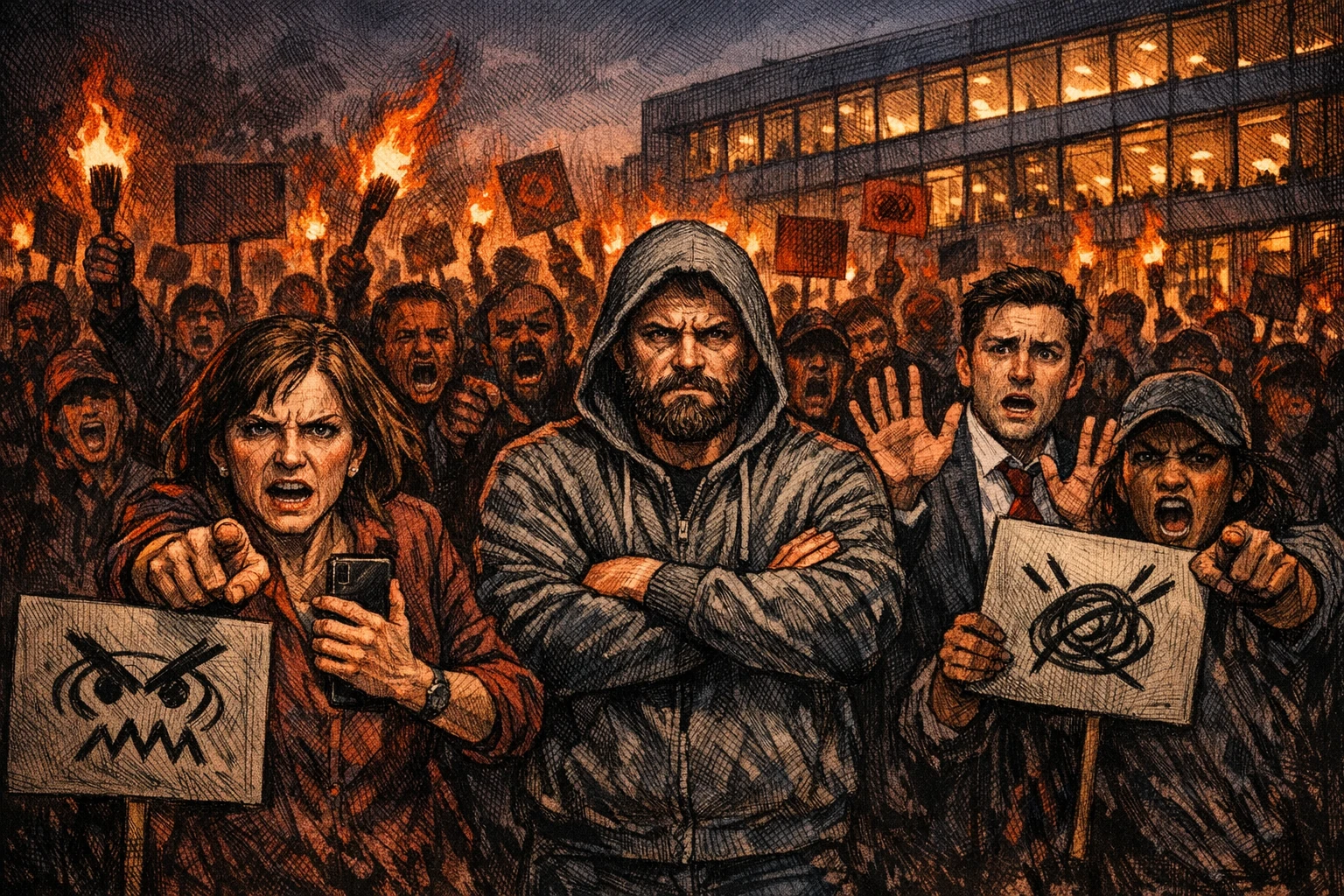
Stanford University’s Human-Centered AI institute said in its 2026 AI Index Report that 73% of AI experts see AI as positive for long-term employment, while 69% hold the same view for the economy. Public opinion is far colder. Only 23% of the general public said AI would be positive for jobs, and 21% said the same for the economy. The report, as cited in the source material, says nearly two-thirds of Americans believe AI will mean fewer jobs over the next 20 years.
Two violent incidents put the backlash into sharper focus
The survey landed in a tense political and social climate. On April 7, 2026, the home of Indianapolis Democratic city council member Ron Gibson was hit by 13 gunshots. A note left at the scene read, “No Data Centers.” PBS NewsHour reported that Gibson had publicly supported a data center development plan in his district. His 8-year-old son was inside the home at the time, though no one was injured.
Three days later, on April 10, OpenAI CEO Sam Altman’s San Francisco home was targeted with a Molotov cocktail. The suspect, 20-year-old Daniel Moreno-Gama, was arrested the same day. According to the source, he left behind an anti-AI manifesto and described himself as a “butlerian jihadist,” a reference to Frank Herbert’s Dune series and its anti-machine crusade. The two attacks happened within one week and roughly 2,000 miles apart. They pointed to the same pressure point: anger over AI expansion moving beyond rhetoric.
Costs and job fears are feeding the mood
Polling cited in the article shows that sentiment has been shifting fast. A Gallup survey from March 2026 found that the share of Gen Z respondents who felt “excited” about AI fell from 36% to 22%. The share who felt “angry” rose from 22% to 31%. Futurism, also cited in the source, reported that the AI industry’s favorability rating had dropped below that of ICE and President Trump.
Part of that anger is tied to visible local costs. Virginia has the highest concentration of data centers in the US, and a Georgetown Law report estimated that residential electricity bills there could rise by as much as 25% by 2030 to support growing data center power demand. For residents, the issue is concrete. The benefits may accrue to technology firms, while households face higher utility bills and workers worry about job security.
Policy promises have not closed the credibility gap
The industry response has done little to calm suspicion. OpenAI released an Industrial Policy White Paper in April that proposed a public wealth fund so the broader population could share in AI-driven growth. At the same time, OpenAI president Greg Brockman was donating millions of dollars to a super PAC opposing state-level AI regulation, according to the source material. The article also said OpenAI supported Illinois bill SB 3444, whose practical effect would include shielding the company from legal liability tied to large-scale harm caused by AI models.
Microsoft announced a Community-First AI Infrastructure Initiative in January, promising support for local electricity costs and lower water use from data centers, but the source noted there was no independent accountability mechanism. A New Yorker investigation published on April 13 by Ronan Farrow also described a pattern in Sam Altman’s public positioning, with stated commitments shifting when company interests changed. The tension is plain in the report’s framing: AI companies need public acceptance to keep expanding, yet they also seek to limit regulation that could weaken their commercial edge.