
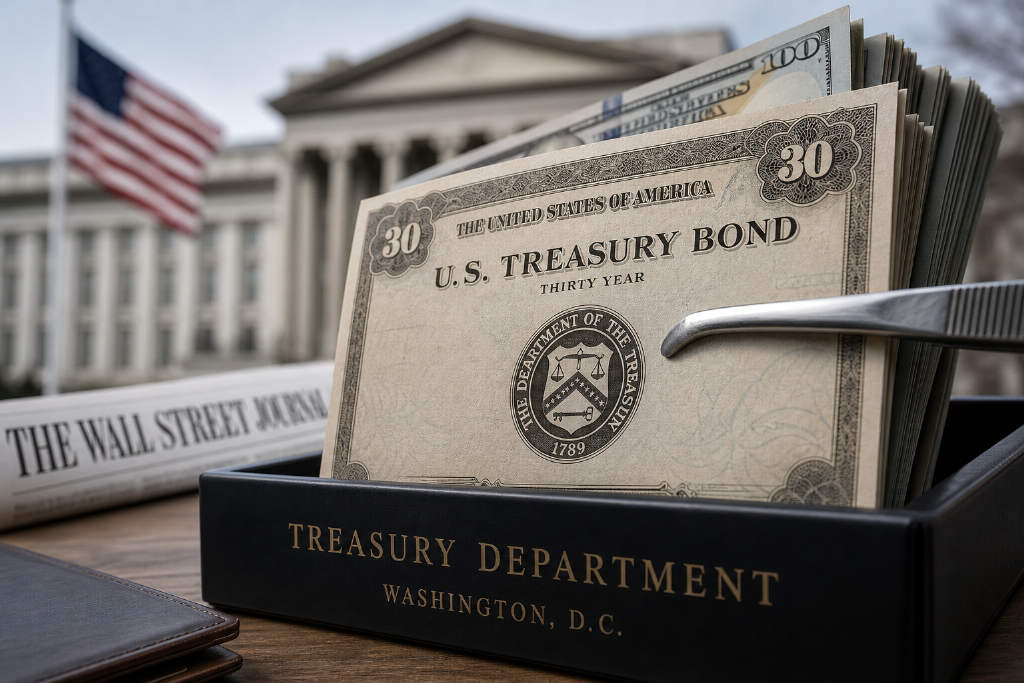
Stanley Druckenmiller has taken aim at the U.S. Treasury, arguing that its recent expansion of long-dated Treasury buybacks risks dulling the bond market’s ability to price America’s fiscal problems.
Writing in a Wall Street Journal opinion piece on Aug. 25 Beijing time, the veteran investor said the Treasury’s larger buyback program may be framed as a liquidity measure, but its practical effect would be to weaken the market signal coming from higher long-end yields.
The debate comes as long-dated Treasury yields have remained elevated. The 30-year Treasury yield had previously climbed to its highest level in 19 years. On Aug. 19, the U.S. Treasury announced that it would increase the size of its 10-year to 30-year bond buyback operations from $2 billion per operation to at least $4 billion. The operations are scheduled to run from Sept. 9 through Nov. 4.
The Treasury’s official explanation was that the move would support liquidity in the long-end government bond market. Druckenmiller disputed the need for that step at this moment. He wrote that the market was not showing failed auctions, disorderly trading, or forced deleveraging, and said the larger buybacks could easily be read as an attempt to hold down long-end yields.
In his view, rising yields are the warning. He pointed to inflation still running above target, unemployment near full employment, a federal deficit equal to about 6% of GDP, government debt above $40 trillion, and net interest expense rising quickly.
Under those conditions, he argued, higher long-end yields should not be surprising. They reflect investors demanding more compensation for the risks tied to fiscal deficits, debt expansion, and sticky inflation.
Druckenmiller’s deeper concern is that continued intervention in long-bond yields would reduce the pressure on Washington to confront fiscal discipline. If borrowing costs are pushed lower, the urgency to cut deficits, restrain welfare spending, and alter the debt path also falls.
He went a step further, saying that if the Treasury buys long-duration bonds while financing that activity by issuing short-term Treasury bills, the market could treat the move as a Treasury version of a “mini quantitative easing” program.
The issue is not limited to the bond market. U.S. stocks, particularly AI names and high-valuation technology shares, have been highly sensitive to long-end rates. Higher yields lift discount rates and weigh on growth-stock valuations. If yields are temporarily pinned down by policy tools, that can also encourage risk assets to keep trading on easier-financial-conditions expectations.
Druckenmiller warned that if the market comes to believe officials are defending a particular yield level, traders will keep testing that line, and volatility in the bond market could end up increasing rather than falling.
His prescription was straightforward: let the bond market determine the government’s borrowing costs and address the fiscal problem directly by reducing the primary deficit, reforming welfare programs gradually, and managing the debt more responsibly. Liquidity tools, he argued, can buy time but cannot replace fiscal adjustment.
For markets, Treasury yields have become more than a macro indicator. They now sit at the center of risk-asset pricing, and the Treasury’s handling of long-end rates will continue to shape trading across U.S. equities, gold, the dollar, and crypto assets.
BlockBeats noted that Druckenmiller has long-standing ties to current U.S. Treasury Secretary Bessent. Bessent joined the London office of Soros Fund Management in 1991, when Druckenmiller was already a central portfolio manager and senior figure at the fund. Both later took part in the well-known 1992 trade against the British pound.
Bessent has also said that Druckenmiller invited him to join Soros Fund and that Stan was his “real business mentor.”
Separately, BlockBeats said Druckenmiller’s Duquesne family office disclosed in its latest 13F filing that it had opened a new position in HYPE treasury stock Hyperliquid Strategies Inc. (PURR), reporting holdings of 2.9415 million shares valued at about $23.15 million.