

China’s A-share market turned sharply higher on July 21 after several sessions of declines, with early trading forming a V-shaped reversal before major benchmarks accelerated into the close. By the end of the session, the STAR 50 Index had jumped 10.73%, its strongest single-day gain in nearly a year. The Shanghai Composite rose 1.79%, the Shenzhen Component gained 4.81%, and the ChiNext Index advanced 7.05%.
Turnover across the three exchanges reached 2.97 trillion yuan, up 256.1 billion yuan from the previous day. Market breadth also improved sharply, with more than 3,100 stocks finishing higher and over 100 stocks hitting their daily upper limits.
Semiconductor shares led the rebound. Equipment, memory, wafer and HBM-related names all posted strong gains, while oil and gas, banks, coal and motorcycle-related sectors were among the laggards.
Semiconductor ETFs post outsized gains
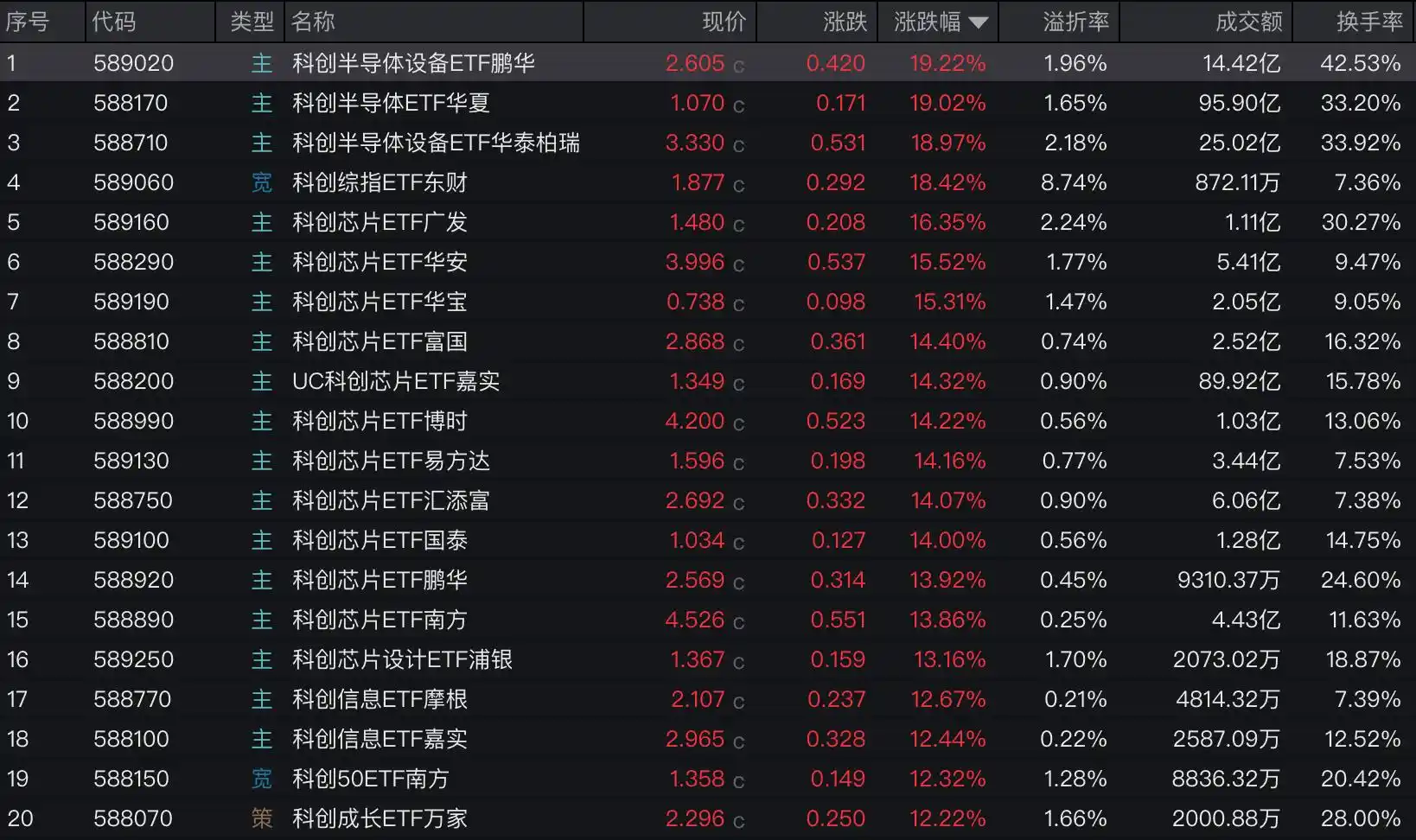
The move in chip stocks spilled over into themed exchange-traded funds. According to the report, 73 related ETFs rose more than 10% during the session.
Among the biggest gainers were Penghua STAR Semiconductor Equipment ETF, ChinaAMC STAR Semiconductor ETF, Huatai-PineBridge STAR Semiconductor Equipment ETF and Eastmoney STAR Board Composite Index ETF, all of which climbed more than 18%. STAR chip ETFs under GF Fund, Huaan Fund and Huabao Fund each gained more than 15%.
Three factors behind the rebound
The report said the sharp recovery in A-shares was driven by a combination of three factors.
The first was fresh capital entering the market. Since July 19, positive funding signals have come from several directions, including increased holdings by the so-called national team and insurance funds, share buybacks by listed companies, and proprietary purchases by public and private funds.
Jinying Fund said the continued inflow of stabilizing capital had helped lift market confidence. In its words, “during the previous sharp and persistent market decline, investors’ risk-off sentiment was largely released, A-share valuations gradually returned to a reasonable range, and major long-term funds entered at that point, supporting market liquidity and laying a firmer foundation for stabilization.”
Wind data showed heavy trading in several broad-based ETFs over the last two sessions. On July 20, aggregate net inflows into broad-based ETFs totaled 59.061 billion yuan. ChinaAMC STAR 50 ETF, Huatai-PineBridge CSI 300 ETF and E Fund ChiNext ETF recorded net inflows of 13.7 billion yuan, 12.52 billion yuan and 9.4 billion yuan, respectively. Trading remained active on July 21, with turnover in those three ETFs reaching 17.322 billion yuan, 15.266 billion yuan and 12.895 billion yuan.
The second factor was policy support. On July 20, China Securities Regulatory Commission Chairman Wu Qing chaired an investor symposium and said the regulator would “do its utmost to maintain stable market operations.” Bosera Fund said technology stocks had already gone through a substantial correction, easing valuation pressure, and that the combined effect of policy support and capital inflows triggered the day’s concentrated rebound in growth and tech shares.
The third factor was a stabilization and rebound in overseas markets, which gave A-shares a more supportive external backdrop. Jinying Fund said global equity markets had already gone through a rapid deleveraging process and a fairly deep correction, leaving many indices sharply lower in valuation terms and creating the objective conditions for a rebound.
South Korea was cited as an example. After falling more than 30% from its historical high and clearing out a large share of market risk, the Korea Composite Stock Price Index reversed higher on July 21 and rebounded 3.56%, led by major Korean technology stocks. Jinying Fund said the broader recovery in global technology shares also provided support for a synchronized rebound in China’s tech sector.
Funds say the worst panic may have passed
On whether technology stocks have moved beyond the darkest phase, institutions cited in the report offered short-, medium- and long-term views.
Bosera Fund said crowding in the technology sector had fallen sharply after the earlier rapid correction. After margin balances declined for several consecutive days, the process of clearing leveraged positions was approaching its final stage. Statements on increased holdings by central state-owned enterprises and insurers also sent a clear signal that long-term capital was entering the market, supporting the valuation floor for technology shares.
Jinying Fund said the market remained in the late stage of deleveraging and sentiment bottoming. As allocation-oriented capital continues to flow in and panic selling is gradually cleared, investors can keep an eye on opportunities created by short-term oversold rebounds.
CE Fund took a more cautious near-term view. It said the release of positive policy signals had eased liquidity stress and panic to some extent, and the concentrated unwinding of leveraged positions had already moderated. Even so, the market still needs time to find a bottom. After the index’s outsized one-day gain, volatility in the technology sector remains high. CE Fund said investors should watch whether volatility can decline further, whether national-team buying continues, how margin financing and quantitative funds rebuild positions, and how earnings hold up during the intensive interim reporting season.
Mid-term focus shifts to cloud earnings and AI supply-demand dynamics
For the medium term, Jinying Fund said a new round of gains after this oversold rebound would still require a fresh industry catalyst. It pointed to second-quarter earnings from overseas cloud service providers in late July as a key checkpoint for judging returns on capital expenditure.
It also said that differentiation within the AI supply chain would likely become more visible. The key question is whether specific segments can keep raising their share of demand and whether supply bottlenecks will persist. In segments where those bottlenecks begin to ease, valuation centers may face downward revisions. On that basis, AI-related technology investing should remain focused on core areas where supply and demand are still tight.
Bosera Fund said trends such as expanding demand for AI computing power and domestic substitution in semiconductors have not changed because of the recent correction. As interim results are released, the growth resilience of leading technology companies has begun to show through. The fund said short-term volatility may continue, but the most panic-driven phase for the technology sector has likely passed. If industry catalysts continue to materialize, growth-oriented technology shares still carry medium- to long-term allocation value.
The article was originally published by Caijing New Media and credited to reporter Jiang Jinli, edited by Jiang Shizhou.