
China’s STAR Market closed out the 2026 interim reporting season with earnings that beat the prior year’s full-year level. According to information released by the Shanghai Stock Exchange, companies on the board generated a combined 1.01 trillion yuan in operating revenue in the first half, up 38.6% from a year earlier. Combined net profit reached 144.887 billion yuan, a 437.6% increase year over year.
Wind data showed that 409 of the 616 STAR Market companies were profitable in the first half, representing more than 60% of the total. Among them, 334 companies posted year-over-year net profit growth, and 133 recorded profit increases of more than 100%.
Semiconductor names led the gains
A review by China Business Network noted that domestic computing power, innovative drugs, and high-end equipment all delivered notable results in the first half of 2026, with semiconductor companies standing out the most.
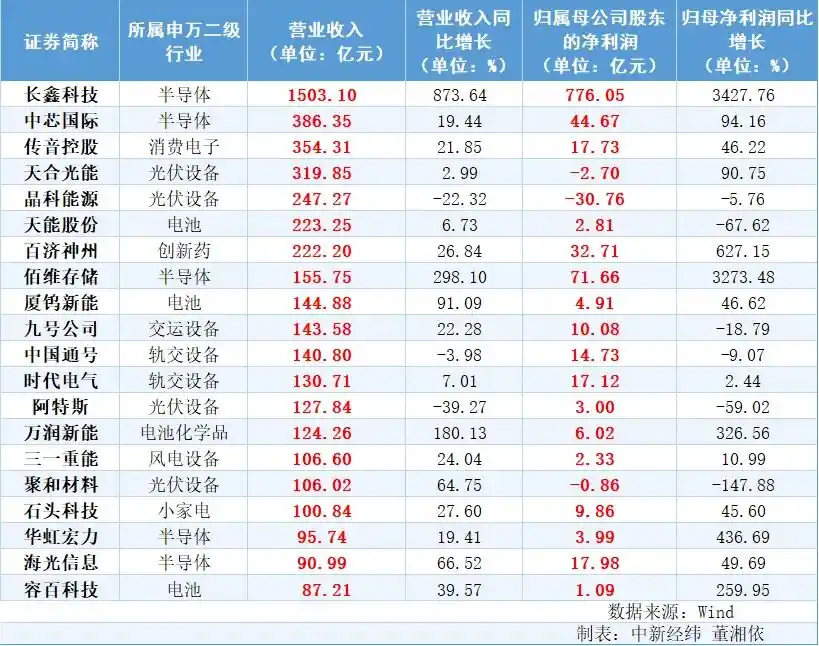
Newly listed ChangXin Memory Technologies reported surging revenue and profit. Net profit attributable to shareholders reached 77.605 billion yuan in the first half, up 3427.76% year over year, making the company the STAR Market’s top profit earner. The report said that works out to roughly 400 million yuan in profit per day.
In its interim report, ChangXin Memory Technologies said the increase in revenue, total profit, net profit attributable to shareholders of the listed company, and net profit after excluding non-recurring gains and losses was mainly driven by rapid growth in global demand for computing power and capacity allocation by major global manufacturers. The company said DRAM products were in short supply globally and prices rose sharply, lifting gross profit on its core DRAM sales.
Recovery in the memory sector also boosted Biwin Storage. The company posted first-half revenue of 15.575 billion yuan, up 298.10%, and net profit attributable to shareholders of 7.166 billion yuan, up 3273.48%.
Heavy research spending remained a key feature among hard-tech companies. Advanced Micro-Fabrication Equipment Inc. China reported about 2.041 billion yuan in R&D spending in the first half, accounting for 30.51% of revenue and staying well above the board average. Hygon Information reported 2.652 billion yuan in R&D spending, up 55.05%, with the increase supporting iteration of its CPU and DCU products and the buildout of its AI ecosystem.
Two major wafer foundry players also turned in strong results. Huahong Group posted net profit of 399 million yuan, up 436.69%. Semiconductor Manufacturing International Corp. reported first-half revenue of 38.635 billion yuan, up 19.44%, and net profit attributable to shareholders of 4.467 billion yuan, up 94.16%. Revenue from wafer foundry operations totaled 35.858 billion yuan, up 18.1%. SMIC said the increase was mainly due to higher wafer sales volume, a rise in average selling prices, and changes in product mix.
Innovative drugmakers also posted strong earnings growth
Innovative drugs were another sector with strong profit elasticity in the first half. BeiGene reported net profit attributable to shareholders of 3.271 billion yuan, up 627.1%, while RemeGen reported 4.662 billion yuan, up 1137.1%.
Data from China’s National Medical Products Administration showed that Chinese innovative drug companies completed 81 outbound licensing deals in the first half, with total transaction value of about $110 billion. That was equal to 80% of the full-year total recorded in 2025. The report said commercialization and overseas licensing by Chinese innovative drug companies in global markets are translating into real earnings.
Li Daxiao, former chief economist at a securities firm and a member of the Shenzhen Decision-Making Advisory Committee, told China Business Network that STAR Market companies showed three main features in the first half: profit quality improved, with profit growth outpacing revenue growth; hard-tech tracks such as AI computing power and semiconductors were especially strong; and some innovative drug companies entered an earnings delivery phase.
More than 30% of companies still posted losses
The overall picture still showed clear divergence. Wind data showed that 207 of the 616 companies remained loss-making, accounting for more than 30%. As prices along the industrial chain moved lower, sectors such as photovoltaics stayed under earnings pressure. JinkoSolar posted a first-half loss of 3.076 billion yuan, the largest loss among STAR Market companies.
Xue Hongyan, a special researcher at Sushang Bank, told China Business Network that the divergence reflected a combination of mismatched industry cycles and capital allocation logic. He said AI computing power, memory, and innovative drugs are in an upswing where demand growth and domestic substitution reinforce each other, and earlier R&D spending is now being converted into earnings. By contrast, sectors such as photovoltaics remain caught in overcapacity and price wars, with supply-demand imbalances not yet fundamentally reversed. He also said the continued migration of capital from traditional sectors into technology has intensified the divide.
Xue said the earnings split is unlikely to reverse fundamentally in the short term. As the window for performance verification opens, highly valued names driven only by themes and lacking booked orders may face correction pressure, while hard-tech leaders with real earnings delivery capability may strengthen their positions.
Domestic substitution remains in focus
On investment strategy, Yang Delong, chief economist and fund manager at Qianhai Kaiyuan Fund, said the STAR Market remains a core venue for hard technology and that investors can continue to watch opportunities tied to domestic substitution. After the sharp decline in July, he said, many leading STAR Market stocks have started to show investment value, and investors can consider buying on dips in some technology leaders or related thematic funds.
Xue said domestic substitution has moved from a policy slogan to a stage of substantive implementation, and computing chips, semiconductor equipment, and memory remain key long-term allocation themes. He said ordinary investors can use STAR Market-related index funds and build positions in batches to spread single-stock risk.
He also warned investors to watch for style rotation signals. In his view, interim and third-quarter earnings verification will be the key dividing line, and investors should stay cautious on purely thematic names whose earnings do not support high valuations.
The article said the views cited are for reference only and do not constitute investment advice.
The original report was published via the WeChat account of China Business Network (ID: jwview), written by Dong Xiangyi, edited by Lin Wansi, with Zhang Yihua, Jia Yifu, and Chang Tao listed as editors in charge.