
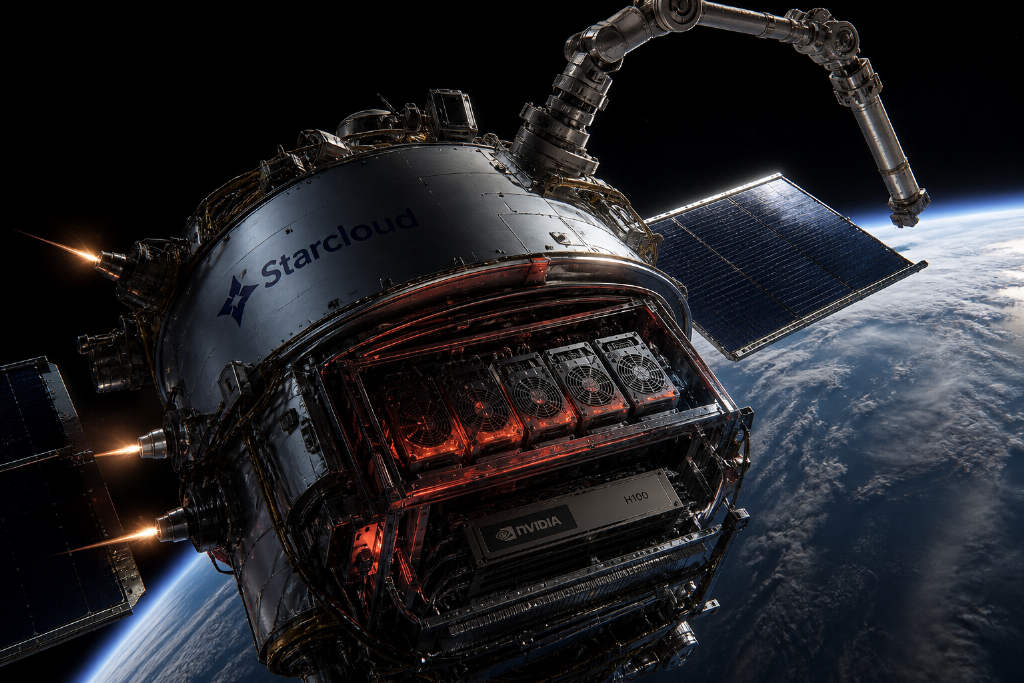
Starcloud, a company building data centers in space, has added bitcoin mining to a plan that Protos says already looked extremely difficult to execute. The company has raised nearly $500 million and reached a valuation above $2 billion, but the report argues that moving BTC mining into orbit would make an expensive concept even harder to justify.

According to Protos, one of the defining factors in bitcoin mining has always been access to the cheapest available energy. Mining firms routinely relocate when another site offers lower power costs. They also replace equipment or switch energy sources, whether that means moving from solar to coal or natural gas, or choosing hydro and wind instead of coal.
That flexibility disappears in space. Protos says running ASIC miners in orbit would immediately cost more than operating them on Earth once launch expenses, the cost of radiating heat, the inability to switch to alternative energy sources, and maintenance in orbit are taken into account. In that framing, Starcloud would be attempting not only a highly ambitious space data center buildout, but also what the outlet describes as the most expensive BTC mining operation in crypto history.
Criticism goes beyond bitcoin mining
Even without the mining plan, Protos says Starcloud’s underlying business model has already been challenged by the Institute of Electrical and Electronics Engineers, or IEEE, and by YouTuber Real Engineering.
The report says that if Starcloud is to deliver on its goal of creating gigawatts of processing power in space, it would need tens of thousands of launches. It would also require a solar array and radiator cluster measuring four kilometers long and nearly one kilometer wide.
Protos compares that scale with current launch activity and existing orbital infrastructure. SpaceX, the report says, is currently carrying out just over 100 launches a year. The International Space Station, which took 13 years to build, is only 100 meters by nearly 100 meters.
Starcloud has already tested hardware in orbit
Protos says Starcloud has already sent one Nvidia H100 GPU into space. That test has its own limitation: the GPU cannot run at full power because the satellite overheats.
The report adds that this does not cover the full list of problems facing the company. On Earth, data centers still need a steady supply of replacement parts and ongoing maintenance. Handling those needs 500 kilometers above Earth would be far more expensive. GPUs in orbit would also face significantly more radiation than they would inside a cooled building on the ground.
Protos says the current funding may not be enough
Despite those issues, Protos says Starcloud’s CEO continues to promote the concept and has found support from wealthy backers. The report references a recent interview with Y Combinator founders and partners, saying the investors around Philip Johnston asked no especially difficult questions and appeared open to committing more capital.
Protos ends with a blunt assessment: even if Starcloud manages to achieve only a fraction of its goals, the effort would likely take well over a decade and cost far more than the roughly $500 million it has raised so far.