
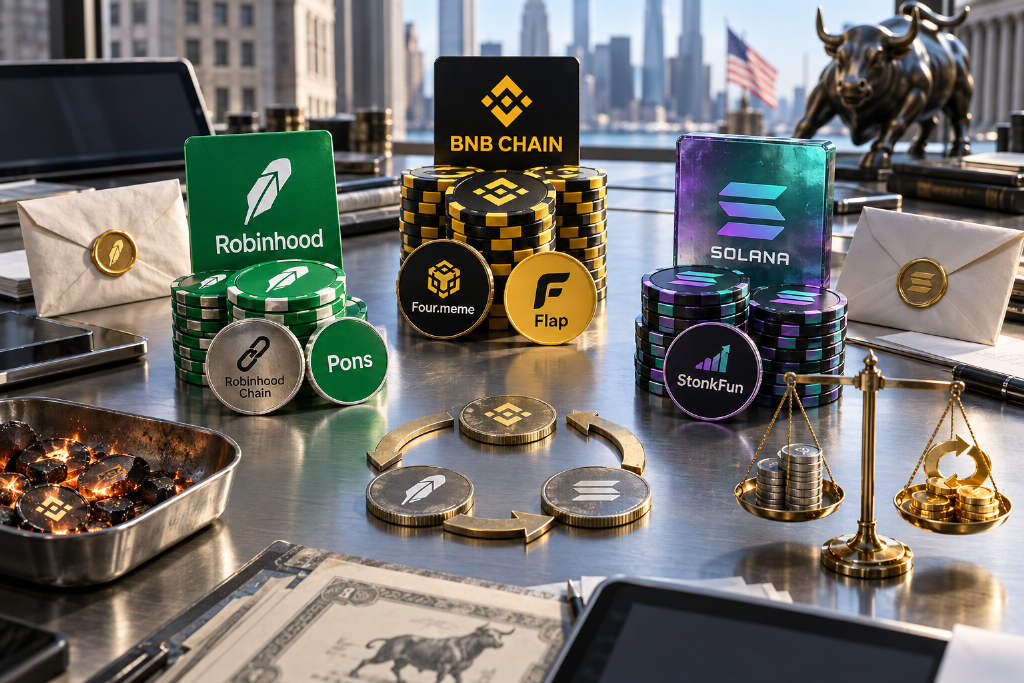
As stock-paired meme tokens flooded crypto social feeds, attention shifted from the hottest individual trades to the launch platforms behind them. In recent days, Pons posted more than $10 million in seven-day revenue, StonkFun briefly out-earned Pump.fun on a daily basis, and Four.meme rolled out its 4Stock model to bring popular U.S. equities not yet covered by Binance bStock onto BNB Chain.

MarsBit’s review compared stock-meme launch platforms across Robinhood Chain, BNB Chain, and Solana, looking at issuance design, fee scale, and the mechanisms used to send value back to platform tokens or related assets.
Robinhood Chain
Pons: $10.67 million in revenue over the past seven days
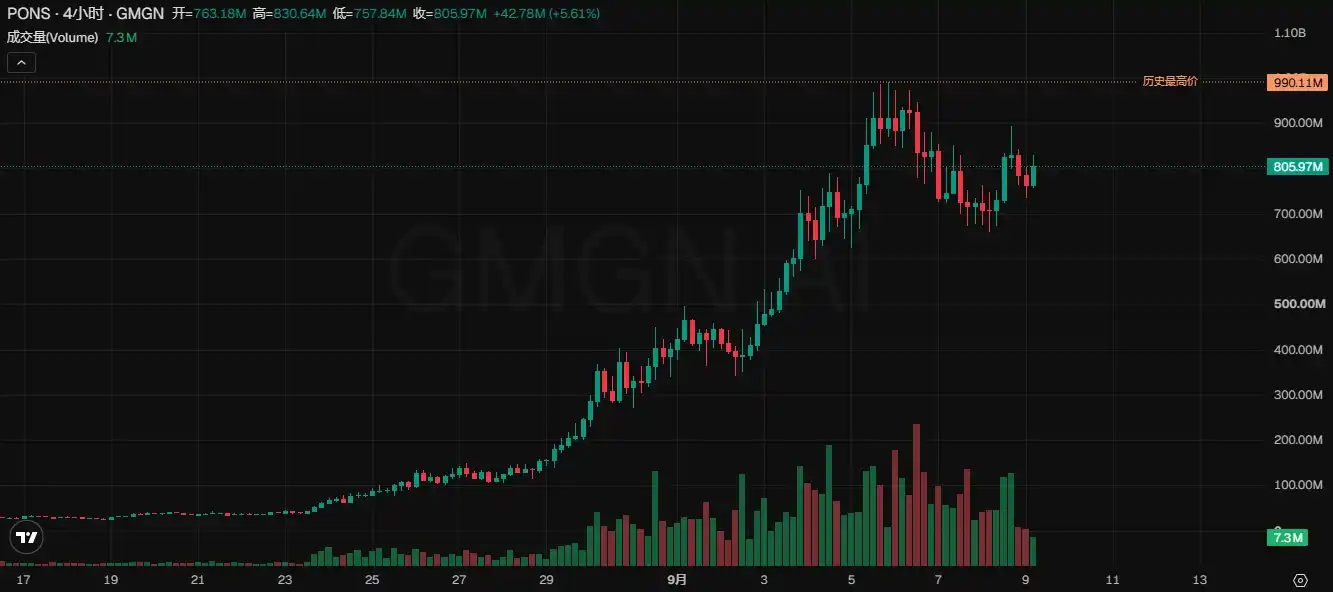
Pons, operated by Pons Labs, is a token issuance and trading platform where users create and trade tokens through wallet-signed transactions. The platform does not custody user assets. Its platform token is PONS. According to GMGN data, PONS recently climbed to a market capitalization of $990 million before pulling back to $810 million.
Each new token on Pons has a fixed total supply of 1 billion tokens. Creation costs 0.0005 ETH, and the platform charges a 1% trading fee. Creators only need to fill in a token name, ticker, image, and social links. Dune data shows Pons has been issuing roughly 15,000 to 30,000 tokens per day over the past week, making it the dominant token launch platform on Robinhood Chain.
Under the new Pons contract, trading fees are split 70% to the creator and 30% to the protocol. Under the old contract, the split is 90% and 10%. Of the protocol share, 80% is used to buy back and burn PONS, while the remaining 20% goes to infrastructure and team operations. Over the past seven days, Pons generated $10.67 million in revenue, ahead of Pump.fun at $9.76 million and Fomo at $8.91 million.
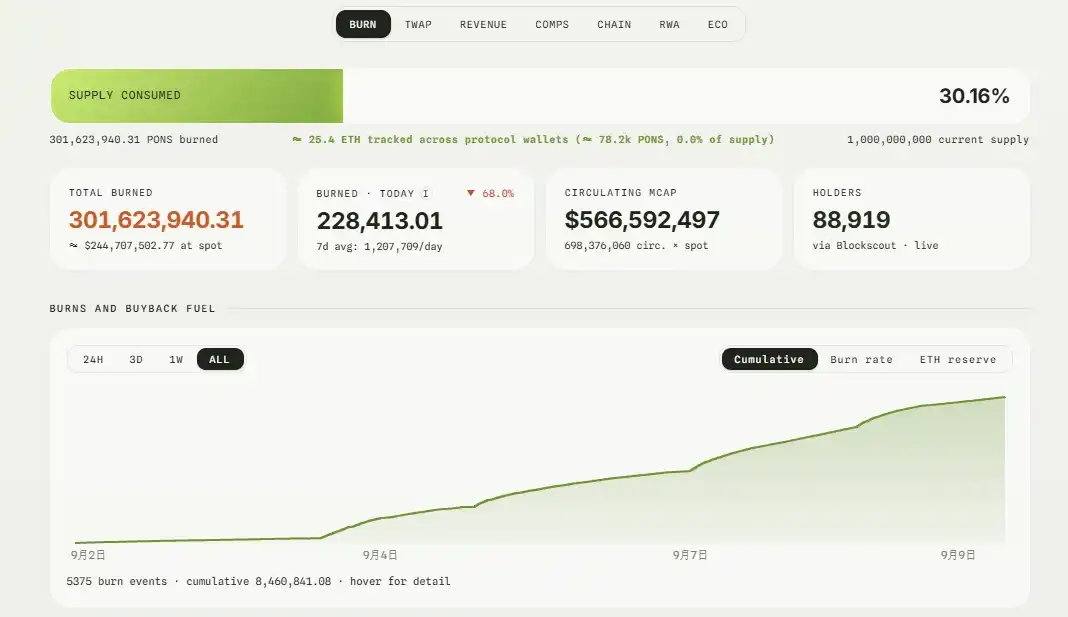
Stateofblocks data shows that more than 1.2 million PONS were burned daily over the last seven days, worth nearly $1 million at a token price of $0.82. In addition, 30% of total PONS supply has already been burned.
Long.xyz: cumulative stock-token volume tops $1 billion
Long.xyz was one of the earlier Robinhood Chain platforms to support stock-paired meme launches. Unlike platforms that typically use ETH or stablecoins as quote assets, Long.xyz lets creators choose stock tokens such as NVDA, AAPL, TSLA, and SPY directly as trading pairs. That setup means meme-token trading also adds volume and liquidity to the underlying stock tokens. As of Sept. 8, cumulative stock-token trading volume on Long.xyz had surpassed $1 billion.
The platform recently introduced LongX Expansion, which wraps a 3x leveraged long NVIDIA position on Lighter into a freely tradable ERC-20 token. Users can mint and redeem the token, and they can also use it as a trading pair for newly launched coins, extending the meme issuance model to leveraged stock exposure.
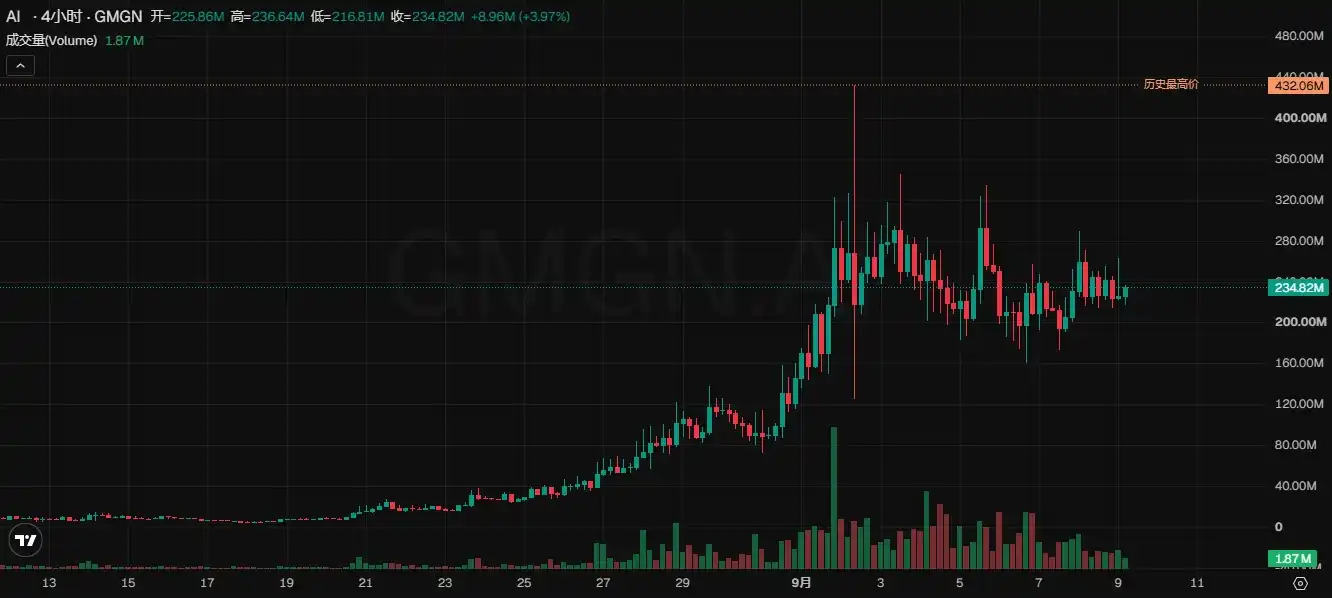
Long.xyz has not formally issued a platform token. Even so, the project has repeatedly used platform fees to buy back Artificial Inu, or AI. Part of the fees from the newly launched LongX Expansion product also goes to AI buybacks. GMGN data shows AI once rose above a $400 million market capitalization and was recently quoted at $230 million.
So far, about 27.53 million AI have been removed from circulation, equal to 2.75% of total supply. Of that amount, about 8.59 million AI have been permanently burned, or 0.86% of supply. Another 8.59 million AI have been permanently locked in the community treasury, with the rest attributed to paired liquidity locks and over-the-counter buybacks.
- On July 26, Long.xyz carried out its first buyback and burn of 2 million AI.
- From late July, platform fees began to be used automatically for burns and token locks.
- After Aug. 13, fees generated by new token pairs involving AI were also directed to continued buybacks and locks.
PAIR: 90% of protocol revenue goes to buybacks
PAIR is a Robinhood Chain RWA token launch platform built around multi-stock trading pairs. Instead of allowing only one quote asset for each new token, PAIR lets creators build as many as five stock-token liquidity pools for the same token. A newly issued meme token, for example, can trade at the same time against stock tokens tied to NVDA, TSLA, AAPL, and SPY.
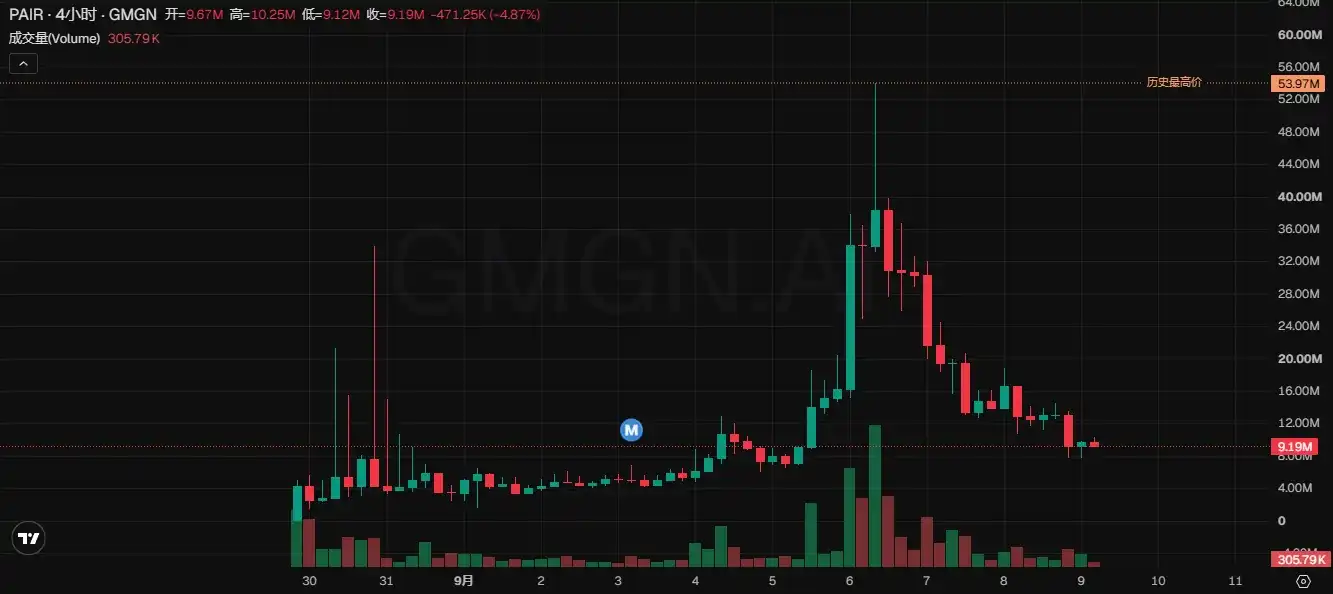
All liquidity pools are built on Uniswap V4 and are permanently locked. There is no bonding-curve stage and no later migration to a DEX after a market-cap threshold is reached. PAIR has issued a token under the same name. GMGN data shows PAIR climbed above a $40 million market capitalization before dropping back to $9 million.
According to the platform’s stated revenue plan, 90% of protocol revenue is used for market buybacks of PAIR, while the remaining 10% is used to attract new creators, support marketing, and build infrastructure. DefiLlama data shows PAIR generated about $362,000 in fees over the past seven days and about $109,000 in protocol revenue. Since launch, cumulative fees have reached about $558,000 and cumulative protocol revenue about $169,000.
According to pair.fund, PAIR has so far burned 106.7 million tokens, or 10.67% of total supply.
BNB Chain
Four.meme: first stock-meme token cleared an $80 million valuation within three hours
Four.meme is one of the best-known meme launch platforms on BNB Chain. It rolled out its 4Stock model yesterday, aiming to bring popular U.S. stocks that have not yet been covered by Binance bStock on-chain. GMGN data shows that 4Stock, the first meme token launched with stock token BNC4 as its base pool, rose above an $80 million market capitalization yesterday and was recently quoted at $45 million.
The 4Stock model runs in two steps. First, a U.S. stock is mapped 1:1 into a stock token. Then that stock token is used as the base pool for launching a meme token. To mint a stock token, users must transfer at least 10,000 USDC to a designated wallet and submit a mint form. Four.meme says it will buy the corresponding shares through a custodial account within 24 hours and then issue stock tokens 1:1 based on the amount purchased. If the stock later lists on Binance bStock, the platform will convert the related 4Stock stock token into bStock on a 1:1 basis.
Four.meme first introduced BNC4, a stock token tied to CEA Industries (BNC), and then launched the 4Stock meme token with BNC4 as the underlying pool. The article says 4Stock reached a $90 million market capitalization within three hours of launch, while the on-chain price of BNC4 briefly moved above $30, around 10 times the price of BNC shares.
On fees, Four.meme charges a 1% minting fee on 4Stock stock tokens such as BNC4, and it also earns income from trading fees and LP fees tied to the product. Although the platform has already issued FORM, current 4Stock revenue is not being used to buy back FORM.
A daily buyback campaign for BNC4 started today and will run through Dec. 9. During the campaign, 100% of daily product revenue generated by BNC4 will be used to buy back and burn eligible community meme tokens.
Flap: centered on BNB Chain but also active on Robinhood Chain
Flap is a token launch platform that supports several EVM networks, including BNB Chain, Robinhood Chain, and X Layer. Unlike platforms that only offer fixed bonding-curve issuance, Flap.sh lets creators configure trading taxes themselves and decide where those taxes ultimately go.
On Robinhood Chain, Flap introduced Stocks Vault, allowing creators to pair meme tokens with stock tokens such as AAPL, GOOGL, NVDA, PLTR, and SPY. It also lets trading taxes be automatically swapped into stock tokens and distributed to meme-token holders.
On BNB Chain, Flap launched Permissionless Launch, allowing creators to enter any token contract address and use stock tokens, RWAs, blue-chip crypto assets, or other meme tokens as quote assets for a new token.
Flap has not issued a platform token and does not route protocol revenue into buybacks of any single asset. Platform income mainly goes to the protocol treasury. Other fees generated through trading taxes are distributed according to creator settings, including holder rewards, liquidity additions, accumulation of stock-based or other RWA assets, or buybacks and burns of the related meme token. In other words, Flap supports buybacks and fee-sharing, but value accrues to individual launched tokens rather than to one unified platform token.
By revenue, BNB Chain remains the platform’s main base. DefiLlama data shows Flap generated $11.74 million in total revenue over the past 30 days, with BNB Chain contributing $11.53 million, or 98% of the total, while Robinhood Chain contributed $200,000.
Solana
StonkFun: about $1.5 million in STONK bought back over the past seven days
StonkFun is one of the most discussed stock-meme launch platforms on Solana. Its pitch is simple: “Launch coins paired with anything.” Users can launch tokens with stocks, ETFs, commodities, foreign exchange pairs, and other crypto assets as quote assets. Compared with stock-meme platforms on Robinhood Chain, StonkFun’s edge is direct access to existing Solana trading liquidity.
The platform has issued STONK. GMGN data shows STONK once climbed above a $180 million market capitalization and was recently quoted at $160 million.
On Sept. 5, StonkFun partnered with Raydium and became the first third-party launch platform integrated with Raydium LaunchLab. Under the arrangement, newly issued tokens first trade through LaunchLab’s bonding curve, and liquidity moves automatically to Raydium after preset conditions are met. After the integration went live, StonkFun revenue climbed quickly. On Sept. 6, daily revenue briefly moved above $1.5 million, ahead of Pump.fun over the same period.
StonkFun’s main revenue source comes after launched tokens reach Raydium. The platform earns trading fees from permanently locked LP positions. That is different from platforms that only collect fees during the bonding-curve stage. As long as those tokens keep trading on Raydium, StonkFun can continue to collect LP fees. DefiLlama data shows about $1.5 million was used to buy back STONK over the past seven days, while cumulative buybacks reached about $2.12 million. The repurchased STONK was then burned.
StonkFun also uses part of its trading-fee income to buy back top-ranked launch tokens on the platform by market capitalization. So far, 78 tokens have been included in that buyback-and-burn program.
How the value flows differ
The platforms in MarsBit’s comparison are not routing value back in the same way.
- Pons, PAIR, and StonkFun all have relatively explicit buyback or burn paths tied to platform income.
- Long.xyz has not formally launched a platform token, but it has repeatedly used fees to buy back AI.
- Four.meme already has FORM, though current 4Stock revenue is not being used for FORM buybacks.
- Flap does not have a unified platform token, and value return is spread across launched assets and creator-defined tax rules.
As trading around stock-meme tokens expands, fee generation, buyback design, and burn mechanics at the platform level are becoming key comparison points for traders looking beyond the latest breakout token.