
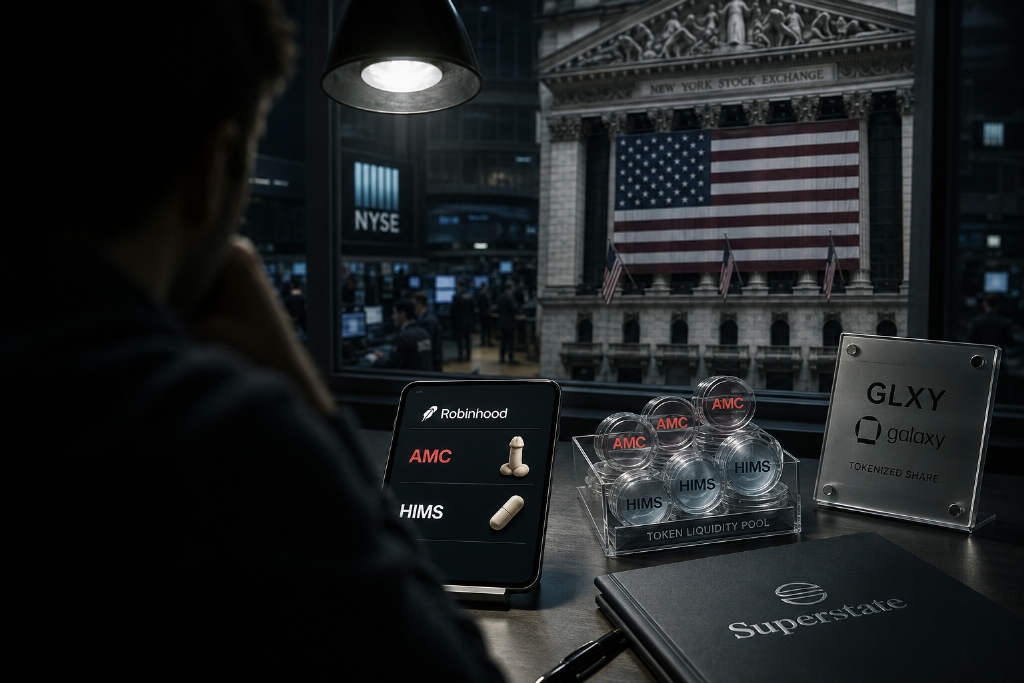
The short-squeeze story built around stock-paired meme coins is colliding with a basic design problem: locking up tokenized shares on-chain does not mean locking up the underlying stock in the real market.
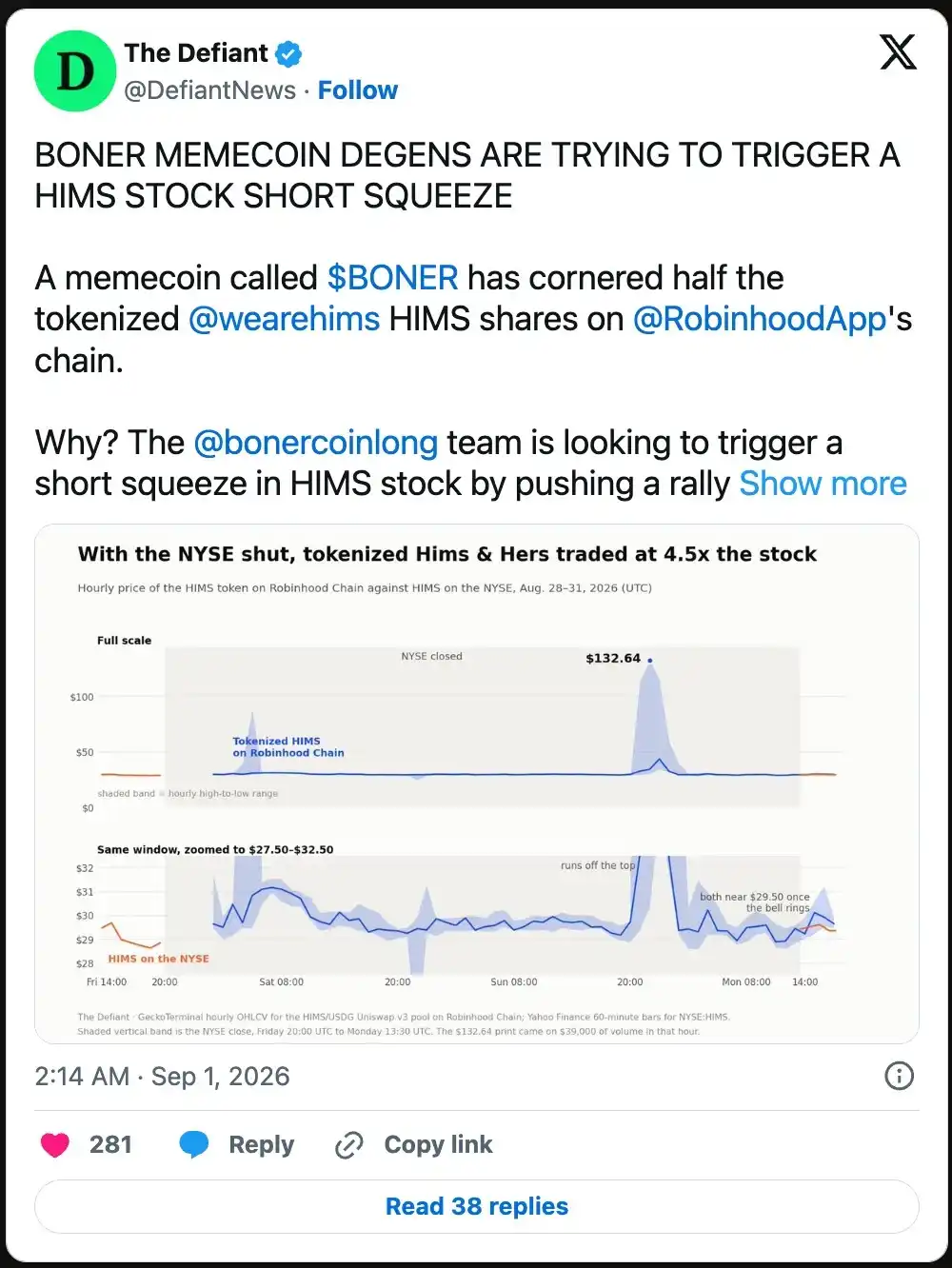
That is the core argument in an article by David Christopher, translated by Saoirse of Foresight News and published by MarsBit. The piece says the market’s biggest hope for these structures — that an on-chain supply squeeze could spill into the cash equity market — is not supported by how the products work today.
Last weekend’s trading gave that argument a vivid example. In a one-in, one-out liquidity pool, aggressive buying of meme coins paired with tokenized equities can trap capital in the pool and absorb a large share of the token float. That can push the on-chain token price sharply higher. What it cannot do, the article argues, is make the real stock scarce.
AMC and HIMS showed how far token prices could detach
The article highlights two cases from the weekend dislocation.
- AMC’s stock token briefly rose to $166.86, while the real stock had closed at $2.59 on Friday.
- HIMS tokenized shares reached $132.64, while the underlying stock closed Friday at $28.84. Prices only normalized after traditional markets reopened on Monday.
Those levels put the on-chain prices at about 64x and 4.6x the corresponding stock prices, respectively.
The move fed a broader market idea: if a heavily shorted name had its tokenized float cornered by a meme coin community, could that create a squeeze on-chain first and then force a squeeze in the stock itself? The article’s answer is no.
It points to BONER, which accumulated Robinhood’s on-chain HIMS tokens. Over the weekend, the tokenized shares traded at roughly 4.5x the real stock price, helping fuel speculation that a forced squeeze might be underway.
Why the squeeze mechanism does not carry over
The first issue is scale.
Most TEQ tokens represent only a tiny slice of the size of the underlying equity market. The article says BONER accumulated 53% of the HIMS stock token supply, a striking figure on its face. But when translated into HIMS’s real share count, that position amounted to only about 0.014% of total shares outstanding.
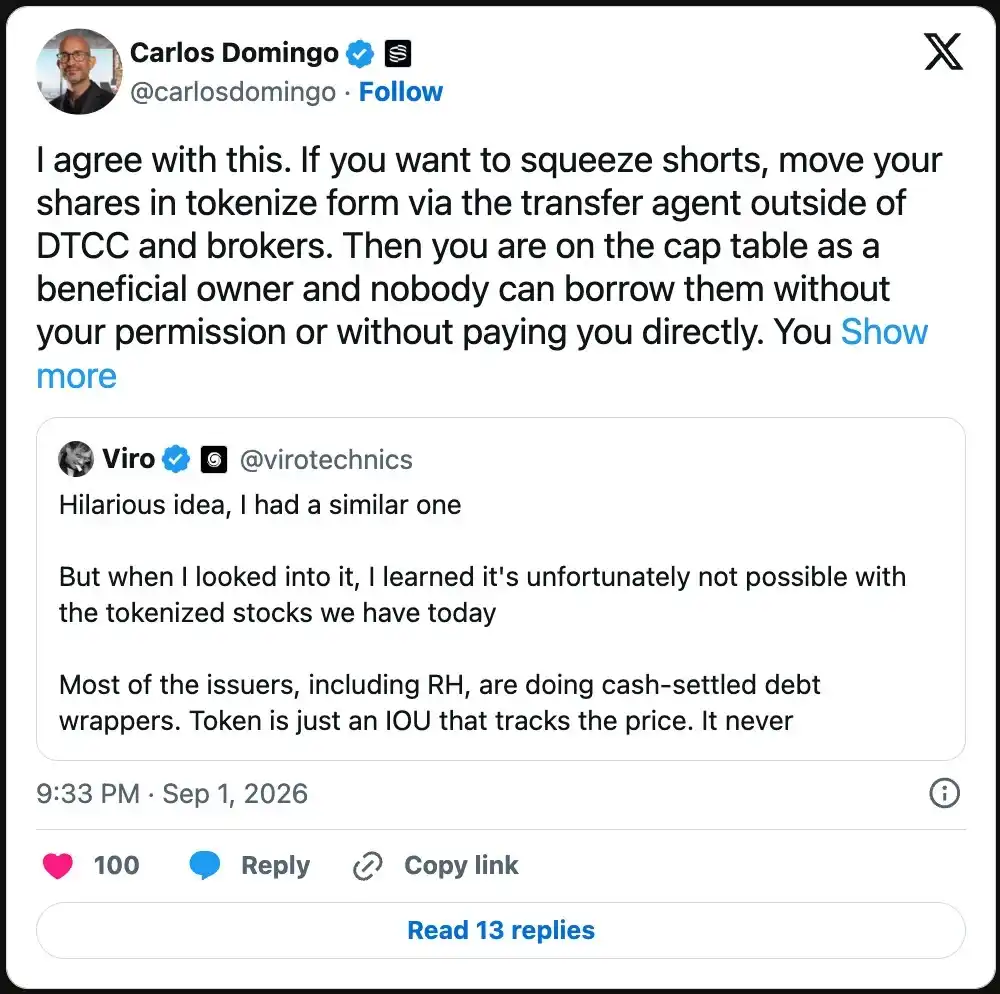
Even before getting into market structure, that leaves the token market too small to dominate the real one.
The larger problem is legal and economic. Controlling a stock token is not the same as controlling the underlying stock.
Under Robinhood’s structure, the stock tokens are backed 1:1 by real shares held in custody. Users receive price exposure, not ownership of the shares themselves. So when BONER pushes large amounts of HIMS stock tokens into a liquidity pool, the result is scarcity in the token market, not scarcity in the actual HIMS float.
If that scarcity drives the on-chain token price far above the stock price, Robinhood’s authorized participants can mint new stock tokens and capture the spread. Minting additional tokens does require buying more real shares as backing, so the article acknowledges there can be some incremental buying in the underlying stock. But hoarding existing tokens does not force one-for-one buying of HIMS shares in the cash market.
The main effect, it says, is to encourage more token issuance, expand supply, and pull the token price back toward the stock.
The weekend action lined up with that view. The article says HIMS tokenized shares traded above $100 on-chain while the real stock stayed near $29. After the traditional market opened, about 4,000 newly minted HIMS tokens entered circulation and the gap closed quickly.
A real squeeze would require tighter links to equity ownership
The piece does not say a squeeze is impossible under every tokenized stock model. It says the current Robinhood-style structure is the wrong foundation for that outcome.
In its view, a more plausible path would require TEQ infrastructure with much deeper links to real equity ownership. The closest example, the article says, is on Solana.
Last year, Galaxy worked with Superstate to move GLXY on-chain. The distinction drawn in the article is simple: Robinhood offers tokens that track a stock price, while in the Galaxy model, the token is the stock.
Existing Galaxy shareholders can convert their GLXY holdings into an on-chain version of GLXY. Those tokens represent Galaxy Class A common stock and carry the same legal rights, economic interests, and voting rights as traditional GLXY shares. When the token moves on-chain, Galaxy’s official shareholder register updates as well.
That creates a more direct connection between on-chain and off-chain markets. Transferring on-chain GLXY means transferring the equity itself, not a mirror instrument tied to its price.
Even so, the article says the structure is not fully developed. At this stage, those on-chain shares can only move between approved wallets, and Galaxy has not opened permissionless automated market maker trading.
That leaves a clear conclusion for the current market: Robinhood-style tokenized stocks function more like IOUs for price exposure than true equity, and that limits their ability to produce a genuine squeeze.
If not squeezes, where could the value be?
The article then shifts to a different question. If the squeeze thesis fails, are stock-paired meme coins just another short-lived speculative wrapper? Its answer is no.
It says the squeeze angle became popular first because it was the most exciting narrative, but tying tokens to stocks can still create new market behavior.
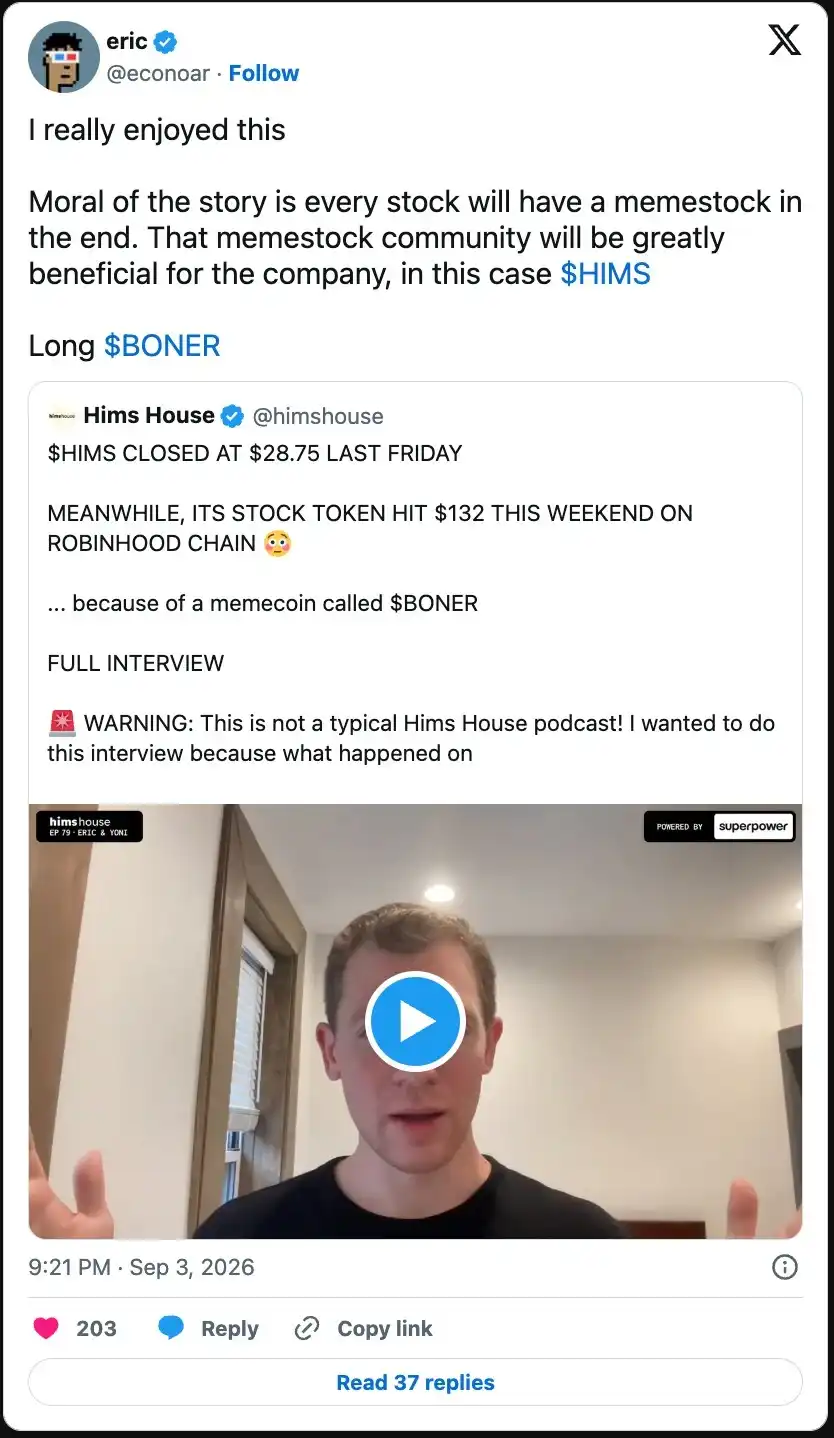
Eric Conner is cited as advancing a mainstream view that these meme coins could act as decentralized marketing tools for listed companies. Token holders may follow earnings, product updates, short interest, industry news, and other stock-specific developments, then turn that flow into memes and distribution.
The article also points out an obvious limit. BONER may fit the tone of Hims products, but a publicly traded healthcare company that relies on mainstream credibility is unlikely to openly embrace a token with that name.
Still, it argues there is a middle ground. Companies do not need to endorse or control these communities for the communities to become organic distribution channels.
Tokenized stocks as building blocks for games and DeFi
The article says the more interesting path may be to treat TEQ as a programmable component for financial and game-like products.
It cites NetNet Capital’s "RW-Play" idea, which uses tokenized equities as modules inside games and DeFi applications. The examples listed are COINflip, which uses tokenized Coinbase stock as a reward for winners; SpaceX Invaders, which distributes tokenized SpaceX stock as prizes; and MSFT Flight Simulator, which rewards users with tokenized Microsoft stock.
In that setup, tokenized stocks are no longer limited to simple buy-and-hold exposure. They can become trading pairs, collateral, rewards, prizes, and sources of liquidity for new applications.
The article says much of the market today is still taking a new asset type and replaying old 2020 DeFi mechanics. The bigger question is what happens once TEQ develops its own native primitives and the surrounding market structure starts to evolve around them.
The race is not only about putting more stocks on-chain
Its final point is that, beyond Robinhood’s recent chart spikes, the combination of equities and tokens is still one of the more original ideas to emerge on-chain in recent months. Robinhood’s stock tokens may have made its chain the current focal point for the sector, but the article does not expect that position to go unchallenged.
It says Galaxy has already shown that Solana can support TEQ models tied more directly to real equity ownership, and that Base will likely launch its own comparable structure in the future. The real competition, in this framing, is not simply who can list more stocks on-chain. It is who can build a more useful bridge between on-chain assets and real equity ownership, and who can discover more compelling applications for tokenized stocks.
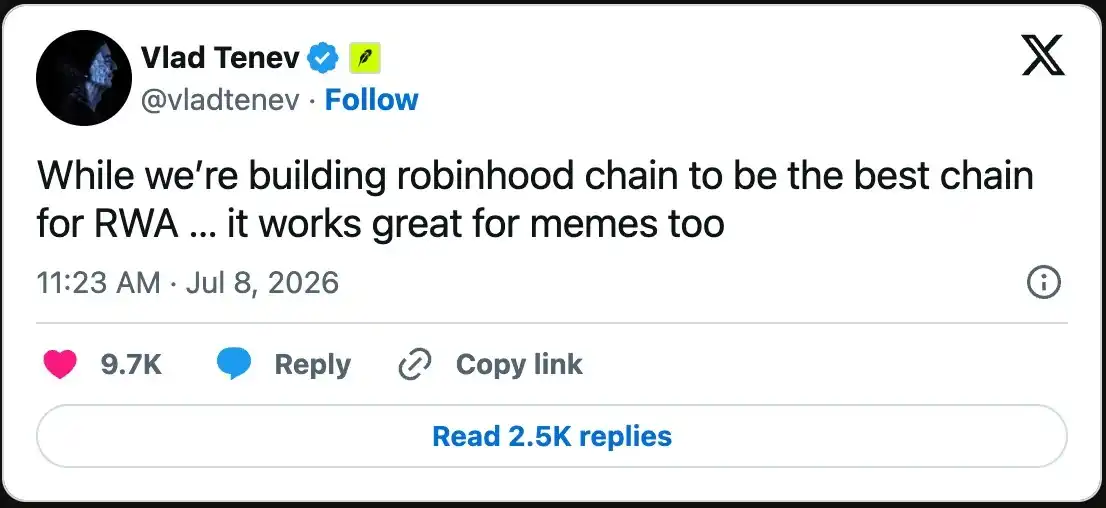
The article closes by noting that a Robinhood co-founder said Robinhood Chain is positioned as a high-quality RWA chain for real-world assets, while also fitting meme coin speculation.