Stock-paired memes are emerging as a new way for launchpads to compete. In a report published by Foresight, Gate Research said the format combines tokenized-stock pairs, stock vault rewards, protocol buybacks and social trading distribution to connect listed-company narratives, on-chain liquidity and high-frequency speculation. The expansion of platforms such as Pons and Long.xyz suggests the model can be replicated across platforms and chains, and could gain wider reach through centralized exchanges.
The report also makes a clear distinction: these assets are not stocks. Holders typically do not receive underlying equity ownership, voting rights or statutory dividends. Thin float, dependence on trading activity, price dislocations, contract risk and social manipulation all limit long-term value. Gate Research’s conclusion is that stock-paired memes may be only the earliest on-chain form of innovation around tokenized equities.
Launchpad competition has shifted from issuance tools to narrative and liquidity
The report says meme launchpads have entered a harsher elimination phase. One-click token creation, bonding curves, automatic liquidity injection and post-graduation migration to DEXs have become standardized features. As token creation falls to the level of an image, a name and a signature, new tokens are no longer scarce. Scarcity has moved to narrative, liquidity, distribution and the shared belief that a community can sustain a price.
That is where stock-paired memes enter the picture. Gate Research defines them as on-chain assets in which memecoins connect directly or indirectly with tokenized stocks. The structure can include using stock tokens as AMM quote assets, converting trading fees into stock tokens and depositing them into a vault, distributing stock tokens to eligible meme holders, or building community narratives around exposure to public or private company equity.
According to the report, the design gives launchpads three differentiation tools:
- quote assets can expand from stablecoins or native chain tokens to stock tokens, adding an equity price factor to the pair;
- fees can be used to buy stock tokens, build reserves or fund rewards, giving meme turnover a visible destination;
- new tokens can be grouped by stock or sector, turning earnings seasons, thematic rotations and company news into reusable attention cycles.
Stock names also come with built-in recognition. Nvidia, Tesla, Apple, AMC and GameStop already live in mainstream media, earnings coverage and retail trading communities. Executive comments, product launches, regulatory events and stock-price moves can all be turned into distribution material. A meme project does not need to build a fictional universe from scratch if it can repackage an existing equity narrative into an on-chain symbol.
Robinhood Chain became the main proving ground, with Pons and Long.xyz fighting for share
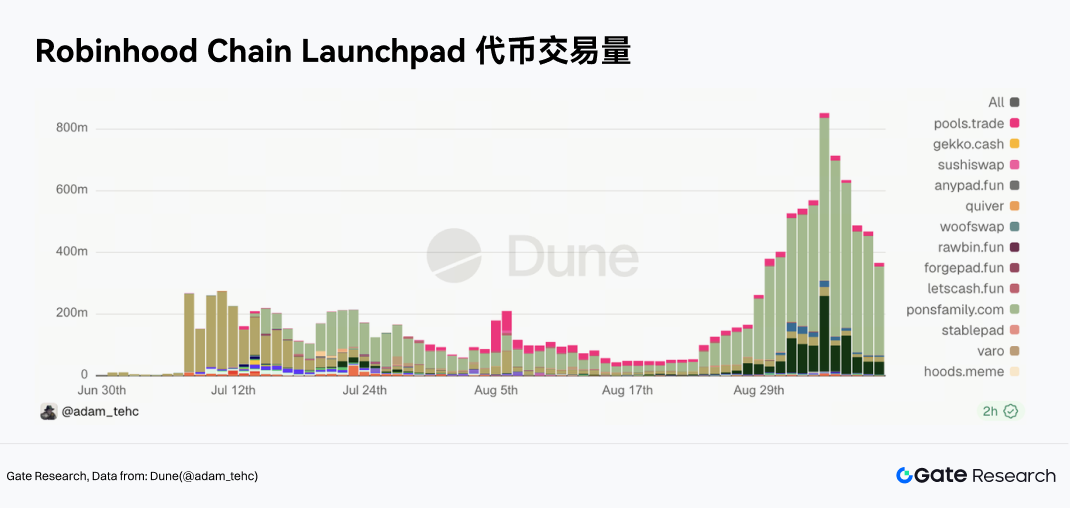
Gate Research said Robinhood Chain’s launchpads briefly topped $800 million in daily trading volume on Sept. 4, 2026. Pons accounted for about 60% of that total, while Long.xyz held roughly 25%. Around the same period, Pons helped push Robinhood Chain’s daily fees to $6 million.
The report notes that Robinhood Chain did not first gain traction because of stock-paired memes or because of the Robinhood name. Early attention came from a conventional meme token, $CASHCAT, which quickly climbed to a market capitalization in the hundreds of millions of dollars. Its launch venue, Noxa, became the chain’s first leading launchpad.
Noxa later shut down on its own, leaving a vacuum. Pons gained traction by directing 80% of protocol fee income to buy back and burn its platform token. Long.xyz, meanwhile, was the earliest launchpad on Robinhood Chain to focus on stock-paired memes.
The report says the concept first drew attention through Bankr, whose market share has now fallen below 0.4%, not through Long.xyz. Because Bankr’s founder already had a successful track record on Base, the founder’s own Nvidia-paired meme token, $REAL, generated more than $5.6 million in volume on its first day. That also helped draw attention to $AI, now the leading stock-paired meme on Long.xyz and Robinhood Chain.
Before July 20, 2026, the most actively traded stock token on Robinhood Chain was $NVDA, and the chain’s Uniswap NVDA/USDG v4 pool had never posted more than $500,000 in daily volume. After $REAL launched, trading in $REAL and $AI pushed that pool above $8.1 million over the next two days, lifting cumulative historical volume past $10 million.
Bankr’s lead did not last. The report says $REAL and $GME lacked the durability and upside seen in $AI. For users, the bigger the market cap reached by a breakout token from a launchpad, the better the liquidity and the larger the perceived opportunity set. Bankr’s decline, in this reading, was tied directly to the absence of a strong enough “billboard” token.
The report also contrasts Pons and Long.xyz. $PONS is not a stock-paired meme but the official platform token of Pons. Long.xyz trails Pons in overall market share, yet it has secured the strongest stock-paired meme niche on Robinhood Chain through $AI. Gate Research argues that $AI functions as a billboard no weaker than PONS. In some respects, it says, PONS being a platform token may cap expectations for the rest of the tokens launched on Pons, because traders are less likely to expect another token on the same platform to surpass the platform token itself.
On Sept. 4, 2026, all tokens on Pons recorded about $525 million in 24-hour volume. The largest by market cap, $PONS, stood at roughly $160 million and accounted for about 30% of that volume. On Long.xyz, all tokens posted about $242 million in 24-hour volume. Its largest token, $AI, had a market cap of about $34 million and represented around 14% of volume. The report says those figures suggest Long.xyz is less dependent on its single largest token.
Among the top 10 launchpad-originated tokens by market cap on Robinhood Chain, Pons and Long.xyz each account for four, according to the report. None of Pons’ four are stock-paired memes, while all four from Long.xyz are. If the market accepts stock-paired memes as the main theme of the next cycle, Gate Research says, Pons’ lead in the launchpad wars is not secure.
Fast growth exposed weak foundations: low graduation rates and skewed user outcomes
The report stresses that strong headline growth does not mean the model is mature. Bitquery’s audit of the first 32 days of Pons activity found that only 3,228 of roughly 207,900 newly created tokens graduated, a rate of about 1.55%. Among 314,736 participating wallets, 66.8% ended with asset values below their starting level.
Another dataset widely cited by the community, covering the social trading app FOMO, showed that 95.2% of 375,740 participating addresses were either losing money or making less than $100 in profit.
Gate Research uses those figures to argue that high trading volume in stock-paired memes does not equal durable asset demand, and it does not mean users are doing well. Most of the gains, the report says, accrue to a small set of leading projects, early wallets and traffic nodes, while the majority absorb slippage, trading taxes and drawdowns.
Asset boundaries matter: similar names do not mean similar rights
The report separates three categories that are often mixed together in market discussion: traditional meme stocks, tokenized stocks and stock-paired memes. All three borrow from public-company narratives and retail trading culture, but the legal relationship of the holder, the source of returns and the mechanics of price formation are very different.
Traditional meme stocks remain legally issued company shares traded in securities markets. In the cases of GME and AMC, prices were influenced by social media mobilization, short positioning, options activity and coordinated retail behavior, but holders still sat within the framework of securities registration, custody and company law. The rights attached to the shares did not disappear because the stocks became memes.
Tokenized stocks depend on the issuance documents. Citing Robinhood’s official documentation, the report says Robinhood Stock Tokens are tokenized debt securities issued by Robinhood Assets Jersey Limited. They provide economic exposure to the relevant stock or ETF, but do not grant legal or beneficial rights in the underlying issuer’s securities. The tokens use the ERC-20 standard, can be held and transferred on-chain, and can connect to applications. Dividends and stock splits are handled through on-chain multiplier adjustments. Robinhood also states that the product is not registered under U.S. securities laws and is subject to jurisdictional and investor-eligibility restrictions.
Stock-paired memes are usually separate meme tokens. They may trade in an AMM pair against a stock token, or route trading fees into stock-token purchases. Holding the meme token does not automatically grant shares, ETF units, voting rights or statutory dividends. A token name that includes NVDA, HIMS, AMC or SPY does not prove participation, authorization or backing from the listed company.
From there, the report divides stock-paired memes into four layers:
- direct pairing, where stock tokens enter liquidity pools and become quote assets for memes;
- stock vaults, where trading taxes or platform fees buy stock tokens that are later distributed;
- protocol finance, where launchpad revenue is routed into buybacks, protocol-owned liquidity, lending or reserve systems;
- distribution, where CEXs, aggregated trading front ends and social leaderboards bring the assets to larger user bases.
The report warns that direct-pair pricing in dollar terms contains two variables: the meme’s AMM exchange rate against the stock token, and the stock token’s own dollar price. A rising stock does not guarantee a rising meme, and meme selling pressure can overwhelm gains on the stock side. During U.S. market closures, on-chain pools can still trade while authorized issuance and redemption may be time-limited, slowing supply adjustment and widening premiums or discounts.
Vault distributions should not be confused with corporate dividends. When a project converts trading fees into stock tokens and distributes them to holders, that is a protocol reward funded by trading activity. Corporate cash dividends come from board decisions and distributable profits. The payer, the conditions for continuation and the legal basis are different.
How the products work: stock tokens as liquidity, rewards and protocol balance-sheet inputs
Stock pairing adds a second price factor to meme trading
Long.xyz is the clearest example. It places stock tokens on the quote side of the AMM. Creators can choose assets such as NVDA, TSLA, MSFT, AAPL, MSTR, GLD, TSM and GME, and a new meme starts trading against the selected stock token from launch. Buyers deposit stock tokens into the pool to receive the meme, while sellers do the reverse.
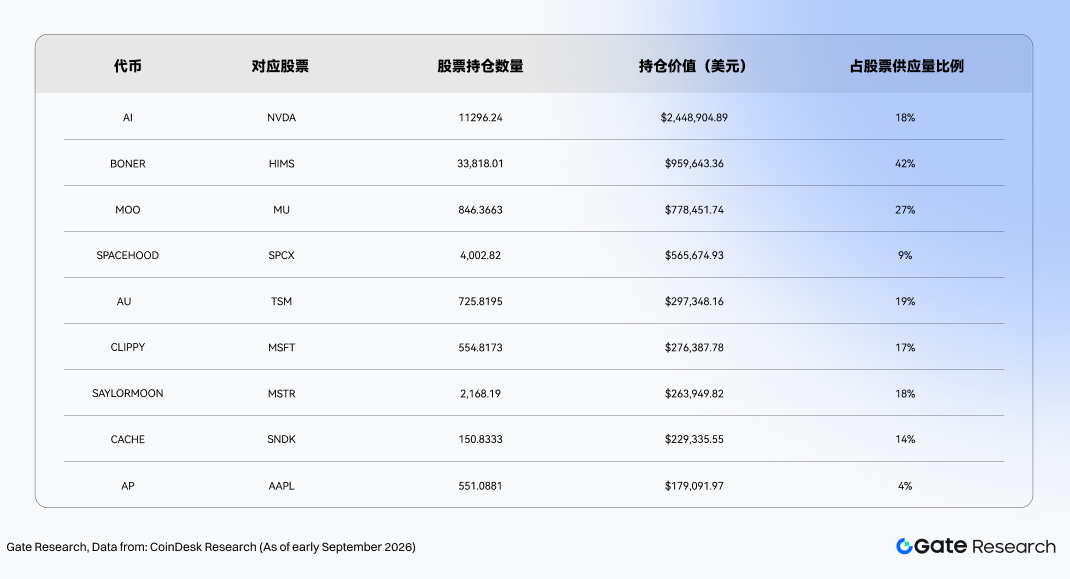
Citing CoinDesk Research, the report says BONER pairs accounted for about 42% of the on-chain circulating supply of the HIMS stock token, MOO for about 27% of MU, AU for about 19% of TSM and AI for about 18% of NVDA. Even if those stock tokens remain tiny relative to the market value of the underlying listed companies, the percentages are large enough in on-chain markets for a single meme to move the marginal price of the stock-token pool.
The report describes this as an on-chain float squeeze. It is not the same as a traditional short squeeze driven by heavy short interest. Here, the pressure comes from limited tradable float in the stock token, concentrated issuance channels and 24/7 crypto trading. If meme buying surges over a weekend or after hours and stock-token supply cannot expand in step, the pair can push the on-chain price sharply higher. Once arbitrageurs regain access to issuance or redemption, the spread can close quickly.
Robinhood Chain has already seen several examples. On July 23, 2026, $GME, a Bankr-issued stock-paired meme linked to GameStop, was heavily speculated on and at one point pushed the GameStop stock token on Robinhood Chain to roughly a 10x premium over the securities-market reference. The relevant pool had only about $200,000 in liquidity, so concentrated buying moved the price quickly.
A month later, a similar episode hit $BONER, a Long.xyz token paired with Hims & Hers Health. This time the move coincided with a weekend market closure. On-chain HIMS liquidity was exhausted, and no new stock tokens could be issued while the securities market was shut. The HIMS stock token on-chain jumped from the Aug. 28 Friday close of $28.84 to $132.64.
Stock vaults turn turnover into visible assets
Flap.sh’s Stocks Vault shows another route. On BNB Chain, MARSCOIN charges a 3% trading tax on each buy and sell. The fees flow into a vault that accumulates SPCXB and then distributes it to wallets holding at least 10,000 MARSCOIN. By early September 2026, cumulative SPCXB distributions were worth about $3.9 million. The visibility of stock rewards, together with a price rebound, helped Flap.sh gain market share, and MARSCOIN reached a new high in early September.
Gate Research says the vault model turns abstract fees into assets users can recognize. In many meme projects, trading taxes go to marketing wallets, multisigs or buyback addresses, and outside users have little way to judge the result. A stock vault can display reserve balances, distribution records and target assets. That gives the community a steady stream of shareable material: how many stock tokens were bought this week, how much a wallet received, how large the vault has become.
The structure is highly sensitive to volume. If the buy and sell tax is 3% and the share allocated to stock rewards is fixed, then distributable assets over a given period are driven mainly by trading volume. If price rises without an expansion in turnover, vault cash flow does not keep up. If volume falls, stock-token purchases decline, the reward story weakens and holder demand can soften. The report adds that markets often annualize distributions from peak-turnover periods to produce eye-catching yields, but that extrapolation ignores how quickly meme volume can decay and how taxes themselves can discourage trading.
The report also notes that both stock vaults and stock-paired memes are contributing to a broader on-chain shift toward rewarding longer-term holders. One example it gives is pump.fun ending its cashback model based on user trading volume and moving to a holder model based on how long users keep tokens.
Protocol finance extends launchpad revenue into the balance sheet
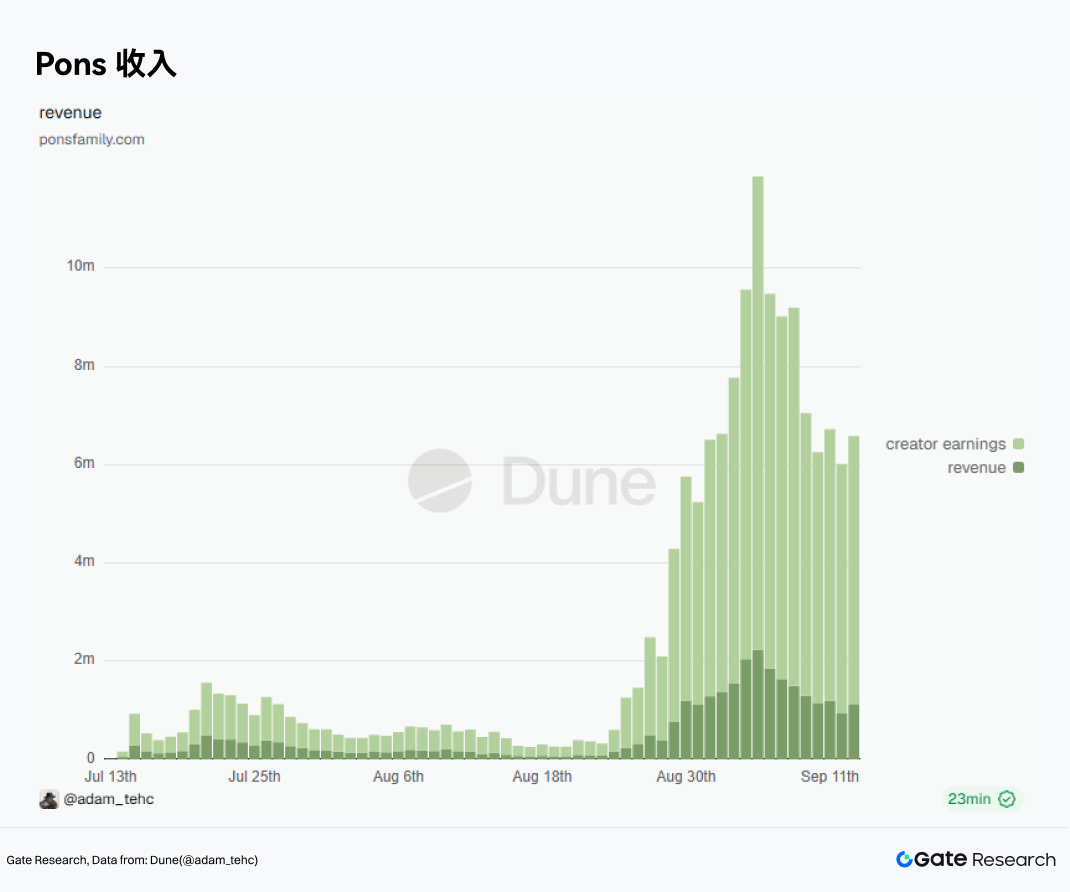
Pons has moved beyond a simple issuance tool. According to official materials cited in the report, PONS is issued through a bonding curve and migrates to a permanently locked Uniswap v4 pool once it reaches the threshold. Trading fees from the platform’s share are used to buy back and burn PONS. As of Sept. 10, more than 300 million PONS had been burned, representing over 30% of supply. In early September, PONS briefly approached a $1 billion market capitalization.
The report says Pons illustrates how launchpads are expanding the way they capture value. The platform first generates fees through mass issuance and high-frequency trading, then routes that income into buybacks and protocol reserves in an attempt to create an asset cycle longer than a single token launch. Bitquery data cited in the report show about $736 million in bonding-curve volume and about $2.14 billion in post-graduation DEX volume in the first 32 days, with creators receiving about $9.7 million in fees. Median creator income per project was only $15.73, showing how concentrated the payoff was.
Gate Research says the willingness of many low-income creators to keep launching tokens suggests the supply side is driven by lottery-like returns. Social media amplifies the few outsized winners, while median outcomes rarely become part of the narrative. Buybacks of the platform token then map issuance activity onto a price that is easier to watch, reinforcing a loop in which more launches, more fees, more buybacks and a higher platform token all support one another. If on-chain activity weakens, the same four links can contract together.
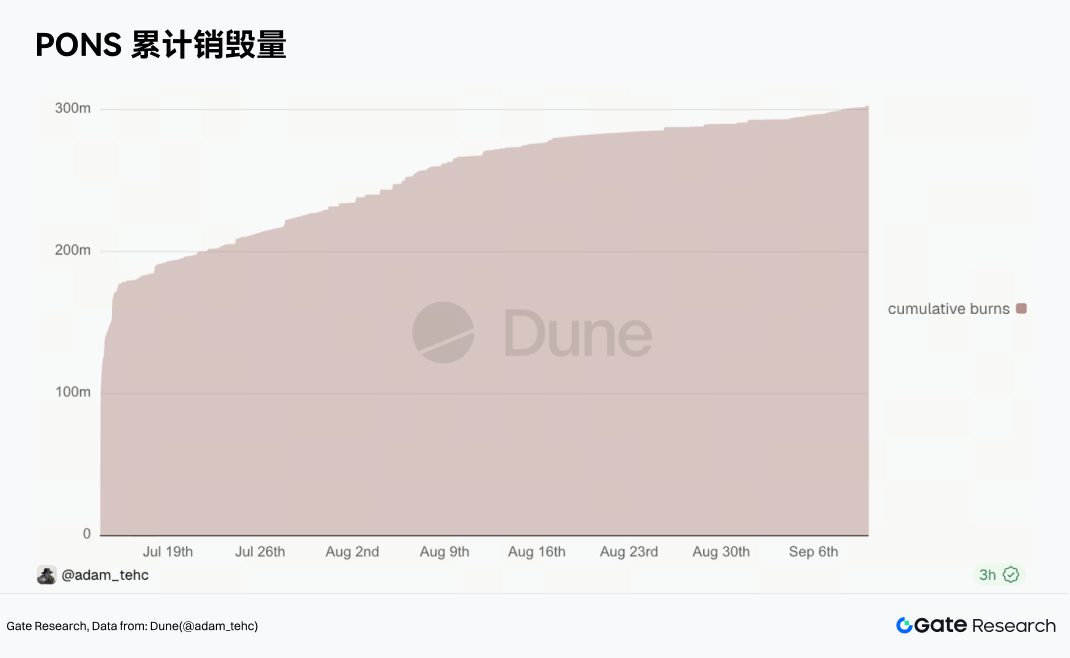
Using Gate market data, the report says PONS price and protocol revenue were tightly correlated in the current phase. Starting on Aug. 28, PONS set a new all-time high each day, while Pons protocol revenue also reached fresh highs almost daily. On Sept. 5, Pons posted a record for single-day protocol revenue, and PONS reached the top of that rally on the same day. As revenue later declined, the token also fell into a correction.
Cross-chain replication is already underway on Solana, BNB Chain and Base
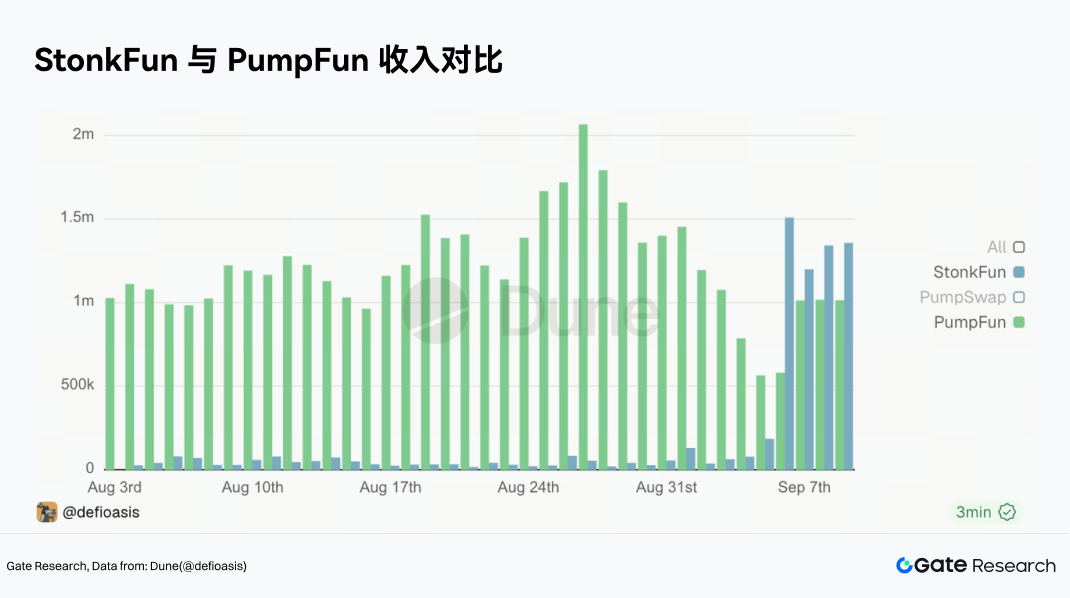
The report argues that the appearance of stock-pairing models on multiple chains was almost inevitable. StonkFun has brought the format to Solana. The platform supports pairs involving tokens linked to stocks, ETFs, crypto assets, currencies and commodities. Its platform token, STONK, is paired with SPYx, which tracks the SPDR S&P 500 ETF.
On Sept. 6, 2026, StonkFun generated $1.5 million in daily revenue, a record high, and for the first time exceeded the long-established launcher PumpFun, according to the report. STONK rose more than 250% that day and its market capitalization moved above $200 million. Earlier in the report summary, Gate Research also said StonkFun’s platform token had risen more than 250% in a day, with market cap briefly around $140 million and daily volume around $135 million.
After integrating with Raydium LaunchLab, StonkFun sends new projects through bonding-curve trading first, then into Raydium pools once thresholds are met, with access to Solana users through aggregators such as Jupiter. The platform also uses part of the trading fees from v3 pools to buy and burn the top 10 platform projects by market cap, with weights tied to market value. The report says that strengthens winner concentration while potentially squeezing the survival space for smaller projects.
Solana already has a more mature meme user base, trading bots, aggregators and mobile access points, which makes it easier to absorb this kind of product. At the same time, the report says Robinhood Chain has overtaken Solana in tokenized-stock trading volume.
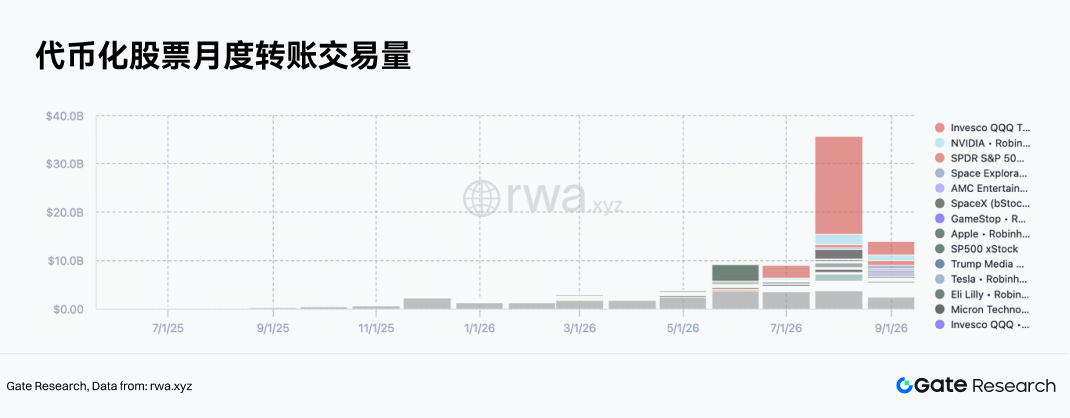
In June this year, Solana’s monthly tokenized-stock volume reached about $3.52 billion, far ahead of every other chain. BSC, in second place that month, recorded only about $101 million. By July, Solana had slipped to second. By August, it had fallen to third, overtaken by Robinhood Chain. During that period, Solana’s tokenized-stock volume kept falling while Robinhood Chain’s kept rising.
One source of Solana’s earlier lead, the report says, was the presence of proprietary AMMs run by professional market makers. These Prop AMMs use 100% market-maker capital, price actively rather than passively, keep liquidity private, usually have no front end and route through aggregators. They can update quotes multiple times every 50 milliseconds within a block and can avoid MEV attacks, improving price discovery for tokenized stocks. In June, when Solana’s tokenized-stock volume hit a record, Prop AMMs such as Zerofi, Goonfi and Tessera often ranked just behind Orca and Raydium in weekly volume.
Gate Research argues that Solana’s strongest widely recognized edge is still memes. Robinhood Chain used that same meme strength together with tokenized stocks and then surpassed Solana in stock-token volume. In that context, the report says, Solana had every reason to respond.
Base has also become a competitive field for stock-pair launchpads. The Stonks Exchange lets newly launched meme tokens use B20 tokenized stocks as quote assets. Each meme has a fixed supply of 1 billion tokens, all placed into a one-sided Uniswap V3 pool at launch. The opening anchor is set using the selected stock’s Chainlink price, while the AMM determines the live market price. Of the 1% swap fee, 0.7% goes to the creator and 0.3% to the platform. Of the platform share, 80% is used to buy back and burn $STONKEX, with the rest treated as operating income.
BaseStonk differs mainly in incentives. Meme tokens launched there can distribute holder rewards based on a chosen percentage of trading volume and up to 10 asset types, including stock tokens, ETFs and cbBTC.
st0x takes a different route. Instead of using Coinbase-issued stock tokens for meme pairing, as The Stonks Exchange and BaseStonk do, it issues its own stock tokens and runs a launchpad around them. Those stock tokens are issued by S01 Issuer GmbH, an independent issuer incorporated in Germany. The report says that route gives st0x a wider range of stock-token themes and a selection better aligned with meme-trader tastes, including FGI Industries and Playboy, Inc.
Robinhood Chain’s Stratton Market follows a similar independent-issuer path and adds an AMM mechanism intended to address stock-token depegging when on-chain squeezes hit and liquidity swings sharply. The report says progress there has been slow so far.
From that, Gate Research suggests that future launchpads may not rely entirely on officially backed stock tokens from public chains. To offer more meme narratives, independent-issuer launchpads may focus more on microcaps and stocks tied to viral events. They may also take on market-making roles themselves, maintaining price anchors for their own stock-token pools, deepening liquidity and potentially generating protocol revenue from that activity.
Social trading has become the acceleration layer for distribution
The report says meme trading has long depended on Telegram groups, X accounts, KOLs, smart-money tracking and trading bots. The traditional callout path is fragmented: users see a ticker on social media, copy the contract address, switch wallets or bots, check the chain and slippage, then submit a trade.
Stock-paired memes add another layer because they often move around premarket sessions, earnings releases, CEO comments and weekend price gaps. A delay of a few minutes can materially change execution. Social trading products such as FOMO compress those steps into one interface.
According to the report, callout boards show recently mentioned tokens, KOL rankings sort accounts by influence and historical performance, active-account feeds display on-chain actions, price charts provide immediate confirmation and users can place orders directly from account pages. What users see shifts from isolated opinions to executable signals, and callouts become an internal trading feature rather than an external traffic source.
Stock-paired memes fit that structure especially well. Stocks provide familiar tickers and events. Meme imagery supplies emotional framing. Stock-token vaults offer quantifiable reward material. On-chain addresses provide traceable evidence of trading. A single distribution cycle can include a company catalyst, a KOL position, a fresh stock-token vault purchase, a pair consuming circulating float and a rising leaderboard rank.
The report says these front ends help in three ways:
- multi-chain aggregation lowers migration costs between platforms and chains, allowing projects from Long.xyz, Flap.sh, Pons and StonkFun to appear in one discovery layer;
- social rankings structure otherwise scattered callout activity and speed up the formation of hot trades;
- when CEX accounts can carry on-chain trades, users unfamiliar with wallets, gas and contract addresses can still participate, expanding the potential capital pool.
But rankings also create reflexivity. Position on a leaderboard may depend on discussion, engagement, volume or account performance. Better ranking brings more exposure, and more exposure drives more discussion and trading. Project teams and KOLs have incentives to manufacture short-term signals, while users tend to chase assets that have already moved. A small number of wallets can build positions in low-liquidity conditions and then attract follow-on buying through public callouts. The report says leaderboards alone cannot solve that conflict.
Gate Research suggests platforms could disclose when a caller entered, average cost, whether the account received project compensation, changes in holdings and historical maximum drawdown. If a ranking page shows only win rates or profit screenshots, it will systematically understate survivorship bias.
Macro context: tokenized stocks are growing, and stock-paired memes are stress-testing the stack
The report places stock-paired memes within a broader acceleration of convergence between traditional finance and crypto. Early tokenized-stock products were sold on 24-hour trading, fractional access and cross-border reach. As the market has grown, competition has shifted toward composability between memes and tokenized equities.
Data from RWA.xyz cited in the report show tokenized stocks approaching a $3 billion market capitalization, up by more than $2 billion since the start of the year. Monthly transfer volume in August reached $350 billion, roughly 100 times the level seen at the beginning of the year.
Gate Research argues that stock-paired memes provide a high-intensity test environment for that composability. Once stock tokens enter AMMs, price oracles, issuance and redemption, trading hours, liquidity management and corporate-action handling all face 24/7 execution pressure. Once they enter vaults, protocols must deal with token authenticity, distribution eligibility, taxes and contract security. Once they enter lending, liquidation parameters must account for trading halts, weekend gaps and company events. Meme-driven flow exposes those infrastructure issues early.
At the same time, Robinhood Chain’s activity shows that the current boom is still driven mainly by crypto capital, launchpad incentives and social speculation. The report says that despite strong meme and stock-paired meme volume, tokenized stocks on Robinhood Chain still have a market capitalization below $150 million. That is not the same as a large-scale migration of traditional stock investors on-chain.
If CEXs and brokerages can eventually bring existing account holders into stock tokens and let those assets enter collateral, lending and unified margin systems, the market base could expand from short-term fee income to holdings and financial-service revenue. If that channel remains weak, on-chain trading may stay concentrated in sharp cycles around a small number of meme names.
Risk pricing: the AMC dispute, dependence on volume and depegging risk
AMC versus Robinhood put naming and consent in focus
In September 2026, AMC CEO Adam Aron and Robinhood co-founder and CEO Vlad Tenev publicly clashed over AMC Stock Token, according to the report. Aron said the product created a false market, stressed that AMC had not participated in or authorized it, and said he might seek action from U.S. securities regulators. Tenev defended the value of stock tokens as a way to provide market access to overseas investors.
The report says the dispute brought a long-running mismatch in tokenized equities into the open. Robinhood’s own documents already state that Stock Tokens are tokenized debt securities issued by a Jersey entity, offering economic exposure but not legal or beneficial rights in the underlying company’s securities. Some members of the public may see the name “AMC” and assume the product is an AMC-issued on-chain share. The gap between issuer disclosure and user intuition is obvious.
Price distortion made the conflict worse. The report says public coverage described one set of AMC-related on-chain pairs trading at roughly 60 times the reference stock price. That may have reflected exchange ratios in a thin liquidity pool, confusion between similarly named assets or supply constraints. It did not mean AMC stock itself had moved by the same amount.
The report also points back to the 2021 AMC and GME trading restrictions. Robinhood then limited some stock purchases because of clearinghouse margin requirements, and social communities saw that as interference with retail trading rights. In 2026, the dispute played out on-chain, where trading can continue around the clock, but issuance, redemption, custody and legal enforcement still depend on centralized actors. Continuous trading at the technical layer does not remove the credit and compliance nodes of traditional finance.
Stock rewards depend on trading activity and cannot replace corporate dividends
The report says the most easily overstated part of stock-paired meme projects is the stock-token reward stream. Those rewards usually come from trading taxes or protocol fees paid by traders. When activity is strong, vaults keep buying stock tokens and projects can showcase cumulative distributions and wallet-level payouts. When trading cools, new income falls with it. If the meme token price keeps dropping, stock rewards are unlikely to offset principal losses.
Taxes create an internal tension as well. A higher tax rate increases the vault contribution from each unit of volume, but it also raises entry and exit costs, discouraging arbitrage and market making. Liquidity providers must bear impermanent loss, meme volatility and stock-token dislocations, so they demand higher returns. Projects may respond by setting even higher taxes to preserve rewards, which can reduce depth further.
Gate Research says cumulative figures should be broken into incremental ones when evaluating cash flow. Cumulative distributions only go up and are easy to market. Weekly net purchases, distribution per unit of volume, the number of active claiming addresses and changes in vault NAV are more useful for understanding the cycle. If income is concentrated in the first few weeks after launch, annualized yields have little decision value.
Thin liquidity amplifies depegs and market-cap illusions
Prices in stock-paired pools are shaped by both meme demand and stock-token demand. If the underlying stock is halted, after-hours reference prices are unavailable, authorized participants pause issuance or a bridge breaks, the stock token can diverge from the underlying asset. The report says cases where meme buying consumed 20% to 40% of on-chain circulating float show that even a small on-chain market can have a large marginal impact.
Thin liquidity also inflates market-cap optics. A small trade can push the pool price higher, and multiplying the last traded price by total supply can produce a rapidly rising market cap even though the amount of capital that can actually exit is far smaller. When KOLs display market cap and paper gains, users rarely see pool depth, top-holder concentration, redeemable stock-token supply or sell taxes. Once exits cluster, prices can gap down through multiple levels.
Contract, issuance and governance risks stack up
The report says stock-paired memes involve more contract layers than ordinary meme tokens. Users must trust the meme contract, the launchpad, the AMM hook, the stock vault, the stock-token issuer, the price oracle, custody arrangements and cross-chain infrastructure. A problem in any one of those layers can affect trading.
Verifying stock-token contract addresses should be a basic step. Robinhood’s official contract pages warn that other contracts with the same name or ticker are not official Stock Tokens. The report says traders should be alert to projects that issue fake stock tokens using the names of popular companies and then pair them with memes, creating both a false brand signal and a false price anchor.
Social manipulation and conflicts of interest remain central risks
Callers may also be early investors, project advisers, market-making participants or paid promoters, the report says. Once callout boards convert influence into order flow, undisclosed economic interests create severe information asymmetry. Historical win rates on rankings can also be distorted by address rotation, cherry-picked peak prices and the omission of slippage.
Gate Research says social trading platforms are, at their core, still fee-extraction tools and may not manage risk from the perspective of ordinary users. Social features preserve market-discovery efficiency, but third-party disclosure tools are still needed to reduce inducement-heavy presentation. The report lists examples: showing changes in holdings before and after a callout, tagging project transfers and promotional payments, measuring the time gap between first entry and public callout, and separating realized from unrealized gains. For stock-paired memes, it says, platforms should also add stock-token contract verification, on-chain float-usage ratios, issuer redemption status and prompts about U.S. stock-market trading hours.
Market view: two key moments drove the narrative from Robinhood Chain to a multi-chain theme
Gate Research summarizes the stage value of stock-paired memes in three points. First, they give launchpads new quote assets and new uses for fees, helping platforms move beyond simple copycat meme issuance. Second, they move stock tokens from passive wallet exposure into AMMs, vaults, rewards and collateral settings, increasing on-chain usage. Third, when combined with callouts, KOL rankings, profitable-account displays and one-click execution, they form an attention-driven distribution network.
The report maps the market into three phases. The short term is driven by launchpad share competition and breakout tokens. The medium term depends on distribution and asset supply. The long term depends on tokenized-securities infrastructure that can support stable issuance and redemption, corporate-action handling, collateralized lending and cross-border compliance.
It also says the industry may split into three types of platforms: one serving high-frequency speculation and earning from trading fees and leaderboard traffic; one emphasizing reserves, redemption and suitability controls for longer-term holders; and one providing market-making, lending and liquidation infrastructure for stock tokens. If stock-paired meme platforms remain little more than name packaging plus high-tax distributions, their life cycle will resemble that of ordinary meme projects. Platforms that can prove the source of stock assets, the quality of fee cash flow and user retention across cycles have a stronger case to become entry points for tokenized equities.
From a sentiment perspective, the report identifies two key moments in the rise of the theme. The first came on July 18, when Robinhood CEO Vlad Tenev posted the widely discussed “two wolves” tweet asking why memes and RWA could not advance together. The timing mattered. Robinhood Chain’s first wave of conventional meme speculation had already run, follow-through was fading, and CASHCAT had fallen from a peak above $200 million in market cap to below $70 million. In the days after that tweet, Long.xyz’s $AI began to attract speculation.
The second key moment came on Aug. 24, when Tenev spoke positively about the theme in an interview on The Iced Coffee Hour. He said, “If you hold a meme coin, you can receive tokenized U.S. stocks as an airdrop. This unique structure ties meme coins and U.S. equities together into a distinct asset class we had not thought about before.” After that, the two most watched names in the current wave, $PONS and $AI, both began sharp rallies.
The report says Tenev’s influence has been critical to the development of the theme, but influence tends to diminish over time. The longer-term question is how to combine traditional securities markets with on-chain stock-paired memes and DeFi structures, then distribute the result through channels large enough to reach traditional users and blur the boundary between off-chain and on-chain assets. As Tenev has repeatedly said, the goal is to distribute U.S. stocks to a much broader global investor base. In that sense, Gate Research says, stock-paired memes may be only the earliest form of on-chain innovation around tokenized equities.
Conclusion: not equity, but possibly an early gateway for tokenized stocks on-chain
The report concludes that stock-paired memes have given launchpads a workable set of differentiation tools. Stock tokens can serve as quote assets, vault assets, reward assets and social-distribution material. Long.xyz, Flap.sh, Pons and StonkFun each demonstrate a different path: direct pairing, stock reserves, protocol finance and cross-chain expansion. Robinhood Chain’s surge in volume and fees in early September shows that the market is willing to trade these hybrid assets, while examples on Solana and BNB Chain show the model can be copied across ecosystems.
At the same time, social trading products such as FOMO increase distribution efficiency while intensifying momentum chasing, conflicts of interest and concentrated returns. Weak outcomes for most addresses, very low token graduation rates and the high share of stock-token float consumed by leading projects all suggest that growth in trading volume should not be equated with growth in user wealth.
The AMC-Robinhood dispute, meanwhile, marks a boundary the sector cannot avoid. Tokenized stocks may provide economic exposure without granting underlying shareholder rights. Pairing a meme with a stock token does not create authorization from the listed company. Trading-fee rewards in stock-paired memes depend on market activity and cannot replace cash dividends backed by corporate profits. Naming, legal rights, reserve custody and price-formation mechanics all need to be disclosed clearly at the product entry point.
Gate Research’s final point is that the biggest incremental change from stock-paired memes is not the number of stock-themed memes created. It is that tokenized stocks are being pulled into the daily trading, social and asset-management workflows used by crypto participants.