

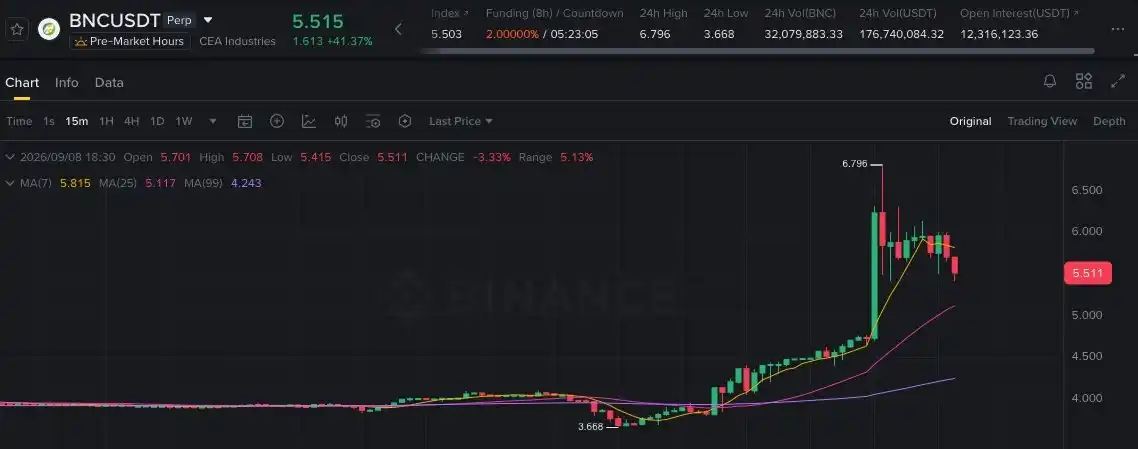
On the Asian afternoon of Sept. 8, 2026, the United States had just come through the Labor Day holiday and Nasdaq had not yet opened. CEA Industries’ BNC stock had last traded officially on the previous Friday. On Binance, Bitget, Bybit and other crypto exchanges, though, BNC had traded throughout the weekend.
PerpEquities recorded the BNC perpetual price at about $4.56, or 35.5% above the last price before the U.S. market closed. Perpetual volume over the previous 24 hours was about $71.5 million by PerpEquities’ count. Adding exchange-reported figures pushed the total above $200 million. BNC’s comparable spot-stock volume was about $2.8 million.
On the first comparison, BNC perpetual volume was roughly 25 times the volume of the underlying shares.
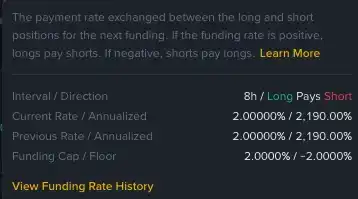
Open interest was also substantial. BNC perpetuals carried about $88 million in open contracts, equal to more than half of the value of the company’s tradable shares. Binance alone handled about $33.2 million in BNC perpetual volume over the 24 hours ending Sept. 8. Funding briefly reached Binance’s stated ceiling of +2% every eight hours.
BNC shows what a second capital market can look like
BNC was not a large-cap stock. CEA Industries had a market capitalization of just over $100 million at the time. In an SEC filing, the company disclosed that it held 515,544 BNB as of the end of April 2026, with a fair value of about $317 million at that point. CEA had shifted from an environmental-control equipment business into a BNB treasury company.
The result was unusual for U.S. equities: while a Nasdaq-listed company with a market value of just over $100 million was closed for trading, an always-on derivatives market with nearly $100 million of open interest was operating elsewhere. It had longs, shorts, leverage, liquidations, funding and market makers. CEA did not need to issue another share for that market to exist.
Calling the BNC contract merely another crypto product misses the larger point. The perpetual was not just an additional way to trade the stock. It was adding a second capital market around the company.
Small caps often lack market capacity, not attention
Apple and Nvidia do not need stock perpetuals to solve a liquidity problem. They already have spot trading, premarket and after-hours sessions, established options, ETFs, securities lending, prime brokers and institutional over-the-counter markets. A stock perpetual may attract activity in those names, but it is more likely to sit alongside an existing financial system than to supply a missing one.
Small caps are different. A company may be worth $1 billion, $500 million or $100 million and still become the subject of intense discussion because of artificial intelligence, drones, quantum computing, nuclear power, space, crypto treasuries or biotechnology. Attention can be global and continuous, while the available trading infrastructure remains limited.
The stock order book may be thin. Premarket and after-hours liquidity can be thinner still. Options may exist without meaningful long-dated depth, leaving wide spreads across many strikes. A trader seeking to short the shares must also deal with locate requirements, borrow availability and borrow fees. If the company releases news on a Friday night, the U.S. equity market may offer only one answer: wait until Monday.
That creates a mismatch. Information demand runs around the clock, speculative demand is global, but traditional small-cap infrastructure is still built around the schedule and scale of the U.S. stock market.
Perpetual futures can address part of that gap. They do not require dozens of strikes or monthly expiries. An exchange needs to manage an index, an oracle, margin, funding, liquidation and market making, then it can offer a unified long-and-short market around a ticker.
Users can post USDT or USDC as collateral without first opening a dollar-based securities account. A short seller does not have to locate the stock personally. Someone in Asia who sees news overnight does not have to wait for New York to open.
For Apple, that is another instrument. For a small stock without deep options, borrowing or global institutional market making, it can amount to a layer of financial market that did not previously exist.
ONDS and AAOI show why the model is selective
Not every small-cap company can become a major stock-perpetual market. The setup requires a particular combination of conditions.
Ondas Holdings, or ONDS, is a useful counterexample. It has several themes popular with crypto traders: drones, automation, defense and critical infrastructure. Its story is new enough, and its stock volatile enough, to attract attention. In the second quarter of 2026, revenue rose to $83.77 million from $6.27 million a year earlier. First-half revenue increased to $133.9 million from about $10.52 million.
Crypto venues did not ignore the ticker. ONDS perpetuals were available across more than 10 venues, including Binance, Bybit, Bitget and OKX. Yet as of the afternoon of Sept. 8, PerpEquities measured 24-hour ONDS perpetual volume at about $2.14 million, with open interest near $2.89 million. The underlying stock traded about $330 million over the same period. Perpetual-to-spot volume was about 0.01 times, and perpetual open interest represented only a small share of the tradable equity value.
The explanation is straightforward: ONDS’ traditional market was not as underdeveloped as BNC’s. Its shares already traded actively and its options market had scale. Crypto venues could reproduce the ONDS ticker, but they were not solving a problem that traditional finance had left unresolved.
Applied Optoelectronics, or AAOI, presents a similar case. It is a high-beta stock tied to AI-related optical communications. Second-quarter revenue reached $191.9 million, up from $103.0 million a year earlier. Shipments of its 800G products more than doubled sequentially, and demand was expected to exceed capacity through mid-2027.
AI, data centers, optical modules, rapid growth and volatility gave AAOI many of the characteristics sought by crypto traders. Bitget, OKX, Binance and Bybit quickly listed AAOI perpetuals. The contracts were eventually distributed across more than 20 crypto venues.
Even so, AAOI perpetuals generated about $42.7 million in 24-hour volume on Sept. 8, with open interest around $28.7 million. The underlying stock traded about $736 million. Perpetual-to-spot volume was only about 0.06 times.
Traditional finance was already present. AAOI had active spot and options markets, with tens of thousands of option contracts open in a single expiry month. For a stock like this, crypto was not filling a hole. It was placing another table beside a mature market.
The dividing line is clear: the less traditional finance builds options, borrowing, ETF and market-making infrastructure for a ticker, the more valuable a perpetual can become. Where those tools are already deep, perpetuals must rely on 24/7 access, stablecoin collateral and crypto-native traders to win peripheral volume.
FWDI connects a public-company balance sheet to DeFi
Forward Industries’ FWDI is more interesting because its balance sheet is already using DeFi-style mechanics.
Forward was once a small hardware company. It later became a Solana treasury company. As of Aug. 3, 2026, it held about 7.807 million SOL and SOL equivalents, equal to about 1.3% of Solana’s circulating supply.
The company did not simply buy tokens and hold them. It operated a validator and worked with Sanctum on fwdSOL, a liquid-staking token. Its stated plans included staking SOL, deploying assets into DeFi protocols for yield, lending SOL, borrowing against SOL collateral and reinvesting in the Solana ecosystem.
By the end of June, more than 3 million SOL or fwdSOL had been pledged to Galaxy, with loan balances above $100 million. The company also had on-chain debt and had conducted SOL lending and over-the-counter options activity.
That makes Forward more than a listed company that bought crypto. It is combining treasury assets, staking, lending, collateral and derivatives on one corporate balance sheet.
A stock perpetual around FWDI was therefore not an isolated development. Binance listed BNCUSDT and FWDIUSDT together on July 9. FWDI perpetual open interest now stands at more than $60 million, or a low-teens percentage of its tradable equity value. Perpetual volume has not surpassed the stock’s volume, but the external derivatives exposure is large enough to form a meaningful pool of positions.
The four examples show four different market conditions. AAOI remains dominated by traditional equities. ONDS has a strong story, but its traditional market is already active. FWDI has built a peripheral derivatives pool that cannot be ignored. BNC, during certain windows, has seen perpetual volume, open interest and price discovery look more like the primary market than the underlying shares.
The key variable is not simply company size. It is the gap between speculative demand and traditional financial supply.
Perpetuals create additional risk capacity
A stock’s float is finite. The market contains only so many shares. Increasing the number of shares requires issuance, while shorting generally requires a willing lender.
Perpetuals do not face the same physical limit. If a company has a $200 million equity float, a perpetual market can still produce $50 million, $100 million or several hundred million dollars of open interest. As long as longs and shorts continue to enter and the liquidation system can absorb the positions, economic exposure can grow.
It would be inaccurate to say that open interest is simply synthetic shares. Every perpetual has both a long and a short, and whether a market maker hedges in the stock market, and how much it hedges, depends on the market’s structure. Perpetuals do, however, create additional risk capacity.
A company with only $100 million of equity float can have a derivatives position pool worth $50 million or more than $100 million. Traders do not need to compete for a limited supply of physical shares or wait for a new issue to express a view.
Research on these stocks may therefore need more than short interest divided by float. A second measure is Perp OI divided by Equity Float.
BNC was above 50%. FWDI was in the low-teens percentage range. AAOI and ONDS were both below 1%. The comparison gives a rough indication of where the external market has actually developed.
Open interest is inventory, while funding sets a price on crowding
Open interest is not revenue. BNC having $88 million in OI does not mean Binance collected $88 million. OI is better understood as inventory that can support recurring activity.
An investor who buys $1 million of stock and holds it for a year may generate a fee only when the purchase is made. A perpetual position behaves differently. Traders add, reduce and close positions. Some change direction because funding becomes too expensive. Liquidations create additional trading, and market makers repeatedly hedge.
As long as OI remains in the market, fees and spreads can continue to be generated. For exchanges, market deployers and market makers, OI is close to a stock of future trading activity.
Hyperliquid’s HIP-3 has turned that structure into a product. A market deployer can create a perpetual market and receive a share of trading fees. The platform is no longer limited to operating a broad securities market; third parties can operate markets around individual tickers.
Funding adds another layer. During the BNC episode, longs became crowded enough for Binance funding to reach +2% every eight hours. A traditional stock tells traders what the company is worth in the market. A perpetual also asks how much it costs to maintain a particular view.
A short seller may not believe BNC must collapse. The trader may simply decide that longs are paying enough funding to make the other side attractive. A vault can also build a market-neutral strategy around spot exposure, a tokenized stock, perpetuals and funding. Traditional equities already have dividend yields, borrow fees and option premiums. Perpetuals add funding yield.
The source provided this reference for the extreme BNC funding example: reference post.

One ticker can take several forms on-chain
This is where stock perpetuals differ from traditional CFDs. A CFD may remain a contract inside a broker’s database. Crypto instruments can connect to wallets, lending markets, collateral systems and liquidity pools.
A tokenized stock can sit in a wallet, serve as collateral, enter a lending market or be used for liquidity provision, with a perpetual used as a hedge. xStocks already covers hundreds of tokenized stocks and ETFs and has entered multiple DeFi settings. Protocols such as Kamino have also built lending markets around tokenized stocks.
The financial structure around one ticker can then change. Nasdaq has the share. Traditional markets have options. Binance, OKX and Bybit have perpetuals. The chain has a tokenized stock. A market maker can hold the tokenized stock and short the perpetual. A user can post the tokenized stock as collateral, borrow stablecoins and increase exposure. A protocol can build a vault around funding.
Crypto also turns attention into another layer of liquidity. If a company has a ticker, a narrative, a community, a perpetual, a tokenized asset and on-chain liquidity at the same time, memes, prediction markets, points programs and different vaults can form around it.
FWDI suggests issuers may join the structure
Forward Industries is worth watching because it has not waited for outsiders to build a DeFi framework around its assets.
It issued fwdSOL, ran a validator, staked, used assets as collateral, borrowed, wrote SOL options and bought back shares with borrowed funds. In explaining these activities, the company looks beyond traditional EPS and also considers SOL per share.
A new loop follows. The stock price affects financing capacity. Financing adds to the crypto treasury. The treasury generates staking returns. The liquid-staking token can be pledged again. Collateral creates new financing. The company uses financing to repurchase shares and reduce the share count. The market recalculates crypto exposure per share. Outside the company, FWDI perpetuals allow traders who do not own the stock to trade that loop.
This is no longer a simple case of a public company buying crypto. It is closer to a public company using the balance-sheet language of DeFi.
The issuers most suited to stock perpetuals may therefore be companies whose businesses are closely tied to on-chain assets, rather than random small caps. Crypto treasury companies may come first, followed by businesses linked to AI compute, DePIN, real-world assets and some energy companies.
Derivative exposure without issuing another share
A perpetual can allow a market to build large economic exposure around a company without increasing the company’s share count.
When a listed company wants to raise money from market interest, it usually turns to an ATM program, a secondary offering, a convertible or a warrant. Each route eventually touches share supply. Perpetuals separate speculation from issuance. A company with a $200 million float can support $200 million, $500 million or more in gross derivatives exposure outside the equity market. That exposure can change hands repeatedly during a day, creating fees, funding, spreads and liquidation activity without requiring any action from the transfer agent.
It is only partly correct to describe this as monetizing attention without dilution. The recipient of the revenue matters. If the company has no relationship with the perpetual, outside volume does not automatically send money to the issuer. Exchanges, market makers, deployers, arbitrageurs, liquidity providers and funding recipients are the parties that may earn from the activity.
If issuers, tokenization providers, market deployers, oracle providers and DeFi protocols begin forming commercial relationships, the ticker itself could become an asset that is licensed, distributed and operated over time. A listed company might monetize attention without relying on a new share issue every time.
Regulation is being tested between categories
Stock perpetuals are not outside regulation. The United States has long had rules for single-stock derivatives, including security-based swaps, and access for ordinary retail investors can face significant restrictions.
The difficulty grows when perpetuals, offshore exchanges, tokenized stocks, stablecoin collateral and DeFi lending are combined. Traditional classifications ask whether a product is a security, a future or a swap. A crypto structure may function at once as tokenized-stock collateral, a perpetual hedge, a stablecoin margin account and a DeFi lending position.
In 2026, the SEC and CFTC began revisiting the boundaries among swaps, security-based swaps and perpetual contracts. The issue is not a complete absence of rules. Regulators are trying to catch up with a product that crosses jurisdiction, product classification and distribution channel.
The same BNC illustrates the split. A U.S. retail trader using a securities account buys a Nasdaq share. A crypto user outside the United States may trade a BNCUSDT perpetual. CEA has not issued another share, yet the legal relationships are entirely different.
A venue may also build a market around a ticker without the issuer actively issuing a perpetual in the way a company conducts a Nasdaq listing. The issuer may not even be a party to the contract. That is a major change from conventional corporate finance.
Perpetuals change the tax route, not the existence of tax
It is also too broad to call perpetuals tax-free. In some jurisdictions, a cash-settled derivative can avoid certain transaction taxes tied to the transfer of share ownership.
The United Kingdom provides a clear example. Opening and closing a CFD does not involve buying or selling the shares, so it generally does not create Stamp Duty or Stamp Duty Reserve Tax. Some cash-settled futures receive similar treatment.
That does not mean profits are untaxed. The United States has rules such as Section 871(m) for equity derivatives, and countries differ in their treatment of derivative gains, crypto settlement and stablecoins.
The main change is the entry point for tax. Traditional equities combine trading, custody, ownership, settlement, dividends and tax. A cash-settled perpetual removes ownership and leaves a price contract. Some taxes and operating frictions connected to share transfers may decline, while capital moves into another derivatives-tax framework.

The source supplied this reference on the tax discussion: reference post.
Which small caps are most exposed to the model?
BNC, FWDI, ONDS and AAOI suggest that market capitalization alone is not the answer. The most interesting stock for a perpetual market is one with significant attention but limited traditional financial capacity.
It needs a compelling story to generate global speculative demand. A relatively small float makes external derivatives capacity look larger. Shallow options and borrowing markets increase the replacement value of a perpetual. A large Asian or crypto-native user base gives 24/7 access practical significance. A tokenized wrapper, a related crypto asset or an on-chain hedge can help complete the structure.
BNC meets nearly all of those conditions. FWDI meets many of them. ONDS has a strong narrative, but its spot and options markets are active enough that perpetuals have captured little volume. AAOI is a high-beta AI stock below $10 billion in market capitalization, and more than 20 crypto venues list its perpetuals. Yet Nasdaq spot and options already provide a mature trading venue, leaving crypto to operate beside it.
The source also identifies AMC, HIMS and GME on the Robinhood chain as names to watch in this context.
The next test may come before Monday’s open
The BNC Labor Day weekend also showed how perpetuals can supply a price before the U.S. equity market reopens. If company news, BNB volatility or the broader crypto market moves, BNC perpetuals can trade first. By the time Nasdaq opens on Tuesday, the stock is no longer facing only Friday’s closing price. It is facing a price formed over dozens of hours elsewhere.
The effect is limited when the perpetual market is small. If perpetual OI reaches a large portion of the float and 24-hour volume is several times or dozens of times the stock’s volume, the weekend market has enough capital to produce a price that cannot be ignored.
Legally, the BNC share remains the underlying. Over the weekend, though, the underlying is silent while the derivative continues to speak. When Nasdaq reopens, the stock may have to answer the questions posed by the perpetual market.
A perpetual does not need to take most of a stock’s annual volume or replace Nasdaq. It only needs to remain open when the stock has the least liquidity, the fewest venues and the greatest need for an immediate price. That is enough to give it a degree of price-discovery power.
The risk is equally direct. Small-cap markets are thin. If external perpetual OI approaches the size of the stock float while U.S. equities are closed, it becomes difficult to decide which price an oracle should trust.
The stock has no fresh quote, but the perpetual still needs an index and a mark price. The order book moves first, the mark follows, and the mark can trigger liquidations that push the order book again. Poor design between market price, oracle, mark price and liquidation can create a self-reinforcing loop.
Multiple perpetual venues make the problem harder. Platform A may reference platform B, while B references platform C. A large part of the supposed external price may ultimately come from other derivative venues.
That is why Binance, Bitget, OKX and Bybit need tools such as Impact Price, EWMA, index bands, staleness filters and mark-price protection. For a company such as Apple, these are safeguards around a huge existing market. For BNC, they can define the market itself.
Related reading: Who Quotes the Stock After Nasdaq Closes? Stock Perps, Oracles and a 24/7 Pricing Contest.
Stocks are moving through crypto’s earlier development path
Crypto’s first decade followed a familiar sequence. A project began with one token, then gained spot trading, margin, perpetuals, lending, stablecoin collateral, liquidity pools, vaults, structured products and prediction markets. A full financial system eventually grew around the token.
Stocks are now moving in the opposite direction. The share provides legal ownership. The tokenized stock provides on-chain settlement. The perpetual provides leverage and 24/7 price discovery. Stablecoins provide collateral. DeFi supplies capital efficiency. Options continue to price volatility. Memes and communities distribute attention. Funding rates put a price on crowding.
BNC is an early extreme example. AAOI shows that a deep traditional market is difficult to rewrite. The question is not whether stock perpetuals will replace stocks. It is which tickers will first develop an external financial system larger than the original equity market.
The likely candidates are not Apple or Microsoft. They are the next BNCs: companies with modest market values and floats, very large narratives and global attention, but without a sufficiently broad traditional financial highway.
Those companies may not lack investors. They may lack a market capable of carrying speculative demand. Crypto can build that market beside the stock exchange, keep it open around the clock, use stablecoins as collateral, price crowding through funding, store positions in open interest, and connect tokenized stocks with lending, vaults and other DeFi components.
It can do so without issuing another share. Once a company worth just over $100 million has a perpetual market carrying close to $100 million in OI over a weekend before Nasdaq opens, describing stock perpetuals as a crypto novelty beside the stock is no longer sufficient.
It is a new trading venue—one without a closing bell, a trading floor or a requirement to wait for 9:30 a.m. in New York.