

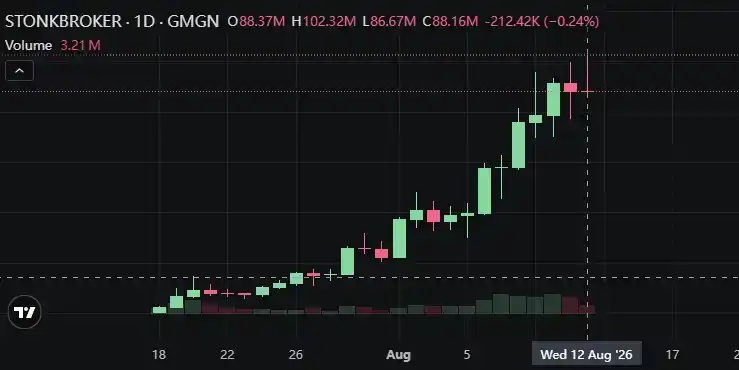
StonkBroker has moved into the center of the Robinhood chain conversation after a 14-day run that pushed the token’s market capitalization above $100 million at one point, setting a new all-time high. The source material says the token is up 9x from the first time BlockBeats mentioned the project.
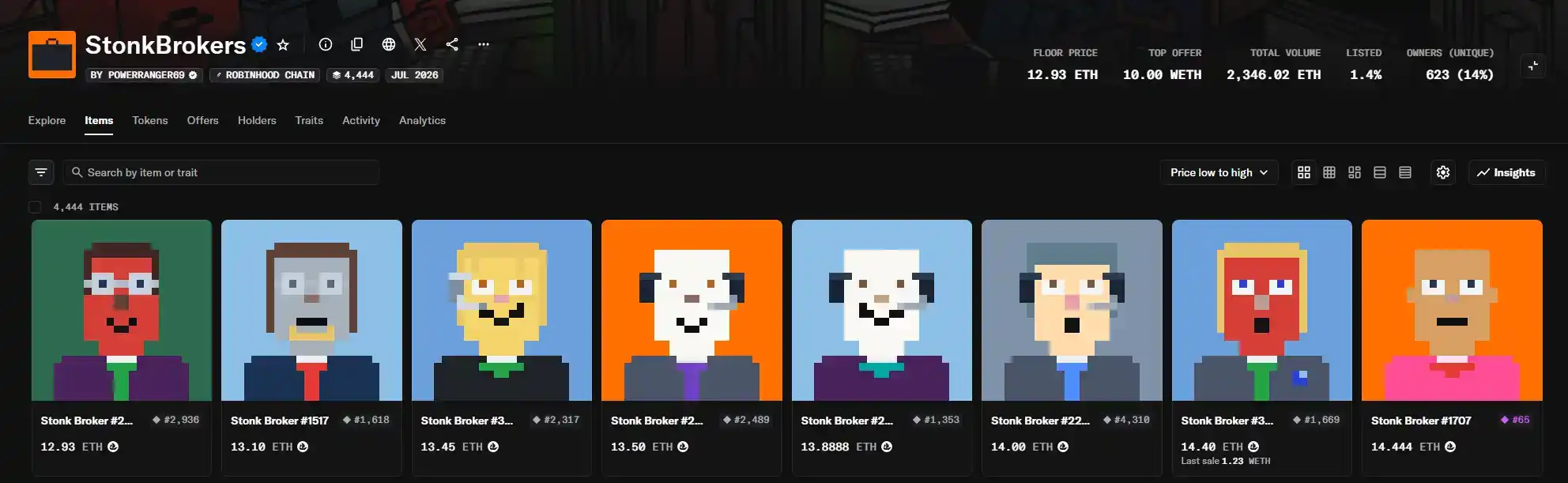
That rally has spilled into the project’s NFT line as well. Its floor price briefly rose above 13 ETH, or about $25,000, and was later quoted at 12.93 ETH. On a per-NFT basis, the collection has moved past Bored Ape Yacht Club, according to the source, while total market capitalization for the series also crossed $100 million, overtaking older blue-chip NFT names such as Pudgy Penguins and Milady.
Those numbers have been enough for some market participants to label StonkBroker the likely No. 2 project on the Robinhood chain behind CASHCAT. The source’s argument is more restrained: the price action is clear, but the underlying support may not be as firm as the market narrative suggests.
Revenue is strong on paper, but highly concentrated
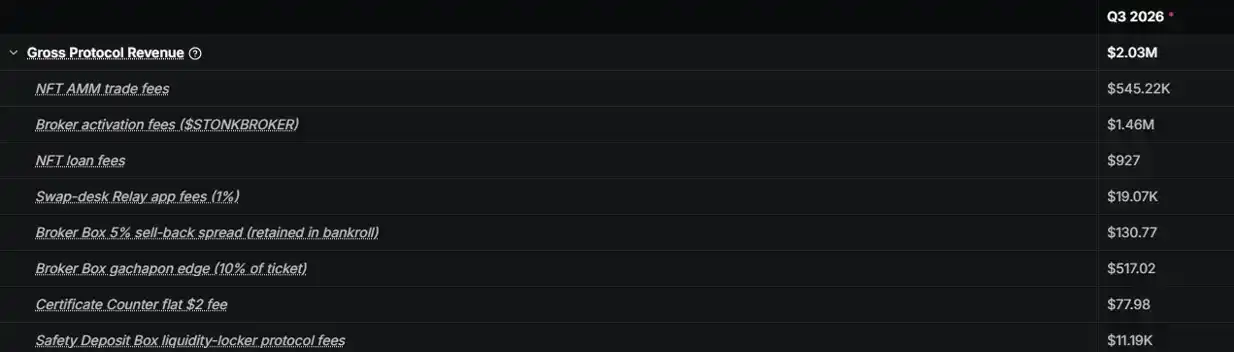
Based on defillima data cited in the article, StonkBroker ranked third in revenue over the past seven days, behind only Uniswap and Pons. On some individual days, its revenue even topped Pons.
A closer look at the mix shows that nearly all of that income comes from two buckets: NFT AMM trading fees and Broker activation fees.
How the NFT AMM fee model works
Each StonkBroker NFT corresponds to 666,666 STONKBROKER tokens. The project built an NFT AMM around converting that exposure, and every such conversion carries a 10% ETH fee.
- 7% is used to buy tokenized U.S. equities on the Robinhood chain and airdrop them to activated StonkBroker NFTs.
- 2.5% goes to the protocol treasury.
- 0.5% is used for buybacks and burns.
The article says a large share of this revenue is generated when arbitrage opportunities open up between the meme-token side of the system. As long as prices keep moving in one direction, attention tends to build, more arbitrage traders show up, and the fee engine keeps turning. That, in the source’s view, is the core flywheel behind this revenue stream so far.
Broker activation fees come from new NFT holders
The second revenue source comes from NFT buyers who want to receive the tokenized stock airdrops mentioned above. To qualify, they must “activate” the NFT by spending STONKBROKER tokens.
The activation cost ranges from 66,666 tokens to 1,666,666 tokens. The more a holder spends, the higher the distribution multiplier. Half of the activation fee is burned, while the other half goes to the protocol.
Once activated, a holder can choose up to three tokenized U.S. equities as airdrop rewards and decide how the allocation is split across them. Rewards can also be set to ETH and STONKBROKER. If the NFT changes hands on the secondary market, the new owner has to activate it again.

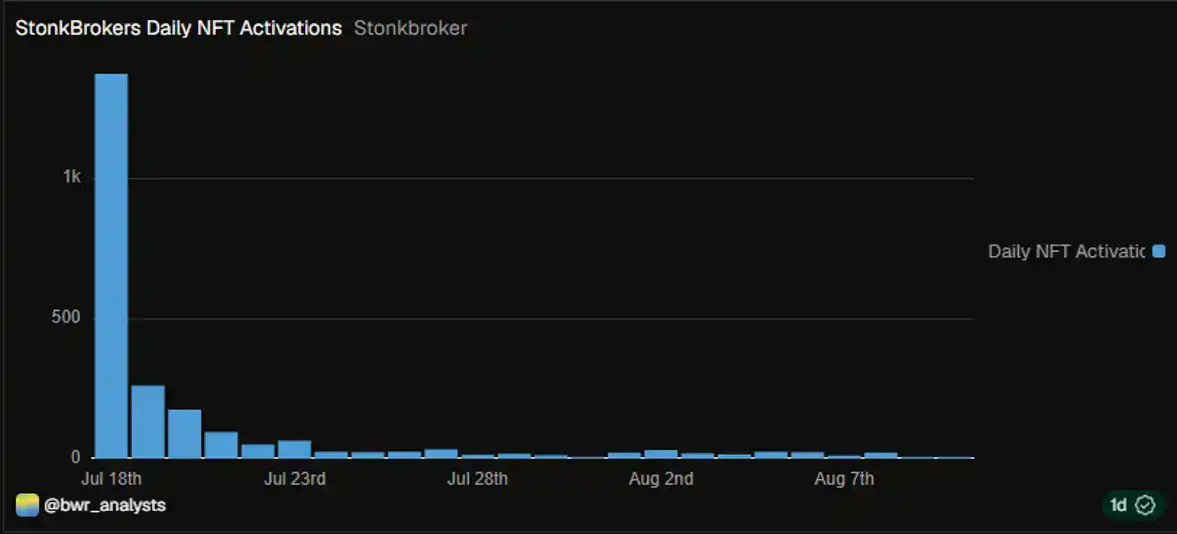
According to data from the official website cited in the article, StonkBroker NFT holders have received more than $620,000 in airdrop distributions to date. At the same time, the source notes that daily NFT activations have become scarce as meme-token prices have climbed to much higher levels.
There is technical experimentation, but current cash flow still depends on the flywheel
The article does not dismiss the project as technically empty. It points to the use of ERC-6551, with each NFT tied to its own wallet so that airdrops can be delivered directly into that address.
Even so, the source says almost all of StonkBroker’s current throughput still comes from the meme-token flywheel. That matters because the project has presented a broader roadmap including NFT lending, a Launchpad, and stock raffle blind boxes, yet those pieces have not become material revenue contributors so far.
The article compares that setup with other Robinhood chain projects, especially Pons. In that comparison, Pons’ token appreciation was tied to winning a share of Launchpad activity on the chain, which gave traders a way to value it against revenue and market share. StonkBroker, by contrast, has not yet launched its own Launchpad in a form that is producing this kind of business income.
Still, price strength can feed attention on its own. The source says traders are now watching to see what kind of new projects may emerge on top of StonkBroker. If those projects perform well, they could reinforce the core asset. The NFT layer adds another reason for speculation, because it revives the familiar “golden shovel” setup in which downstream assets reward holders of the parent asset.
Calling it the chain’s No. 2 may still be premature
The article stops short of calling StonkBroker a hollow meme-token shell. In fact, it argues that if the project has already rallied this far on the token layer alone, and if the market is willing to buy into stories that are not yet fully live, that says at least two things: the people organizing the project are capable, and the community still has a measure of stickiness for now.

Even so, the source says it is early to make a final No. 2 call. StonkBroker’s Launchpad is set to list a community-organized meme coin called CLOCKIN. Because “clock in” is the project’s official term for NFT holders claiming airdrop rewards, the token has already drawn broad attention. The source notes that scammers on X have been promoting paid insider Telegram groups while claiming they can provide the contract address in advance.
The article also draws a line between what is already visible on the platform and what has not gone live yet. Projects such as Mancer and Yard can already be seen under Special Project on the Launchpad page, but the source says that should not be read as proof that StonkBroker’s own native Launchpad is already operating. Those projects were launched through the NFT AMM structure the project had in place earlier, described in the article as closer to a multi-chain meme-token launch venue where users buy tokens in order to redeem NFTs.
Yard is used as an example. In that case, all NFTs were placed directly into the pool with no whitelist, and users who wanted the NFTs had to buy tokens on the market and swap into them. By contrast, the Launchpad described on StonkBroker’s website still resembles the familiar bonding-curve token launcher, and that product has not opened yet.
Even before that official rollout, projects such as Mancer and Yard appear to have benefited from the strong performance of StonkBroker’s main asset, receiving more attention and stronger market demand. The source says CLOCKIN will matter more. Its eventual performance could have a larger impact on what happens next for the main asset, though the direction is still uncertain.
The market will eventually judge execution and share
As more of the project’s planned features go live, the article says StonkBroker will have to be judged on two harder questions: whether it can keep generating wealth effects for market participants, and whether it can win real market share against similar products. If that expectation weakens, asset performance may weaken with it.
The article ends with two ways to frame the Robinhood chain “No. 2” debate. First, how far can CASHCAT go as the first in-house ecosystem asset listed by Robinhood itself. If CASHCAT cannot reach the kind of level WIF once reached on Solana, then looking for a “No. 2” may say more about a market narrative than about a proven hierarchy. Second, traders who remain constructive on StonkBroker may want to wait and watch how its derivative plays develop. The source warns that even the best “golden shovel” structures tend to decay as they are split into smaller and smaller downstream assets, which makes the balance between risk and upside harder to ignore.