
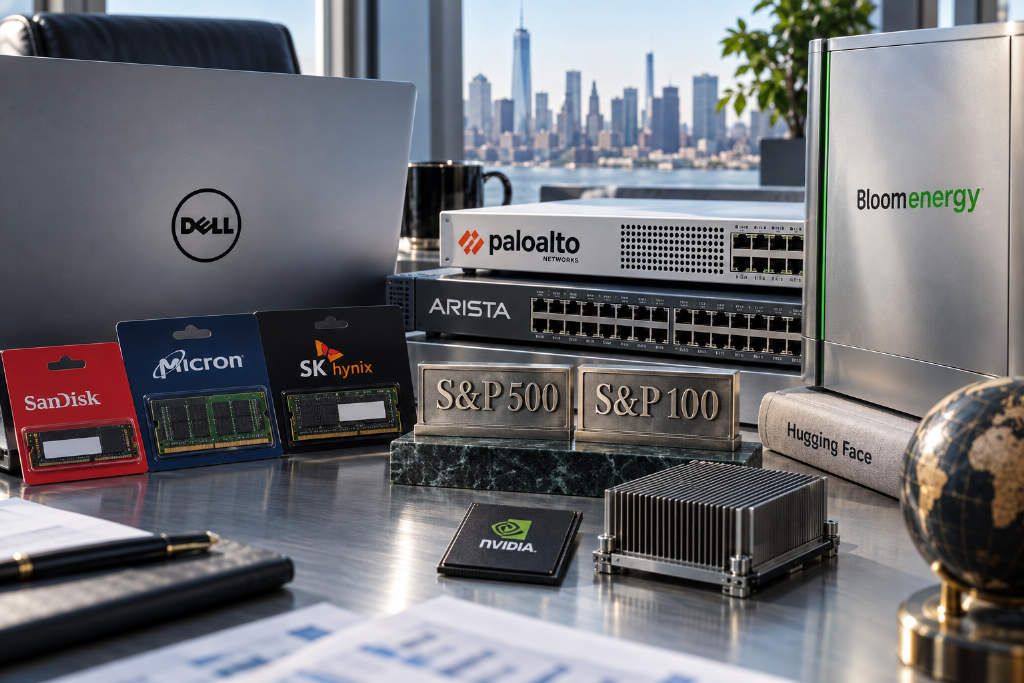
U.S. equities linked to memory chips and AI hardware outperformed in late trading last Friday. SanDisk surged 11.9% in a single session, SK Hynix rose more than 8%, and Micron Technology gained more than 6%. After the market closed, S&P Dow Jones Indices announced its quarterly constituent changes, adding Bloom Energy, Illumina and Everpure to the S&P 500, and adding Dell, Palo Alto Networks, Arista Networks and SanDisk to the S&P 100.
Bloom Energy stood out even before the index announcement. The stock had already climbed 7.35% intraday on strong earnings, then jumped another more than 5% after the inclusion news. With Nvidia’s latest acquisition, continued AI capital spending and expected passive fund rebalancing all landing at once, AI, semiconductors and cybersecurity became the main areas to watch ahead of the next U.S. session.
Nvidia’s Hugging Face deal put memory suppliers back in the spotlight
The article argues that the latest move in memory stocks was not driven by one headline alone. It ties the rally to three pressures building at the same time.
The first was Nvidia’s decision to push beyond raw compute and deeper into the AI development stack. On Sept. 3, Nvidia confirmed that it would acquire AI development platform Hugging Face for about $12.9 billion. Often described in the article as the “GitHub of AI,” the platform has gathered more than 18 million developers, while more than 200,000 companies use it to find, evaluate, customize and deploy AI models.
According to the report, Nvidia already holds an advantage in the compute market. What it is buying is not simply more exposure to model training, but a position earlier in the process that turns AI tools into actual use cases and revenue. Over the past few years, competition centered on model capability. A parallel race has been forming around what happens after a model is found: testing it, integrating it into business workflows and running it in production. The report says Hugging Face sits at that intersection.
It adds that what Nvidia is really acquiring is a layer of developer trust and usage habits built over time and not easily reproduced in the near term. Open models have lowered the barrier to enterprise AI adoption, but training and deployment still run through AI servers and data centers. That means demand flows not only to Nvidia GPUs, but also to companies such as SanDisk that supply high-bandwidth memory and high-capacity flash storage for model weights and data.
Against that setup, SanDisk rose 11.9% on the day to $1,740, bringing its gain for the year to more than 550%. U.S.-listed SK Hynix climbed 8.14%, Micron added 6.1%, and Intel rose 4.51%.
AI demand is reshaping memory supply
The second line of support in the article is a supply-side shift across the memory industry. To meet strong demand from AI servers and data centers for higher-margin products such as high-bandwidth memory, major manufacturers including Samsung, SK Hynix and Micron have continued to steer capacity toward enterprise and AI server product lines. The article says that has directly squeezed supply for consumer memory products.
That is one reason DRAM and NAND prices have remained elevated even as PC and smartphone demand softened. The report quotes Dell’s chief operating officer, who previously described the bottleneck this way: “DRAM, DRAM, DRAM, and then NAND, NAND, NAND.”
Citing industry data, the article says DRAM and NAND prices rose close to 60% quarter over quarter in the second quarter. The pace cooled in the third quarter, but prices are still expected to rise another 13% to 18% for DRAM and 10% to 15% for NAND.
The third point is that the shortage is being framed as structural rather than a one-off cyclical swing. Building advanced memory wafer capacity typically takes three to five years before it becomes effective output, the article says. In that context, institutions broadly view the current AI-driven shortage as something that cannot be eased quickly through fresh expansion.
That also explains why, in the article’s telling, SanDisk can still trade at only about 8 times forward earnings despite its huge stock move and still not be seen as expensive by people cited as authorities in the storage sector. The underlying support, the report argues, is a real supply-demand gap rather than pure speculative momentum.
Bloom Energy rallied on earnings, then got an S&P 500 boost
Among individual stocks, Bloom Energy drew some of the most attention. The hydrogen fuel-cell power company reported second-quarter revenue of $1.07 billion, up 166% from a year earlier. Adjusted EBITDA reached $253.4 million, far above Wall Street’s expectation of $149.4 million.
The report links that performance to rising power demand from AI data centers. It says all major hyperscale cloud providers in the United States, along with more than a dozen emerging cloud computing firms, AI labs and colocation operators, have validated and adopted Bloom’s fuel-cell power systems. The International Energy Agency data cited in the article shows AI data center electricity demand growing at 50%, compared with about 3% for total global power demand.
On the day of the earnings release, Bloom Energy rose 7.35% intraday to $252.87, lifting its market value to $74.48 billion, up 506.8% from an earlier level referenced in the report. After the close, S&P Dow Jones Indices said the company would join the S&P 500, and the shares gained another more than 5% in after-hours trading to $266.14.
Quarterly S&P changes favored chips, cloud hardware and cybersecurity
After the close on Sept. 4, S&P Dow Jones Indices released the third-quarter adjustment list for the S&P 500 index family. The article says the additions were concentrated in semiconductors, cloud hardware and cybersecurity, reflecting a shift in passive index weightings away from traditional consumer, real estate and industrial names and toward the AI infrastructure chain.
The new S&P 500 additions were:
- Bloom Energy, backed by 166% second-quarter revenue growth and a higher full-year outlook.
- Illumina, which raised its full-year revenue guidance in July and rose about 1% to 1.7% in after-hours trading after the inclusion announcement.
- Everpure, which beat earnings expectations and gained about 1.5% to 2.2% after hours.
The four new spots in the S&P 100 all went to technology companies tied to AI capital spending:
- Dell, up about 316% this year, the largest gain among the newly added names.
- Palo Alto Networks, up about 78% this year, outperforming the S&P 500’s roughly 12% gain by 66 percentage points.
- Arista Networks, up more than 40% this year, with switching products that serve as key infrastructure for connecting GPU clusters in AI data centers.
- SanDisk, up more than 550% this year, the strongest performer across the whole index adjustment set discussed in the report.
Names the article says are worth tracking
The report then singles out several newly added companies and lays out the details it says the market is still watching.
Palo Alto Networks
After the company reported better-than-expected fourth-quarter results on Sept. 1, Benchmark analyst Yi Fu Lee raised his price target to $400 from $340. The reason cited in the article is that AI infrastructure buildout is lifting demand for cybersecurity at the same time, with Palo Alto’s Prisma Cloud platform and its unified AI security platform Prisma AIRS showing strength.
At the same time, the article notes that Palo Alto Networks is trading at roughly 173.6 times earnings. Whether future results can keep validating the “AI security stack” thesis is presented as the key question from here.
Arista Networks
Arista, a switch supplier for GPU clusters in AI data centers, has gained more than 40% this year. The article says the average market price target is about $241, implying around 24% upside from the current share price, making it one of the names on the list where valuation digestion may still be incomplete.
Bloom Energy
Bloom management, citing industry data, said new global AI data center capacity is expected to reach 30 to 40 gigawatts by 2027, while Bloom has deployed only about 1.5 gigawatts of fuel-cell capacity so far.
The article also says the company has a $25 billion financing agreement with Brookfield and roughly $20 billion in backlog, including about $6 billion in product orders, up around 2.5 times year over year. Wall Street’s average target price is about $275, which the report says still implies some upside from the latest post-inclusion share price.
SanDisk
Even after a gain of more than 550% this year, SanDisk still trades at about 8 times forward earnings, according to the article. That remains below the broader valuation center for memory and AI hardware peers, leaving it in the category of stocks that have risen sharply without, in the report’s view, becoming obviously expensive.
Dell
Dell, one of the main AI server names in the group, has an AI order backlog of $95 billion and has converted $131.7 billion of AI demand over the past 12 months, the article says. Its inclusion in the index may matter less than the pace at which future quarterly AI server orders are actually delivered and recognized.
Index inclusion confirmed the theme, but earnings still matter most
Across the list, the companies map onto different parts of the AI chain: cybersecurity, data center networking, power infrastructure, storage chips and AI servers. The article’s conclusion is that index inclusion looks more like confirmation of an existing fundamentals-led move than the start of a new one. Whether these stocks keep outperforming will depend on whether quarterly results continue to match the market’s current expectations.