

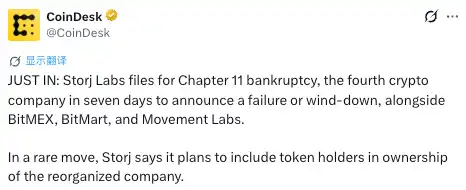
Storj Labs filed for Chapter 11 protection on July 26 in the U.S. Bankruptcy Court for the Northern District of West Virginia, opening case number 5:26-bk-00512. The decentralized cloud storage company also outlined an unusual restructuring idea: STORJ token holders may eventually be allowed to convert into equity holders of the reorganized entity.
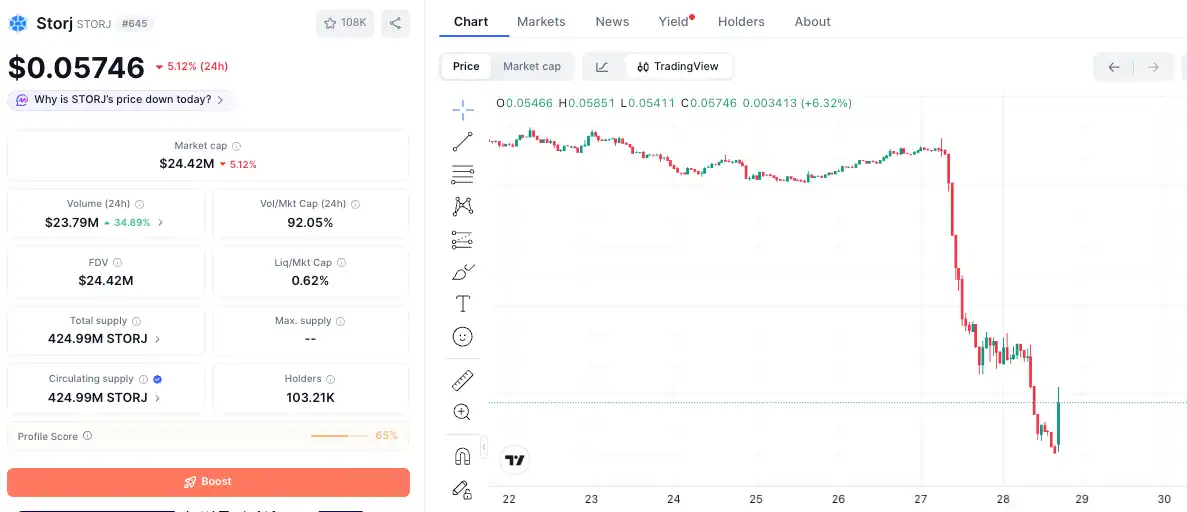
The filing quickly hit the token. Data cited in the report showed STORJ down about 16% over 24 hours to around $0.06. CoinDesk data, as cited in the article, put the token at roughly $0.062 as of July 27, with a market capitalization of about $28 million, below the $30 million mark.
Storj says legacy debt pushed it into court
Storj Labs was founded in 2014. According to the report, the company raised about $35 million over the past decade through equity financing, grants, and its 2017 token sale.
The company attributed the Chapter 11 filing to what it called legacy debt. Storj engineering director Kaloyan Raev said the business itself is operating normally and at a reasonable scale, but has been held back by financial burdens built up in earlier years. He described the Chapter 11 process as “a decisive, positive step.”
Storj said the network will continue operating during the bankruptcy process, STORJ token functionality will remain unchanged, and customer service will not be interrupted. Its core model remains a distributed storage network made up of independently operated nodes around the world rather than company-owned data centers. The STORJ token is used to pay node operators for storage and bandwidth.
Inveniam’s acquisition now moves through bankruptcy court
The bankruptcy filing comes less than a year after a change in ownership. In October last year, data infrastructure company Inveniam Capital Partners announced its acquisition of Storj Labs. Under that deal, Storj was set to continue operating independently as an Inveniam subsidiary, with existing customer, supplier, and community relationships left in place. Then-CEO Colby Winegar was to remain in charge, while executive chairman Ben Golub joined Inveniam’s board.
In the acquisition announcement, Inveniam CEO Patrick O'Meara said Storj’s technology was a key part of Inveniam’s mission and specifically mentioned plans to integrate the STORJ token into the Inveniam ecosystem.
Nine months later, that transaction is being carried forward through bankruptcy court. According to Cryptonomist, as cited in the report, Inveniam has expressed support for Storj’s restructuring process and has encouraged the company to refocus on its core distributed storage, compute, and file access businesses. In other words, the acquisition framework has not been abandoned, but is now being executed through a court-supervised restructuring route.
Non-core acquisitions are set to be sold
Storj also said it plans to divest assets tied to earlier non-core acquisitions.
In 2024, the company bought on-demand GPU supplier Valdi and PetaGene, the developer of the file access product cunoFS, in an effort to expand from storage into compute. Those businesses are now classified as non-core and are planned for sale, though the company has not disclosed a detailed asset list.
Token-to-equity proposal draws attention, but details are missing
The most closely watched piece of the restructuring proposal is the possibility that STORJ holders could receive equity in the reorganized company.
Storj said it plans to build a framework under which management, existing investors, community members, and STORJ token holders would jointly own the post-restructuring entity. If implemented, it would stand out as a rare token-to-equity structure in crypto.
For now, the proposal remains largely undefined. The report said no eligibility criteria, snapshot timing, lock-up period, or equity allocation ratio has been released. Any restructuring plan would still require creditor approval and final sign-off from the bankruptcy court. Holding STORJ today does not automatically grant any right to subscribe for equity.
Analysis under KuCoin, citing data from Foresight News, pointed to a possible conflict of interest. STORJ has a total supply of 425 million tokens, and about 30% of that supply, or roughly 130 million tokens, is still held by Storj Labs itself. If those company-held tokens are also included in any equity conversion, tensions could emerge between management and outside token holders.
Token trades near historic lows as Filecoin towers over the segment
STORJ is now trading close to historic low levels. CoinDesk data cited in the article showed the token at about $0.062 on July 27, down roughly 98% from its all-time high of $3.81 in March 2021. Market capitalization stood at around $28 million.
For comparison, the report said Filecoin, another project in decentralized storage, currently carries a market capitalization of about $607 million and has more than 1.8 EiB of network storage capacity, placing it at roughly 20 times Storj’s scale. Filecoin was also described as having formally launched its Onchain Cloud roadmap earlier this year, using the Filecoin Virtual Machine, or FVM, to enable automated data repair, perpetual renewals, and liquid staking tied to storage power.
Fourth crypto bankruptcy or shutdown case in a week
The report framed Storj’s filing as part of a wider washout across the industry. It said Storj was the fourth crypto company in the past week to announce a bankruptcy filing or shutdown-related move.
The three other cases listed were Movement Labs, which filed for Chapter 11 in Delaware on July 15 with assets between $100,000 and $500,000 and liabilities as high as $10 million; BitMEX, which announced on July 23 that it will permanently shut down on Sept. 23; and BitMart, which said on July 26 that it had begun winding down, with all trading to end on Aug. 26 and full platform operations to stop on Jan. 31, 2027.
Movement Labs had earlier come under pressure after transferring 5% of MOVE supply, about 66 million tokens, to market maker Rentech. The report said Rentech sold immediately after listing and made $38 million, damaging the project’s reputation. BitMEX, founded in 2014 by Arthur Hayes and known for pioneering perpetual futures, was said to have seen daily trading volume shrink to about $400,000.
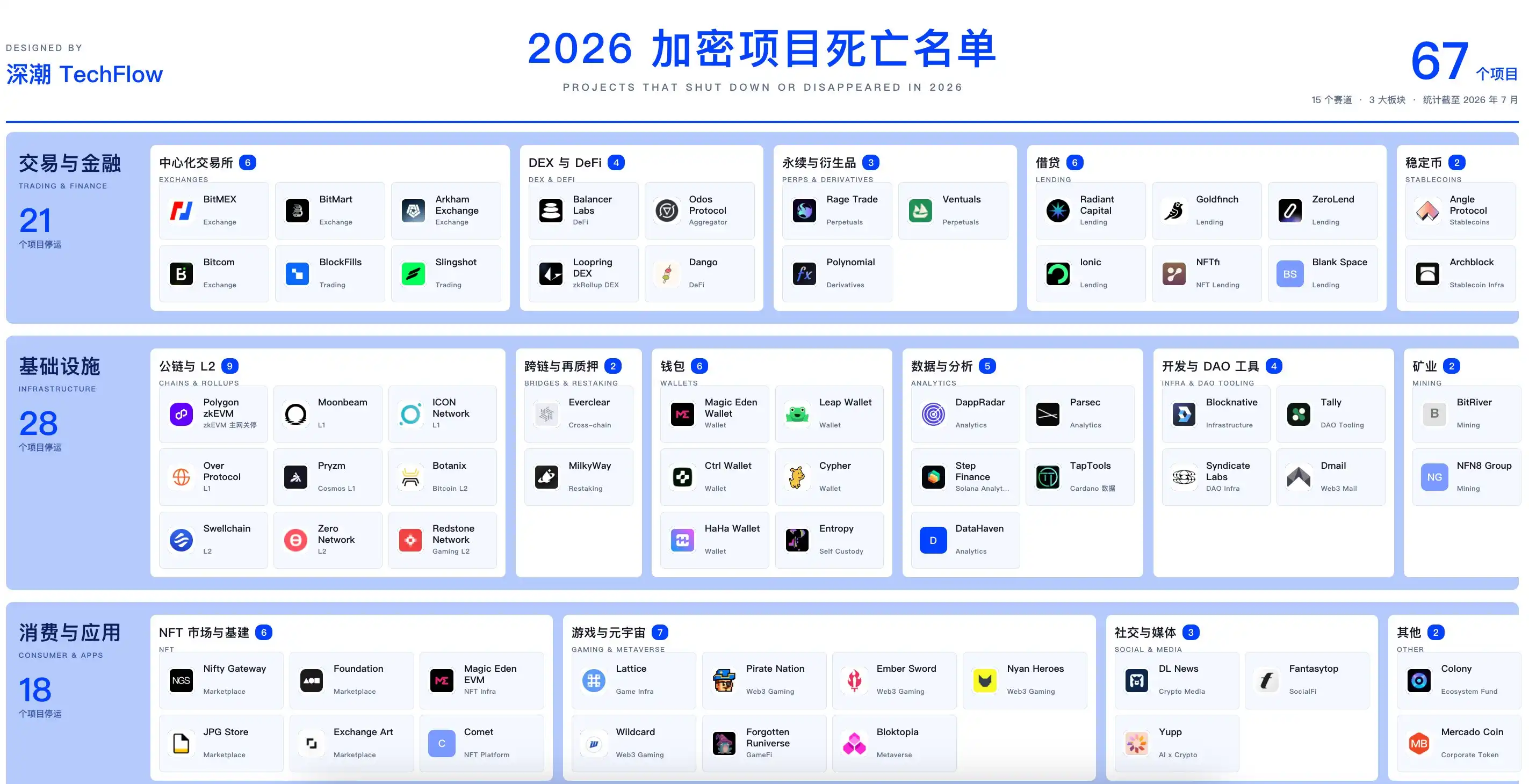
RootData data cited in the article showed about 99 crypto projects had shut down or announced shutdown plans so far in 2026. The report also mentioned a separate incomplete editorial tally of 67 closures this year across multiple verticals. RootData’s count covered exchanges, Layer 1s, Layer 2s, DeFi protocols, wallets, and other categories.
Funding contraction adds pressure as creditors hold the key
Funding conditions have tightened at the same time. Galaxy Digital Research data cited in the report showed blockchain and digital asset startups raised $4 billion in the first quarter of 2026, down 50% from the previous quarter. The article added that 57% of that capital went to projects with already proven traction.
Moonrock Capital founder Simon Dedic said the mid-sized exchange model has a “fatal flaw” because it depends on a steady influx of new users. Once growth stalls, he said, the model breaks down.
The report said Storj’s situation is not identical to that of exchanges, but the underlying pressure looks similar. In decentralized storage, concentration at the top is becoming more pronounced, leaving less room for smaller players. Inveniam’s backing gives Storj a path that differs from many other bankruptcy cases, but whether the restructuring works will depend on creditor support and on whether token holders end up with an equity package that carries real value.