

Strategy’s basic multiple-to-net-asset-value, or mNAV, has dropped by two-thirds over the past two years, falling from 2x to 0.68x, according to Protos.
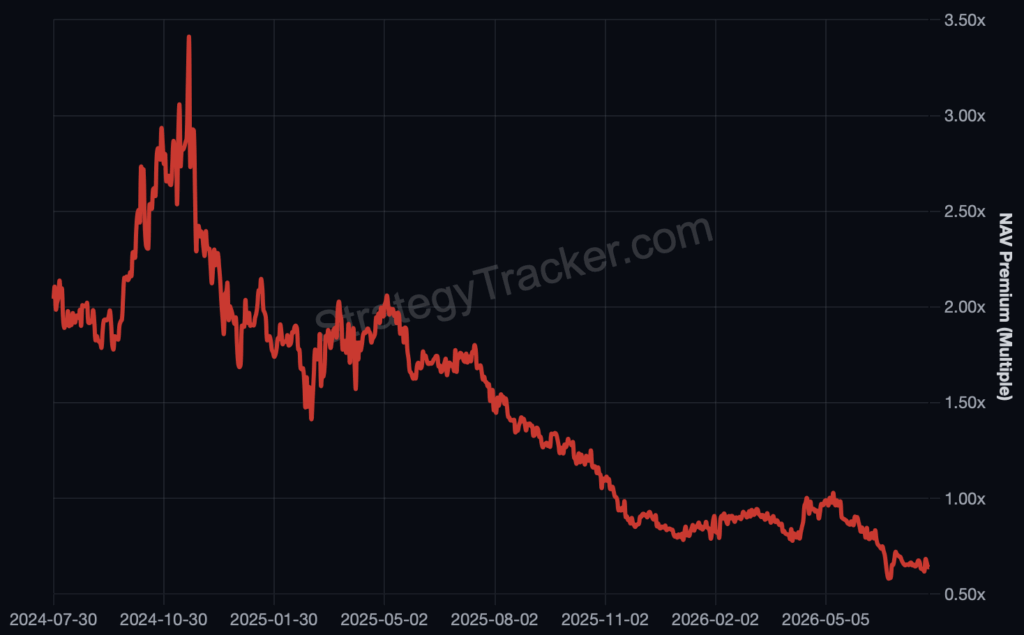
Exactly 24 months ago, Strategy common stock traded at twice the value of the bitcoin it held. In practical terms, for every $1 of BTC on the balance sheet, MSTR traded at $2. Protos says that in 2024 investors were optimistic that Michael Saylor’s company could accrete BTC for shareholders through successful business operations. By this measure, that optimism has now fallen by two-thirds.
Premium to bitcoin holdings has turned into a discount
The report cites data covering July 30, 2024 to July 29, 2026 from StrategyTracker.com. Strategy now holds 843,775 BTC at an average cost of $75,476, a level Protos describes as uncomfortably above the current market price below $65,000.
For most of the past two years, the company’s shares traded at a premium to that bitcoin stack. Once that premium flipped into a discount, Strategy changed the meaning of mNAV twice in an effort to keep the figure above 1x. Its latest version was at 1.03x yesterday, the report says.
Protos also points to a July 23, 2026 post from Strategy, in which the company said new and updated market metrics were live. Strategy wrote that as Digital Credit becomes a larger part of its balance sheet, it had sharpened its precision based on investor feedback.
Three versions of mNAV
Protos describes the original basic mNAV as a simple calculation: divide the company’s market capitalization by the dollar value of its BTC. A figure above 1x means investors are paying more for the stock than for the bitcoin. A figure below 1x means they are paying less.
BitcoinTreasuries.net, which still uses that original approach, puts Strategy’s basic mNAV at 0.64x.
The company’s first redefinition was an enterprise value mNAV. Under that version, debt and preferred stock were added to the numerator alongside the market capitalization of MSTR common stock. Protos says that adjustment kept the metric above 1x well after the basic calculation had already fallen below that level, and it did not cross under 1x until late June 2026.
A second revision arrived in July. Strategy’s dashboard now starts with a reserve of about $57.7 billion in BTC plus dollars, subtracts $6.8 billion of debt and $15.4 billion of preferred stock, and labels the remaining $35.5 billion as a net reserve. It then divides that amount by the share count and compares the result with a share price of $95.32, producing a multiple of 1.04x.
Redefinitions did not stop the stock from falling
Saylor defended the overhaul by saying that “Bitcoin capital markets require a new financial language.” Strategy CEO Phong Le, according to Protos, said the upgraded metric “establishes a 1x threshold for accretive MSTR issuance.”
The report argues that the new definition also breaks comparability with the company’s earlier records. Strategy’s glossary says, “Prior to July 23, 2026, the company’s use of the term mNAV referred to a different metric so references to the company’s mNAV calculated prior to that date are not comparable to the company’s mNAV calculated after that date.” By the company’s own description, every mNAV figure Saylor posted before this month cannot be compared with the version now shown on Strategy’s website.

The same page also states that despite the label, the metric “is not equivalent to ‘net asset value’ or ‘NAV’ or any similar metric in the traditional financial context,” and should be used “only by sophisticated investors who understand its limited purpose and many limitations.” Protos adds that Saylor himself spent seven minutes defining the old mNAV on stage at BTC Prague in June.
Earlier shareholder promise and current share performance
Protos says Strategy briefly told shareholders in July 2025 that it would not dilute MSTR holders below 2.5x mNAV, but later sold $14.3 billion of stock below that level anyway.
By Wednesday, the basic mNAV was down to 0.68x, and the version of the metric that produced both of those figures is no longer the company’s official standard.
What shareholders cannot redefine is the share price itself. Protos says MSTR is down 38% year to date and 76% over the past 12 months.
