

Bitcoin rose 13% last week, reclaimed $70,000 within five trading days for the first time since June, and was back above $78,000 by Monday. During that rebound, Strategy, the world’s largest corporate Bitcoin buyer, did not purchase a single coin.
It chose a different move. The company sold 18.26 million common shares, raised about $2 billion, and converted the proceeds into U.S. dollars. As of Aug. 23, Strategy’s total dollar liquidity stood at $6.69 billion.
$2 billion was routed into two cash pools
The fresh capital did not go straight into Bitcoin.
Strategy directed $300 million into its USD Reserve account, a dedicated pool created in June. That account can only be used to pay preferred stock dividends and debt interest unless the board approves another use. After the transfer, the reserve balance reached $5.1 billion.
The company used another $136.4 million to repurchase 1.43 million shares of STRC preferred stock.
The remaining funds went into a newly created account called USD Cash, which now holds $1.59 billion. That pool is broader in scope. It can be used to buy Bitcoin, repurchase common or preferred shares, repay convertible notes, replenish the USD Reserve account, or cover other corporate purposes.
Strategy said the added flexibility would allow management to respond faster to market dislocations, including cases where Bitcoin or the company’s own securities trade at prices it views as misaligned.
Bitcoin holdings were unchanged for a second straight week
The same filing showed that Strategy neither bought nor sold any Bitcoin in the week ended Aug. 23. Its holdings stayed at 840,447 BTC for a second consecutive week. According to the timeline in the report, the company has not bought any Bitcoin since the week of June 22.
That stands out because Strategy built its identity around turning balance-sheet capital into Bitcoin as quickly as possible. Michael Saylor has spent years arguing that holding cash is like holding a melting ice cube. Now the company has two labeled dollar pools totaling $6.69 billion.
The cost basis is back at the center of the discussion
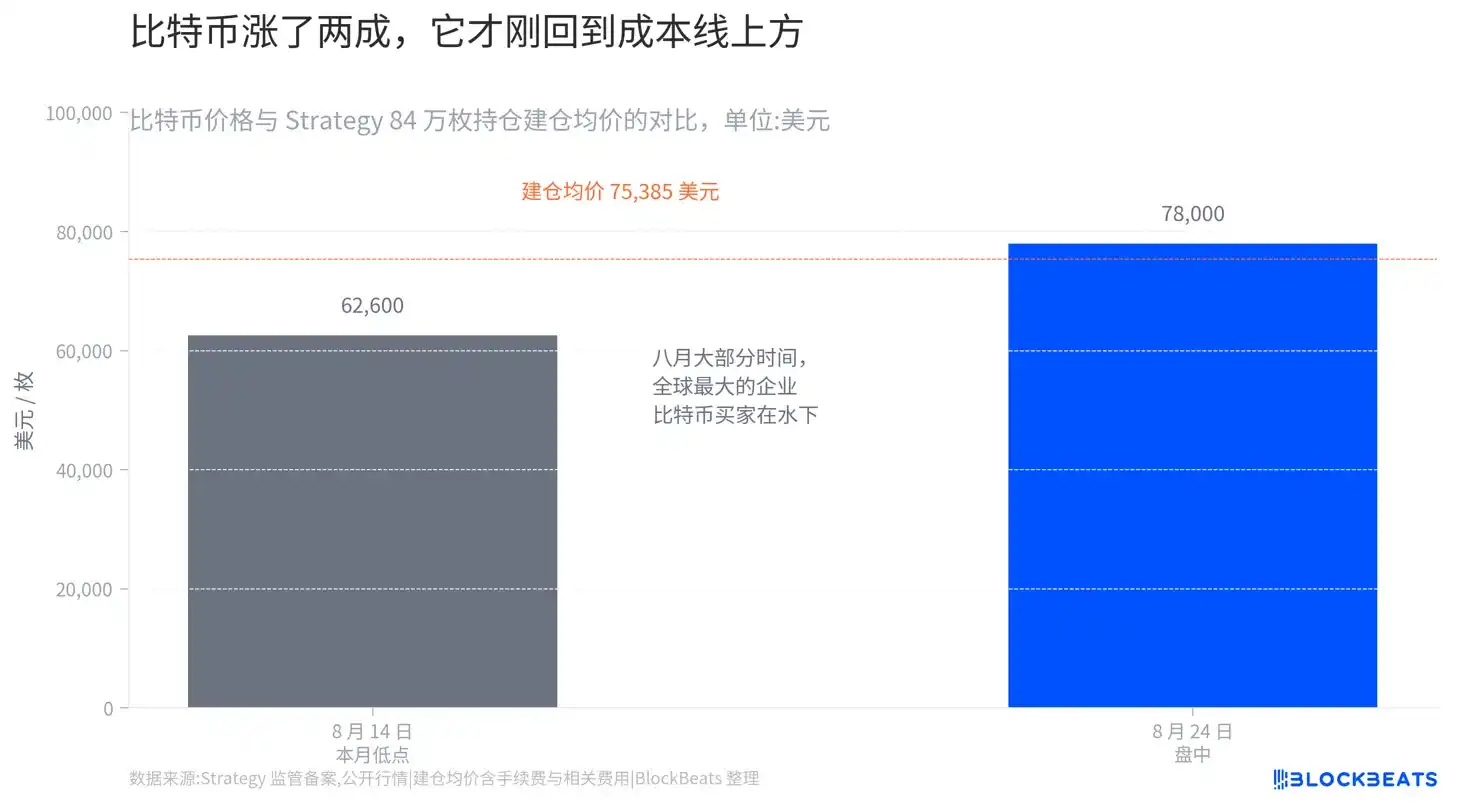
Strategy’s 840,447 BTC were acquired for a total of $63.36 billion, or an average of $75,385 per Bitcoin, including fees and related costs.
On Aug. 14, when Bitcoin fell to $62,600, the company’s unrealized loss on those holdings reportedly reached as much as $8.2 billion. Only after last week’s recovery to the $78,000 area did Strategy move back above its aggregate cost basis, with unrealized gains of about $1.4 billion.
Paper losses can wait. Dividend and interest payments cannot. That gap helps explain why cash has become important again.
STRC remains below par as buybacks continue
Strategy’s STRC preferred stock carries a 12% annual dividend and a $100 par value. The article frames it as a high-yield IOU issued by the company, with market confidence visible in the trading price.
STRC traded below par throughout the summer. Earlier in August, Chief Executive Officer Phong Le said the company would keep the 12% dividend unchanged and that its goal was for STRC to remain in a $99 to $100 range over the long term.
If Strategy wants to support that range, it needs to buy shares back. The question is where the cash comes from when Bitcoin is under pressure and the company’s equity is not offering much relief.
A June capital framework changed the playbook
The answer traces back to a new capital management framework adopted in June. For the first time, it allowed Strategy to sell Bitcoin in order to repurchase preferred shares trading below par.
On Aug. 3, the company sold 1,638 BTC and raised $104.73 million. By Aug. 5, cumulative sales had reached 5,226 BTC, producing $321 million, and Strategy had used that process to repurchase $106 million of STRC. On Aug. 17, it raised another $334 million through an equity sale, also for preferred buybacks.
The latest $2 billion common-stock offering is a larger version of the same capital rotation. So far, Strategy has used about $483.4 million of its $1 billion preferred buyback program, leaving $516.6 million available. A separate $1 billion authorization for common share repurchases remains untouched.
The old financing flywheel has weakened
For years, investors described Strategy’s model as a flywheel: issue stock, buy Bitcoin, benefit as Bitcoin rises, watch the stock outperform Bitcoin, sell more equity at a rich premium, then buy even more Bitcoin.
That system depended on valuation premium, the amount the market was willing to pay above the value of the company’s Bitcoin holdings.
That premium has now faded. The article says MSTR is down about 66% over the past year. Bloomberg’s wording is that the financing flywheel "remains impaired, with valuation premiums well below levels seen in prior cycles." Once the premium shrinks, issuing stock looks less like cheap leverage on Bitcoin and more like straightforward dilution.
Nicolai Sondergaard, a senior research analyst at Nansen, summed it up this way: 「For MSTR shareholders, the trade-off is dilution for flexibility. This latest equity issuance strengthens the balance sheet but does not immediately increase Bitcoin exposure per share.」
He gave a similarly restrained assessment of the new cash vehicle: 「The new USD Cash pool gives Strategy more time and optionality, but it does not remove the underlying obligations.」
In plain terms, dividends still have to be paid, interest still has to be paid, and convertible debt still has to be repaid when due. Cash buys time, not release.
MSCI consultation added another source of pressure
In mid-August, index provider MSCI launched a consultation proposing to remove "non-operating companies" from its global investable market indexes. The screen would use a two-step process based on operating asset mix and five financial metrics. Under that approach, Strategy, Japan’s Metaplanet, and uranium holder Yellow Cake could all be affected.
For a company with meaningful passive ownership, index removal would mean forced selling from funds that do not care about price. MSTR fell 4.3% on the day the news emerged.
Strategy pushed back sharply, saying an index provider’s job is to measure markets, not decide which assets a company is allowed to hold.
Bitcoin recovered, but dollars became the flexible asset
The article links the latest Bitcoin rally to two clear drivers: Donald Trump urging Congress to pass legislation for digital assets, and the U.S. Treasury doubling the scale of long-dated Treasury buybacks, a move that pushed yields lower. Lower yields gave risk assets room to recover.
As prices improved, Strategy’s mark-to-market position swung from unrealized loss back to unrealized gain. In early trading Monday, MSTR rose as much as 3% to $122.79, while STRC traded at $96.49, still more than $3 below the range Phong Le said the company wants to maintain.
Yet Strategy’s main action during the week was not another Bitcoin purchase. It raised $2 billion, turned it into dollars, and parked the money in two cash pools.
For a company that long treated cash as a melting ice cube, the dollar is now one of the most flexible tools on its balance sheet.