

The crypto market’s most steadfast holder has blinked. Strategy (formerly MicroStrategy), the self-styled “DAT first stock” and largest corporate Bitcoin accumulator, disclosed last week that it sold 32 BTC at an average price of $77,135, netting $2.5 million. This marks the first time in three years—since the aftermath of FTX in late 2022—that Strategy has become a net seller of Bitcoin, ending its legendary streak of continuous buying.
The news immediately rattled an already fragile market. Bitcoin broke below $71,000 overnight, last trading around $70,560. At the U.S. stock close, crypto-exposed equities saw broad losses: Bullish dropped 7.99%, DeFi Development fell 7.97%, Circle slid 7.11%, Strategy itself sank 5.85%, and Upexi declined 5.04%. With major exchanges aggressively expanding into U.S. stock trading hours and liquidity tightening across the board, Strategy’s sell-off only deepened the market’s distress.

This is not, however, Strategy’s first-ever Bitcoin sale. In the depths of the crypto winter that followed FTX’s collapse, on December 22, 2022, the company sold 704 BTC at an average price of $16,776. Just two days later, it bought back 810 BTC at $16,845, effectively repositioning at a lower cost basis. The current sale is fundamentally different: its primary purpose is to service the preferred dividend on Strategy’s fixed-income digital credit instrument, STRC.

STRC is Strategy’s flagship funding product, designed as a fixed-income digital credit instrument. After a $1.5 billion convertible debt buyback last month, the company’s cash reserves dwindled to approximately $871 million—enough to cover only about six months of its anticipated $1.7 billion annual preferred dividend obligation. On May 29, STRC briefly dipped to $97.11 before recovering to close at $98.57, reflecting the market’s growing concern over the company’s ability to meet its near-term commitments.

The financial strain was already signaled in Strategy’s first-quarter earnings. The report explicitly warned: “If convertible notes mature or are redeemed without conversion into common stock, the company may need to sell common stock or Bitcoin to generate sufficient cash to satisfy these obligations.” In Q1, the company posted a staggering net loss of $12.54 billion, almost entirely driven by a non-cash impairment on its Bitcoin holdings worth $14.46 billion. At the end of Q1, its 818,334 BTC carried a total cost basis of $61.81 billion, implying an average entry price of roughly $75,537.
From a corporate treasury perspective, the sale is entirely rational, and founder Michael Saylor had previously stated, “Even if we sell 1 BTC, we will buy 10 to 20 times more.” Selling, in his framework, is merely a precursor to buying more. Yet on an industry-wide level, this move effectively pronounced a temporary end to the “infinite HODL” narrative, dealing a severe blow to market confidence and buying momentum. After the sale, Strategy still holds 843,706 BTC valued at approximately $60.94 billion, with an average cost of $75,699 and a floating loss of $2.93 billion. Crucially, just a month earlier—when the market briefly rebounded—its position had been sitting on an $8.2 billion unrealized gain. Ironically, on May 28, Saylor published an article titled “HODL” (Hold On for Dear Life) urging the market to stay the course.

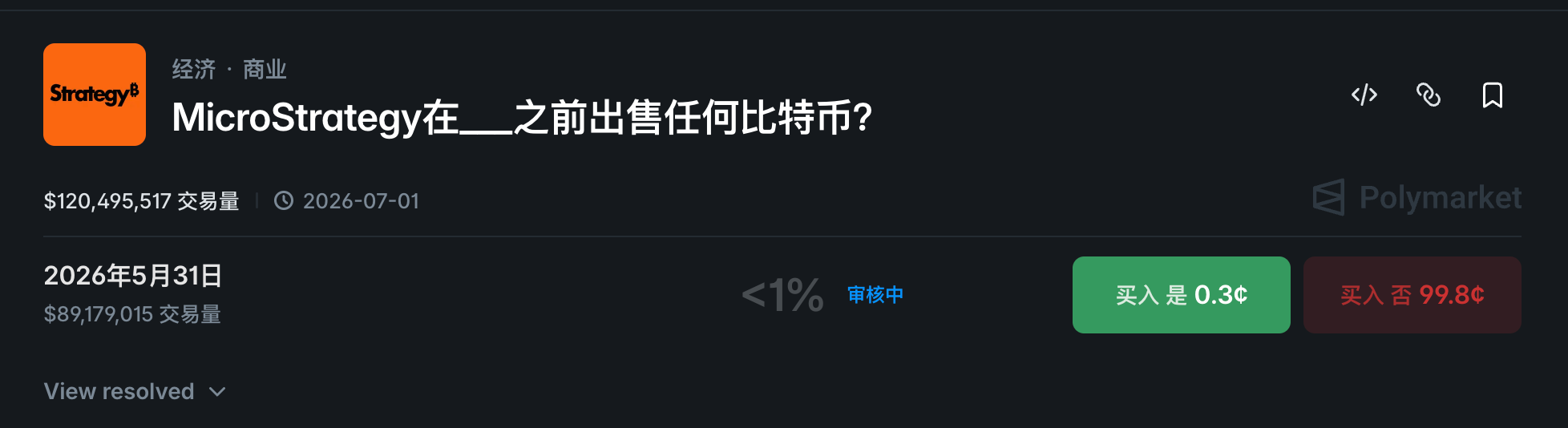
Adding a layer of farce to the sale, the prediction market Polymarket witnessed a dramatic dispute over event resolution. Prior to the sale, the odds of “Strategy sells BTC before May 31” stood at just 40%. As May drew to a close, the probability spiked from 12% to 80% on June 1 before retreating to 58%, with cumulative trading volume surpassing $16.4 million. Because Strategy had not issued an official sale notice in time, the market ultimately resolved as “Strategy did not sell BTC in May,” once again proving that prediction markets trade on rule-defined events rather than the underlying truth.

The sale drew sharp criticism. Economist, gold advocate, and longtime crypto skeptic Peter Schiff declared it a signal that Strategy was pivoting from “biggest Bitcoin buyer” to seller, questioning where incremental demand could now come from. Billionaire investor Mark Cuban, who once called Bitcoin “a better version of gold,” disclosed that he has sold most of his Bitcoin holdings, citing dwindling confidence in BTC as a hedge against currency debasement and geopolitical risk. JPMorgan, in a recent analysis, noted that the “debasement trade” in gold and Bitcoin is heating up as investors exit safe-haven assets.

With prices under relentless pressure, perhaps Bitcoin and the broader crypto market can only wait for the Trump administration to “love crypto one more time.” But as the most iconic diamond hands start to loosen their grip, the cracks in the market’s once-implicit faith have become impossible to ignore.