
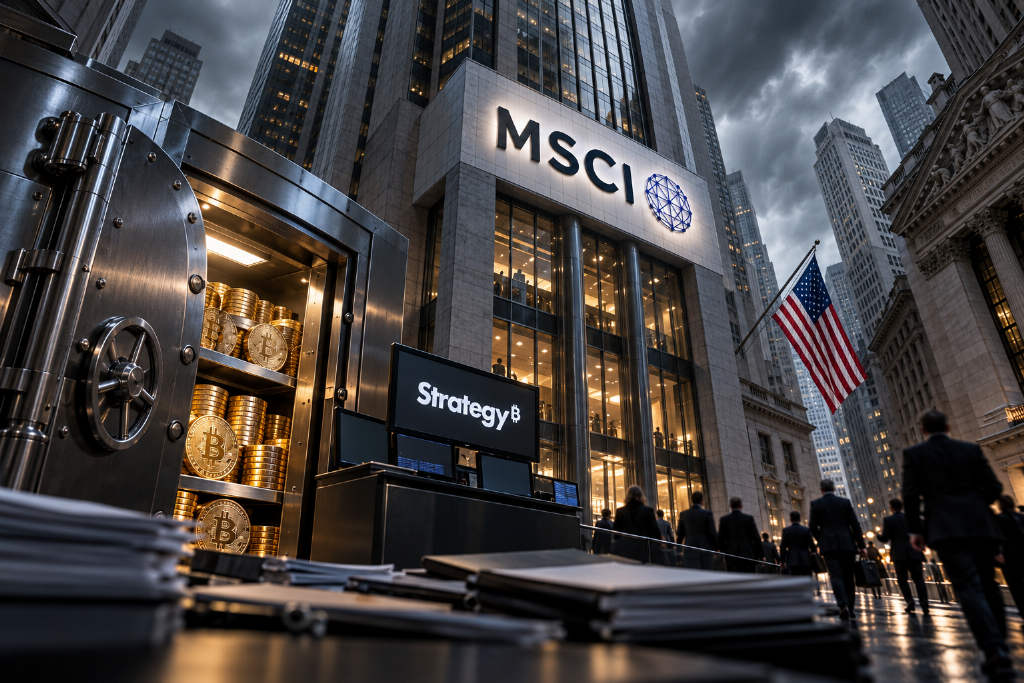
Strategy is heading into a key MSCI decision on Nov. 11, when the index provider is expected to publish the latest constituent screening results. For the company that has branded itself as a Bitcoin treasury, the question is simple: can it stay in MSCI’s global equity indexes? If not, any removal would take effect after the U.S. stock market closes on Nov. 30.
The stakes go well beyond index membership. JPMorgan estimated in 2025 that removing Strategy from MSCI indexes could trigger as much as $2.8 billion in passive selling of the stock, according to Bloomberg. Bloomberg also reported that if other major index providers were to make similar moves, total potential selling could climb to $8.8 billion.
Strategy, one of the largest public corporate holders of Bitcoin, built its model around issuing stock and convertible debt to accumulate more BTC. That structure depends heavily on continued access to equity-market demand and financing channels. Now it is facing closer scrutiny from a major index compiler over whether companies without substantial operating assets should remain in benchmark indexes.
MSCI’s new rules took effect on Oct. 15
MSCI formally adopted its updated constituent eligibility rules on Oct. 15. Under the new framework, the firm first examines whether a company has substantial operating assets. If it fails that initial screen, it then faces five financial ratio tests. Failing at least four of those tests can lead to a loss of eligibility.
For companies already in an index, the process is not based on a single filing. MSCI’s rules say a constituent would face removal only if it fails the screen in the annual reporting periods of the two most recent consecutive fiscal years. MSCI may also take a company’s latest interim financial report into account.
Strategy has not been definitively removed. That decision is still pending.
TradingView reported that MSCI had identified Strategy, Metaplanet, and Upexi as potential removal candidates under its methodology for non-operating companies. Sharplink, Ton Strategy Company, Solana Company, and DeFi Development Corp. were also placed on a watchlist of companies that could be removed.
Why passive flows matter so much
For shareholders, the central issue is not the label itself. It is what an exclusion would do to demand for the stock and to the company’s future financing options.
Bloomberg reported that JPMorgan estimated in 2025 that an MSCI exclusion could lead to as much as $2.8 billion in concentrated passive selling of Strategy shares. Bloomberg added that the figure could rise to $8.8 billion if other mainstream index providers followed with similar exclusions.
Those estimates refer to passive selling pressure in the secondary market for Strategy stock. They do not mean the company would be forced to sell its Bitcoin reserves.
Index inclusion is a major source of structural demand for listed companies. Passive funds that track benchmark indexes must buy constituent stocks according to index weights, and they must sell when a company is removed. If Strategy is excluded, funds tracking the relevant MSCI Global Investable Market Indexes would have to rebalance out of the stock.
Brian Dobson, director of disruptive technology research at Clear Street, told Bloomberg that index inclusion is critical for companies like Strategy because it creates a steady stream of buying. That includes weekly 401(k) retirement contributions from millions of ordinary investors and passive allocations from mutual funds.
Dobson said that once a company is removed, investors and funds tracking the index have to sell their holdings, creating heavy short-term pressure on the share price.
The issue is not limited to Strategy. Tokyo-based Metaplanet, another listed company using a similar Bitcoin treasury approach, could also be affected.
A bigger question: future fundraising
The deeper concern for Strategy is what happens to its ability to raise capital if it loses index status.
The company has typically funded Bitcoin purchases through common stock issuance, preferred stock, convertible bonds, and other financing tools. Its better-known preferred securities include STRC and STRK.
Crypto research firm ZEROBASE wrote on X that passive investment flows have already become a key pillar supporting demand for Bitcoin treasury stocks. If other index providers also shut the door on companies whose core business is accumulating Bitcoin, an MSCI removal could set off a much broader chain reaction for Strategy and similar firms.
Bloomberg reported that Strategy is already seeing weaker demand in parts of its securities issuance pipeline. The company had faced a similar blow to confidence last year when it was not added to the S&P 500.
Earlier in its development, Chairman Michael Saylor was able to expand the company’s asset base by selling common stock at a premium, meaning the share price traded well above the net asset value of the crypto it held. Later, as concerns about equity dilution grew, that premium narrowed sharply, pushing the company to rely more on preferred stock for financing.
Bloomberg reported that investor appetite for those preferred securities has also been fading.
Alexander Blume, chief executive of Bitcoin-focused asset manager Two Prime, told Bloomberg that it is becoming much harder for Strategy to keep selling equity and maintain the financing flywheel that supports continued Bitcoin purchases.
Blume also said he was not surprised that some mainstream index providers may not want their clients exposed to such extreme volatility, because digital-asset treasury companies are often not viewed in traditional finance as true operating businesses.
Preferred dividend changes do not affect the MSCI decision
On Oct. 28, Strategy said preliminary voting results showed shareholders had approved charter amendments allowing daily dividends for four series of preferred stock.
Once the amended terms are formally filed and take effect, the new dividend mechanism will begin with STRC on Nov. 1 and will extend to STRF, STRK, and STRD on Jan. 1, 2027.
That shareholder vote changes only the dividend schedule for preferred shares. It does not influence MSCI’s pending index decision.
Nov. 11 is the next major date
MSCI is expected to publish the list of companies affected by the new classification rules on Nov. 11, with final index changes scheduled to be implemented on Nov. 30, 2026.
For now, Strategy’s removal is not final. The real financial impact will depend on MSCI’s classification outcome and on how passive investors tracking the indexes actually rebalance.
Michael Saylor has tried to play down the risk. In an October interview with Bloomberg Television, he said the amount of capital MSCI actually controls is 「de minimis」 and accused the firm of 「imposing biased values on digital assets」. Bloomberg also quoted him describing the potential decision as a 「value judgment」 that would set a bad precedent.
The November announcement is likely to answer a broader question hanging over the market: whether Strategy and other Bitcoin treasury companies can remain inside widely followed global equity benchmarks, and what that means for their ability to keep raising money and buying more Bitcoin.




