

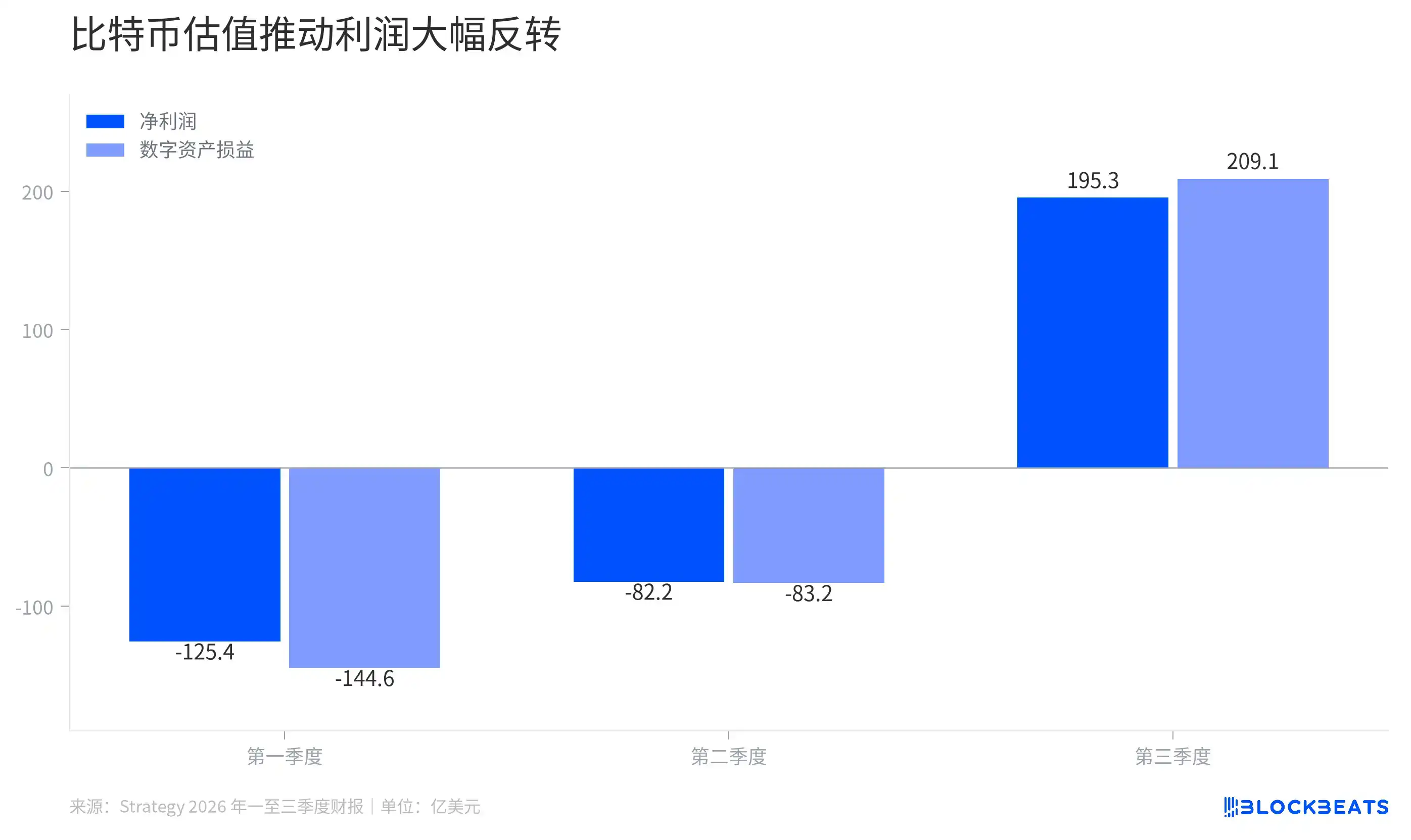
Bitcoin’s rise reshaped Strategy’s income statement in the third quarter. In results released on Oct. 29, the Bitcoin treasury company reported net income of $19.53 billion, reversing the string of losses it posted in the first half of the year. At the same time, another figure in the filing pointed in a different direction: as of Oct. 25, Strategy’s year-to-date BTC Yield had fallen into negative territory.
That leaves the company with more Bitcoin on its balance sheet, but less Bitcoin per share under its own definition. Profit, total holdings and shareholder exposure are telling three different stories in the same set of results.
Digital asset gains drove the quarter
According to Strategy’s third-quarter report, the company recognized $20.91 billion in digital asset gains during the quarter. That figure was nearly equal to operating profit and explains why the income statement swung from losses in the first half to a large profit.
The quarterly profit figure and digital asset gains should not be added together. The digital asset line is already included in operating results, while net income reflects that result after other income, expenses and taxes. The fact that the two numbers sit so close to each other shows how much Bitcoin valuation changes can dominate Strategy’s quarterly performance.
The volatility comes from accounting treatment. As stated in Strategy’s second-quarter report, the company measures Bitcoin at fair value and records changes in value during the reporting period through profit and loss. A rise in Bitcoin’s price can create accounting gains, while a decline can push losses into the income statement, even if the company has not sold all of its holdings.
By contrast, revenue from software and related operations came to $125.4 million in the third quarter, down 3% year over year. Put next to digital asset gains, that revenue looks like the company’s recurring operating business, while the other line reflects changes in asset prices. They are not the same kind of earnings.
A large net profit also does not mean cash came in at the same scale. Strategy still has to pay preferred dividends and debt interest in cash, and mark-to-market gains from a higher Bitcoin price do not automatically turn into dollars in the bank.
More Bitcoin held, but less on a per-share basis
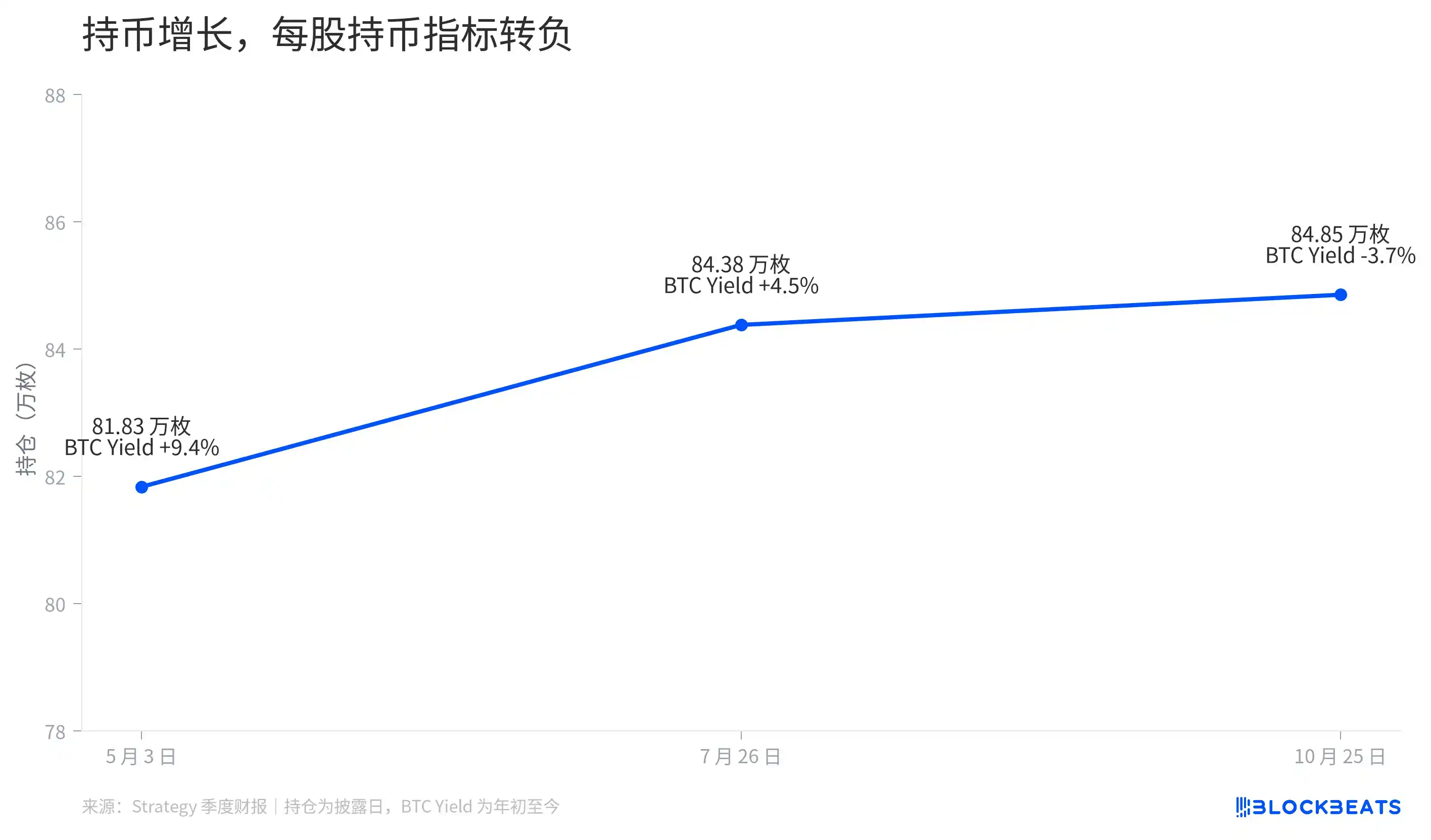
As of Oct. 25, Strategy held about 848,500 BTC, up 26% from the start of the year. That describes the change in total holdings. Shareholders, though, also need to look at another denominator: the number of shares the company has issued or could issue.
Strategy uses BTC Yield to measure the change in Bitcoin holdings relative to assumed diluted shares outstanding. One way to think about it is as a growing cake: even if the cake gets bigger, each slice can still shrink if the number of slices grows faster.
The company’s year-to-date BTC Yield moved from a positive reading disclosed in the first-quarter report to -3.7% in the latest filing. That means the amount of Bitcoin tied to each share, based on Strategy’s assumed diluted share count, fell from the beginning of the year. It does not mean Bitcoin itself fell by 3.7%, and it is not the same as the investment return on MSTR stock. Strategy disclosed the two reference points in its first-quarter and third-quarter reports.
The metric also has limits. Strategy said in the filing that BTC Yield does not fully account for debt and for the senior claims of some preferred stockholders. Financing Bitcoin purchases can lift a per-share Bitcoin metric while also increasing claims or dividend obligations that rank ahead of common equity. One metric alone cannot replace a full reading of the balance sheet.
Cash support comes from dollar assets and some Bitcoin sales
Strategy’s financing stack goes beyond common stock. The company has issued multiple preferred shares that require ongoing dividend payments. It has also been repurchasing the floating-rate preferred stock STRC to support trading near its $100 per-share stated amount.
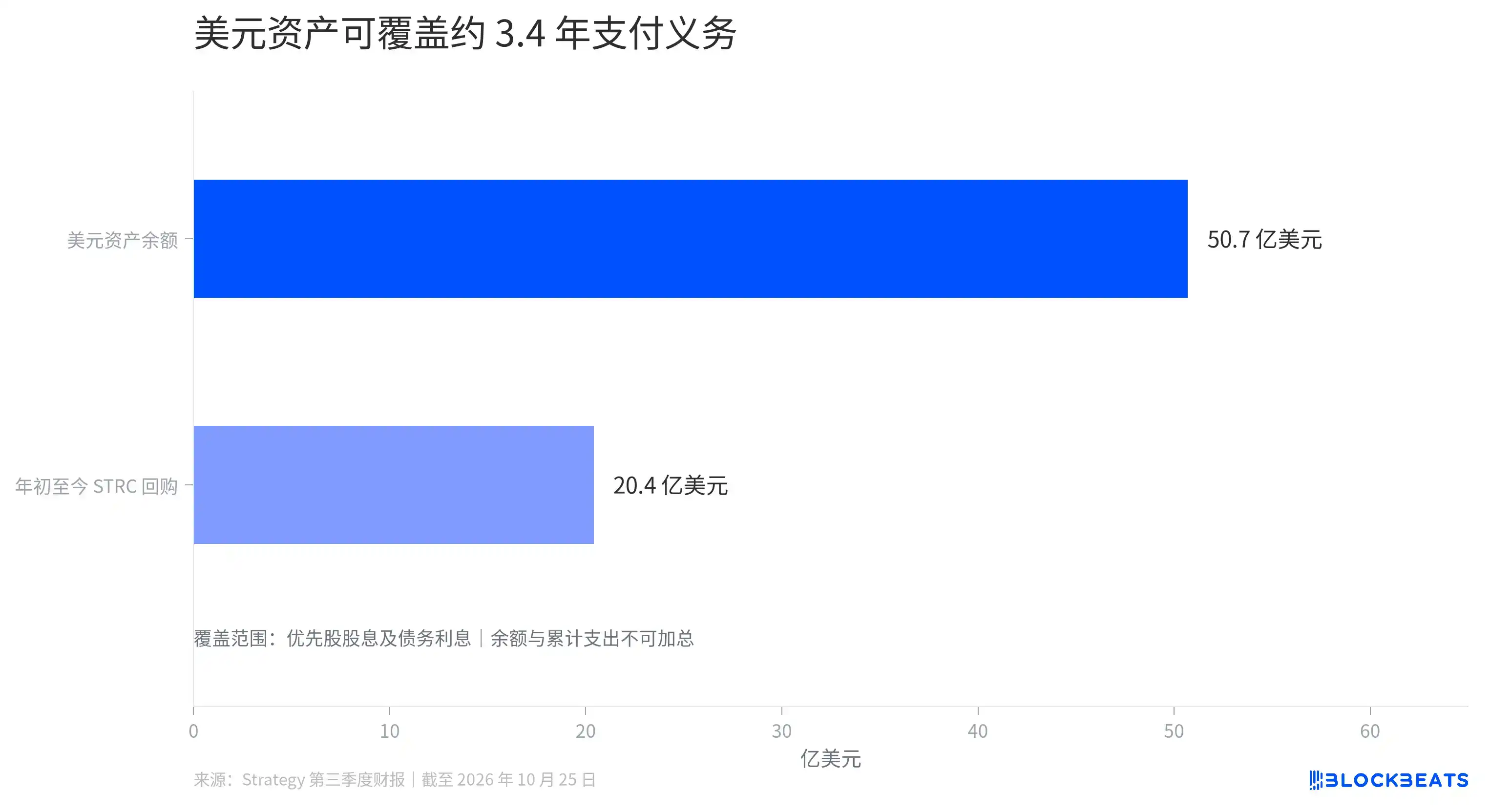
According to the third-quarter report, Strategy had repurchased about $2.04 billion of STRC year to date as of Oct. 25. The company said that figure includes shares that had been repurchased but not yet settled, so it should not be treated as the full amount of cash already paid out by that date.
At the same point, Strategy disclosed about $5.07 billion in dollar assets. By the company’s calculation, that was enough to cover about 3.4 years of preferred dividends and debt interest. That coverage period is based on conditions at the disclosure date. It does not mean future payment levels are fixed, and it does not include every possible funding need. In the chart, dollar assets are a balance, while STRC repurchases are a cumulative year-to-date amount, so the two should not be added together.
The other side of that cash buffer is that the company has already sold some Bitcoin. The filing shows Strategy sold about $432 million of Bitcoin year to date to fund part of its preferred dividends and STRC repurchases. The company also kept room, subject to board authorization, to sell Bitcoin to replenish reserves, pay related expenses or support repurchases.
That does not mean it stopped buying. In the same report, Strategy said it had purchased about $14.33 billion of Bitcoin year to date as of the disclosure date. Buying and selling can happen in the same year; the difference lies in timing and in how the proceeds are used.
In this quarter’s report, Strategy’s income statement moved with Bitcoin’s price, while total Bitcoin holdings, Bitcoin per share and dollar resources available for payments each depended on a different denominator.



