
Strategy repurchased 1,420,467 shares of its STRC preferred stock for $139.3 million in the week ended Sept. 13, according to an 8-K filed with the U.S. Securities and Exchange Commission on Monday.
That was lower than the $176.3 million the Bitcoin treasury firm spent in the previous week. Earlier, the company’s board doubled the authorization behind its digital credit securities repurchase program to $2 billion. Every dollar used for the buyback came from USD Cash, the liquidity pool Strategy uses for repurchases, dividend payments and Bitcoin purchases.
Bitcoin position unchanged for a second straight week
Strategy bought and sold no Bitcoin during the period, leaving its holdings unchanged at 845,050 BTC for the second consecutive week. The company said it acquired that stack for $63.73 billion at an average price of $75,412 per coin, including fees.
Apart from STRC, Strategy repurchased none of its STRF, STRK or STRD preferred shares during the week. It also bought back no MSTR common stock.
Roughly $1.05 billion remains available under the $2 billion digital credit securities repurchase program. A separate $1 billion authorization for MSTR stock remains untouched.
Cash balances and reserve levels
As of Sept. 13, Strategy reported two main dollar balances. USD Reserve, which backs preferred dividends and interest payments, stood at $5.10 billion. USD Cash stood at $1.30 billion.
That cash balance was down from $1.44 billion a week earlier, a move that tracked closely with the $139.3 million spent repurchasing STRC.
Credit dashboard metrics
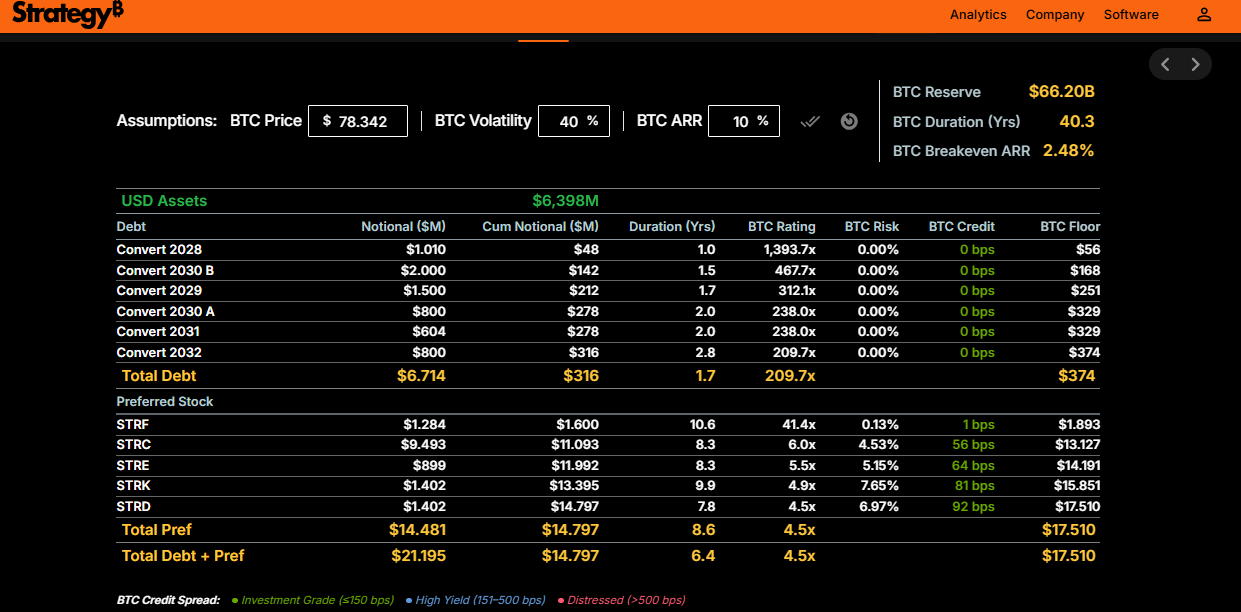
According to Strategy’s own credit dashboard, STRC’s BTC Credit spread sits at about 57 basis points, based on assumptions of a 10% annualized Bitcoin return, 40% volatility and Bitcoin near $77,266.
On Strategy’s internal scale, anything below 150 basis points is classified as investment grade, which keeps STRC within that range. The same dashboard values Strategy’s aggregate Bitcoin reserve at $66.2 billion, with a blended breakeven annualized return of 2.48% and a duration of 40.3 years.
The report also explained the figures in simpler terms. One basis point equals 0.01%, so 57 basis points comes to 0.57%. It described the Bitcoin Credit spread as the extra cost or risk attached to the investment relative to a safer one. Under Strategy’s framework, if that measure stays below 150 basis points, or 1.5%, the security is treated as investment grade.
It also said the 2.48% breakeven return represents the minimum annual growth Strategy needs from its Bitcoin to cover its costs. The 40.3-year duration indicates a long time horizon for reaching that target.
MSCI proposal still in focus
The slower pace of buybacks comes as Strategy waits for the outcome of an MSCI proposal that could remove “non-operating companies” such as Strategy from its global equity benchmarks.
Feedback on that consultation closes on Sept. 30, and a decision is due on Oct. 16. According to the report, that date could affect billions of dollars in passive fund flows tied to Strategy’s index weighting.