

Strategy will hold a special online shareholder meeting at 10 a.m. Eastern Time on Oct. 28 to vote on whether to amend the certificates of designation for four preferred stock series — STRC, STRF, STRK and STRD — so they can set dividend record dates on a daily basis. Voting opened after proxy materials were sent on Oct. 5, and remote voting closed at 11:59 a.m. Beijing time on Oct. 28.

How the STRC payout schedule would change
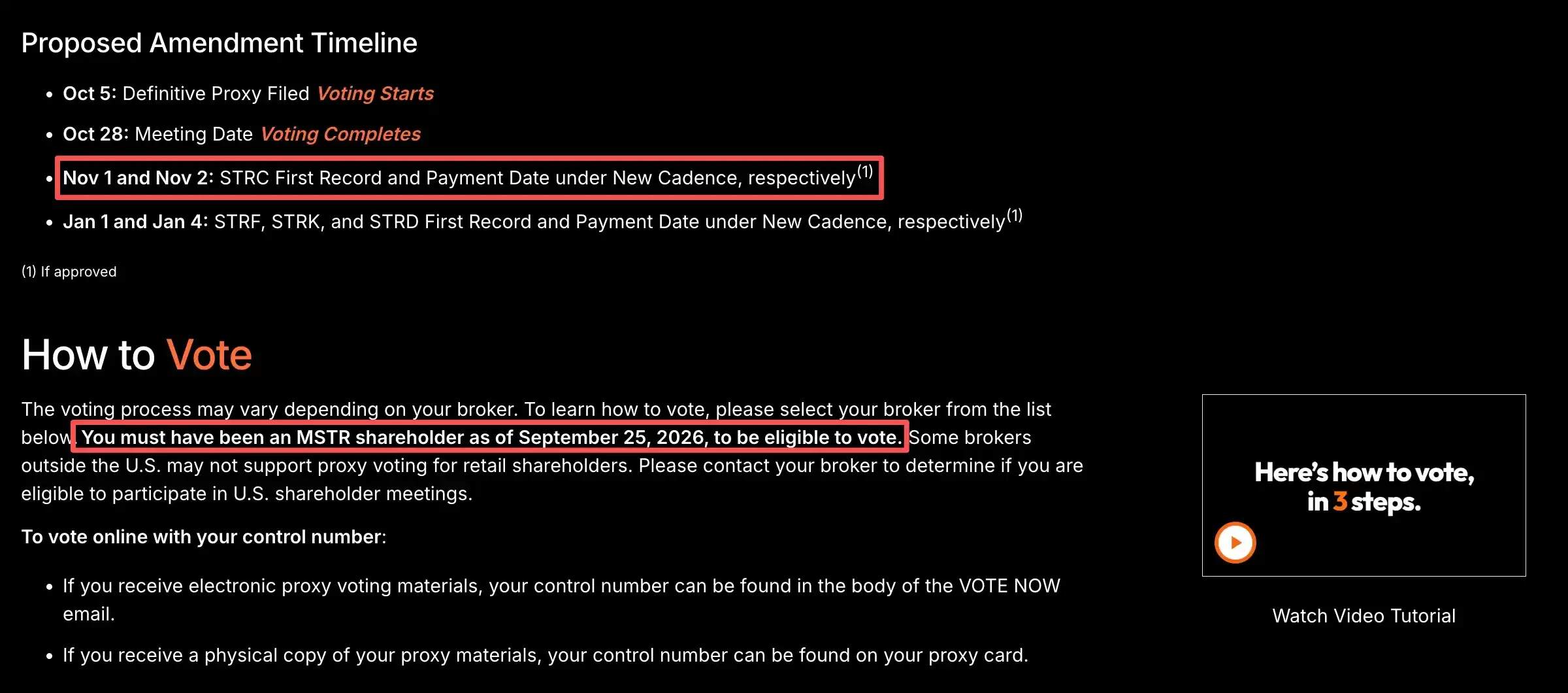
If shareholders approve the proposal, every calendar day starting Nov. 1 would become a record date for STRC, including weekends and holidays, with dividends paid on the next business day. The first payment would be made on Nov. 2. Daily dividends would be $0.03 or $0.04, adding up to $1.00 per share for November, equivalent to a 12% annualized rate.
If the proposal does not pass, STRC would stay on its current schedule and pay $0.50 on Nov. 15. Holders would not be entitled to receive both forms of dividend.
For STRF, STRK and STRD, which currently pay quarterly, the first record date under a daily framework would be Jan. 1, 2027, and the first payment would be made on Jan. 4, 2027.
Another dividend frequency change within months
Strategy changed STRC’s dividend cycle from monthly to semi-monthly in June. Five months later, with STRC approaching its $100 par value, the company is now seeking to move to a daily structure.
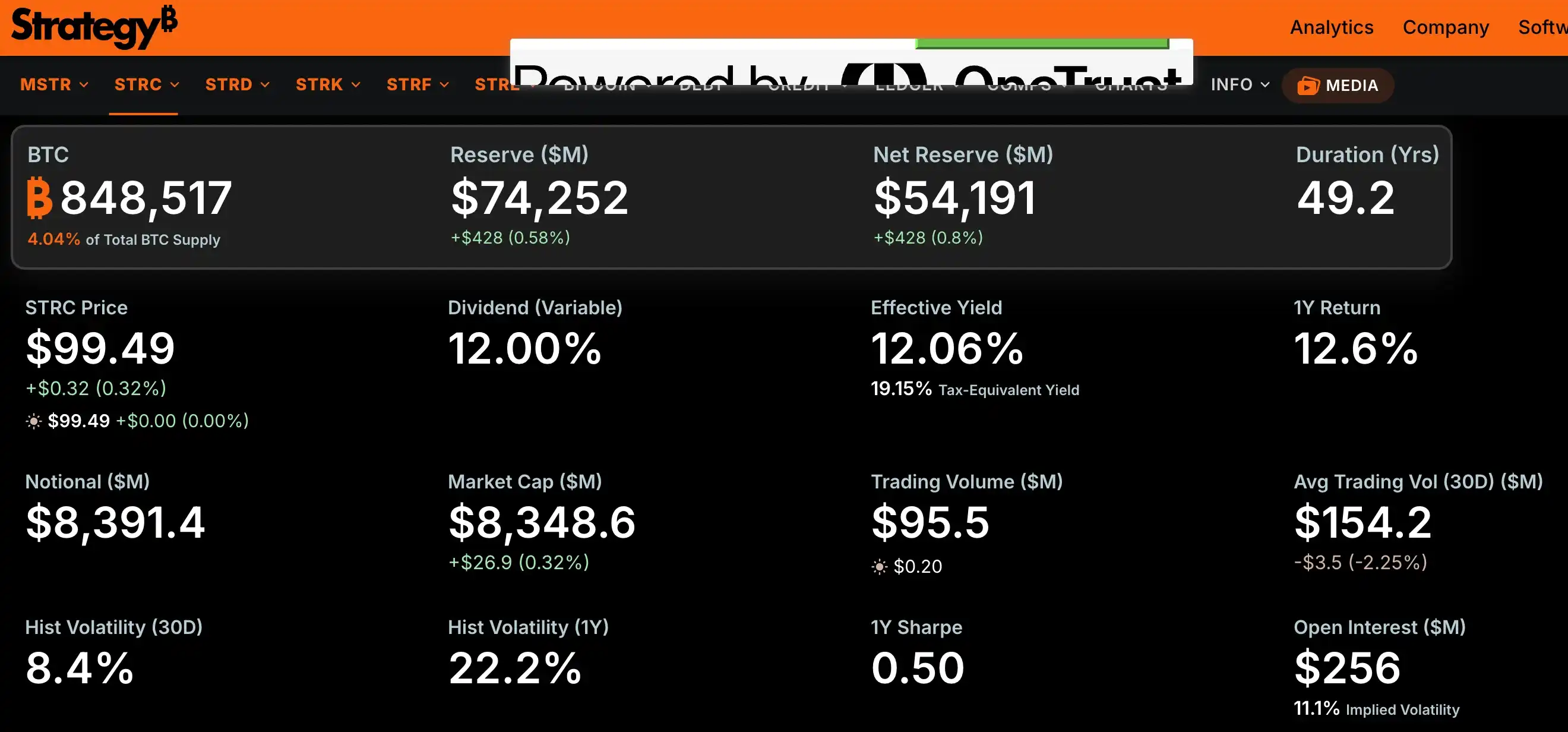
As of Oct. 25, Strategy held 848,517 BTC. It also had $4.83 billion in reserves earmarked for preferred dividends and debt interest, plus $242.4 million in available cash, according to the article.
The central question for the market is whether daily dividends can support a new round of STRC financing and, by extension, Strategy’s common stock.
STRC’s slide and rebound
STRC, described in the article as one of Strategy’s core financing tools, has not returned to its $100 par value since mid-May. In June, as market sentiment turned sharply negative and Bitcoin fell below $60,000, STRC dropped to $71.25 on June 26, its lowest level since listing.
The article says Strategy then carried out its first BTC sale in three years. In its framing, that move eased some of the company’s funding pressure and showed that Strategy had more than one way to raise or manage capital in a changing market environment.
As Strategy later bought more BTC and market conditions improved, BTC, Strategy’s common stock MSTR, and STRC all rebounded. The company’s cash-flow position on the balance sheet also improved, the article says.
At the time of writing, MSTR was trading around $141 and STRC had recovered to $99.49. The article also states that as of Oct. 25, 2026, Strategy held 848,500 BTC and $5.1 billion in assets.
Prediction market odds
Polymarket data cited in the article showed a 78% probability that STRC would touch $100 before Dec. 31 this year. The probability for reaching that level by the end of November stood at 66%, while the probability for doing so by the end of October was only 9%.
Even with a gap of roughly $0.50, the prediction market was not especially optimistic about a near-term return to par.

What it takes for the proposal to pass
According to Strategy’s official voting page, the proposal requires approval from a majority of the voting power of all outstanding common stock. Abstentions and broker non-votes count as votes against the measure. Preferred shareholders do not have voting rights on this matter.
Only holders of record of common stock as of Sept. 25 are eligible to vote. Class A shares carry one vote each, with 402,337,658 shares outstanding. Class B shares carry 10 votes each, with 19,640,250 shares outstanding. That adds up to about 599 million votes.
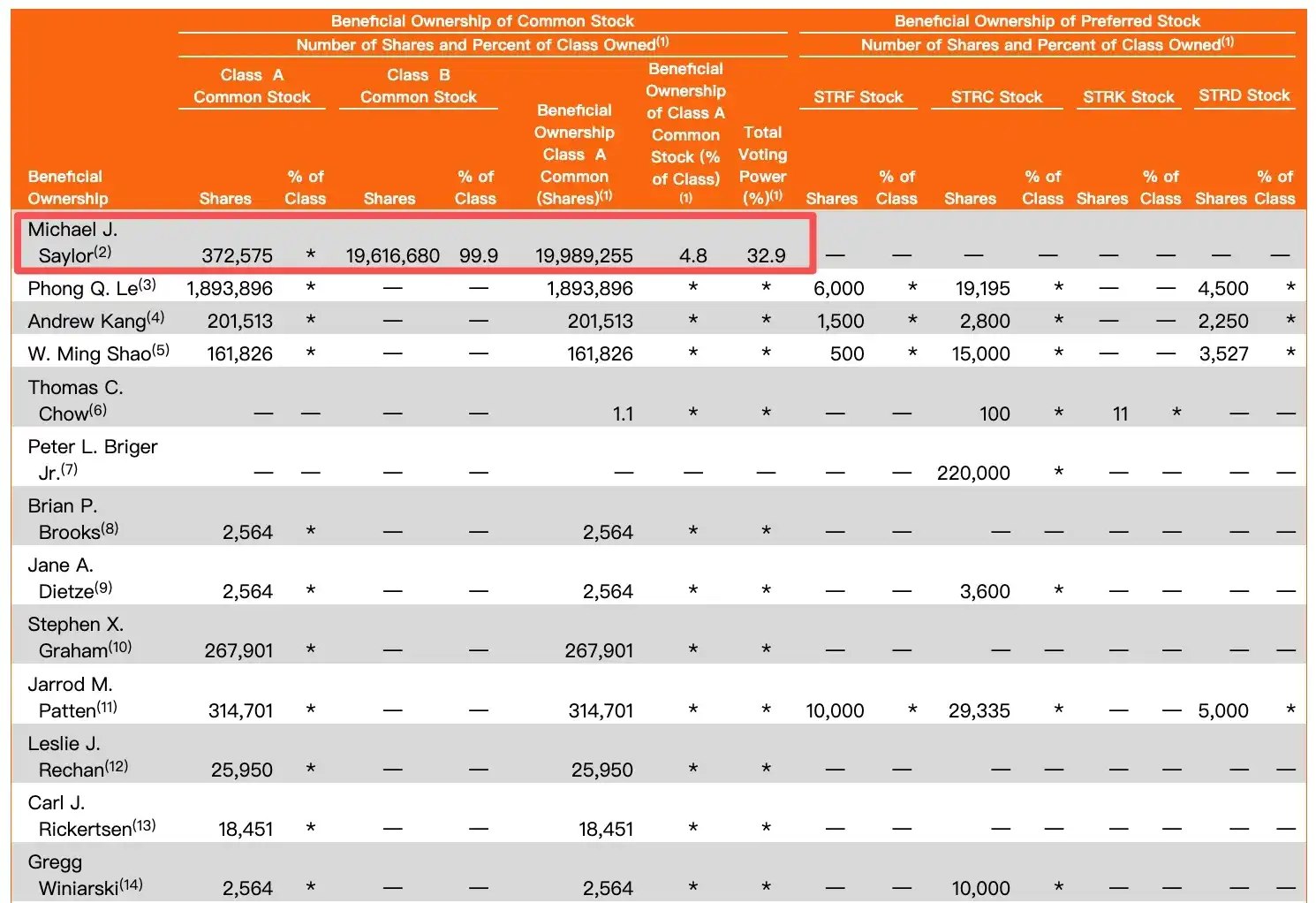
Based on ownership information in the DEF 14A filing previously submitted to the U.S. Securities and Exchange Commission, Strategy Chairman Michael Saylor controls 32.9% of the total voting power. To clear the majority threshold, the proposal would still need support representing about 17.1% of the voting power from other shareholders.
The meeting will be held online. Even if shareholders approve the proposal, Strategy would still need to file the amended certificate of designation for STRC with the Delaware Secretary of State before the change becomes effective. The proxy also includes a separate item authorizing adjournment if there are not enough votes and more solicitation is needed. To complete the first payment on Nov. 2 as planned, the filing would need to be completed by 12:01 a.m. Eastern Time on Nov. 1.
The case for daily dividends
The article describes STRC as an important part of Strategy’s funding loop and says it matters for market confidence, MSTR price stability, continued financing, and continued BTC purchases.
If daily dividends are implemented, the article argues that the change could benefit Strategy, STRC holders, MSTR holders and BTC. It says the company could keep its financing mechanism running, improve capital efficiency, strengthen liquidity and reduce ex-dividend volatility.
Strategy has said directly that the goal is to reduce the price impact of accrued dividends so STRC can trade more steadily near its $100 par value. In that framing, the preferred stock would move closer to a daily-settled cash account, potentially attracting more investors, thickening the balance-sheet cushion, lowering funding costs and improving credit quality. The article adds that this could also lend some support to BTC prices.
The limits and risks highlighted in the article
The article also lays out several points it says daily dividends cannot solve.
First, a daily schedule does not remove the payment process. Dividends still need to be declared by the board and must be backed by legally available funds. A daily structure is not the same as a guaranteed payout. Whether brokers support automatic dividend reinvestment on a daily basis depends on the brokerage channel used by each investor, so the change does not automatically reduce financing pressure.
Second, the article says daily dividends improve cash-flow granularity, not principal stability. They may soften monthly ex-dividend gaps and reduce dividend-capture trading around a single date, but they do not turn a perpetual preferred stock into a money market fund. As an example, it points to BTC treasury company Strive, saying that even after it switched SATA from monthly to daily dividends, the move did not prevent a short-term decline.
In other words, the article argues that daily payouts may reduce volatility tied to dividend investing and curb speculation around a fixed ex-dividend date, but they do not eliminate price risk. Whether STRC investors suffer principal losses still depends heavily on Strategy’s credit profile, BTC price performance, and conditions and sentiment in the crypto market.
Third, a daily schedule would make Strategy’s cash outflows more fragmented and more frequent, increasing finance and custody-related operational burdens. The article describes that as a necessary cost of running a listed company.
Capital structure concerns remain in focus
The article says Strategy’s broader funding structure has not changed much. On Oct. 19 and Oct. 26, the company disclosed STRC repurchases of $193 million and $205 million, respectively. Those funds could otherwise have been used to buy BTC or remain on the balance sheet as cash, meaning the buyback decision and preferred-stock-funded BTC purchases draw from the same capital pool.
If the daily dividend proposal fails, and with the company’s third-quarter earnings release due on Oct. 29, the article says Strategy’s narrative of raising money to buy BTC, waiting for BTC appreciation, using the appreciated portion to service dividends, and then buying more BTC would again come under short-term scrutiny. In that reading, investor sentiment and confidence could weaken, making future financing harder.
What a return to par could mean
From the investor side, the article says that if STRC returns to its $100 par value and becomes one of the first listed securities to accrue or pay dividends on a calendar-day basis, more DAT treasury-listed companies may consider issuing preferred stock to diversify funding channels.
It adds that such a development could improve capital efficiency for both investors and listed companies, bring in a new wave of funds, and add incremental demand to the crypto market.
After nearly half a year of preparation, this dividend-cycle change has become a high-stakes moment for Strategy and Michael Saylor. The outcome will be known soon after the vote.



