

STRC moves away from its $100 target
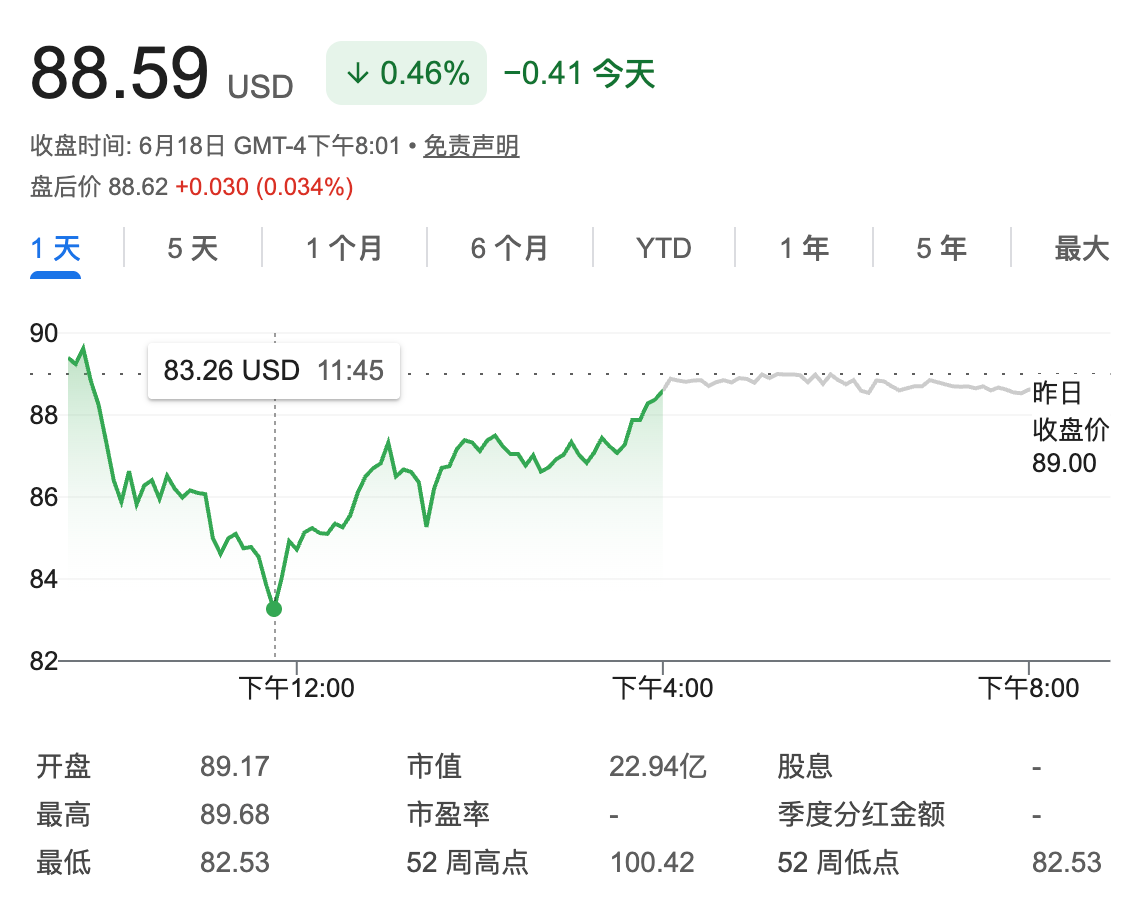
Strategy’s preferred share STRC is now in a sustained de-pegging phase. U.S. equity market data show that since May 15, STRC has gradually moved away from its $100 target par value. The discount widened sharply in recent trading, with the instrument touching an intraday low of $83.26 yesterday before closing at $88.59. That leaves STRC more than 11% below its target par value.

For an ordinary stock, an 11% decline would not necessarily define the entire investment case. STRC, however, was not designed as a highly volatile speculative asset. In Strategy’s original structure, it was intended to operate near a $100 par value as an income-oriented security. The widening gap between market price and target par value therefore challenges the product’s central design objective and has led more investors to revisit the logic behind the instrument.
STRC was launched by Strategy in 2025 as an innovative financial derivative. Unlike Strategy’s common stock MSTR, STRC is structured as a perpetual preferred share with a fixed $100 target par value and relatively stable dividend income. Its characteristics are closer to a security with fixed-income features than to a common equity instrument. As Strategy has continued expanding its Bitcoin reserves, STRC has also grown into one of the company’s most important financing channels.
The financing loop depends on the peg
Before STRC was introduced, Strategy mainly raised capital for Bitcoin purchases through convertible notes and direct issuance of common shares. Each approach carried constraints. Convertible notes are subject to maturities and limits on debt leverage, while repeated common share issuance dilutes existing shareholders. STRC was designed to address that pressure point by providing a new financing route inside Strategy’s broader balance-sheet expansion model.
The core loop can be described as issuing additional STRC, raising fiat currency, buying BTC, increasing corporate net assets and reinforcing confidence in STRC. Through this cycle, Strategy built what appeared to be a repeatable capital flywheel. In this framework, STRC is not just another funding product; it is a central engine of the company’s current capital structure and Bitcoin accumulation strategy.
The entire loop depends on one crucial condition: STRC must remain close to its $100 par value. If the market price trades materially below $100, then under ATM fundraising terms and market arbitrage logic, Strategy can no longer efficiently absorb capital from the market by issuing discounted preferred shares. In practical terms, a deep and persistent discount weakens the financing function that allows the flywheel to keep turning.
A higher dividend has not repaired the discount
To keep STRC’s secondary-market price aligned with the $100 target par value, Strategy introduced a mechanism for monthly dynamic dividend-rate adjustment. In simple terms, when STRC trades below $100, Strategy can raise the dividend rate to make the product more attractive. When STRC trades above $100, the company can lower the dividend rate. In theory, repeated adjustments should keep STRC trading near $100 over the long term.

That mechanism is not producing the intended result at the moment. Strategy has already lifted the dividend to a high level of 11.5% and changed the payment frequency from monthly to semi-monthly, yet STRC has not effectively returned to its target par value. The failure of the dividend adjustment to restore the peg shows that the market is pricing risks beyond the yield level itself.
Current market discussion centers on two layers of concern. The first is a technical factor: forced deleveraging among arbitrage capital. Over the past year, STRC traded for a long period around $100, which attracted a large amount of yield-oriented arbitrage money. Such capital often uses leverage to amplify returns, collecting dividend income while also seeking gains from a move back toward par value. Once STRC fell below $100 and continued weakening, some leveraged accounts hit risk-control lines and were forced to sell positions. The falling price then triggered more liquidations among leveraged holders, creating a chain reaction in which selling pressure reinforced itself.

Liquidity questions and the Bitcoin reserve narrative
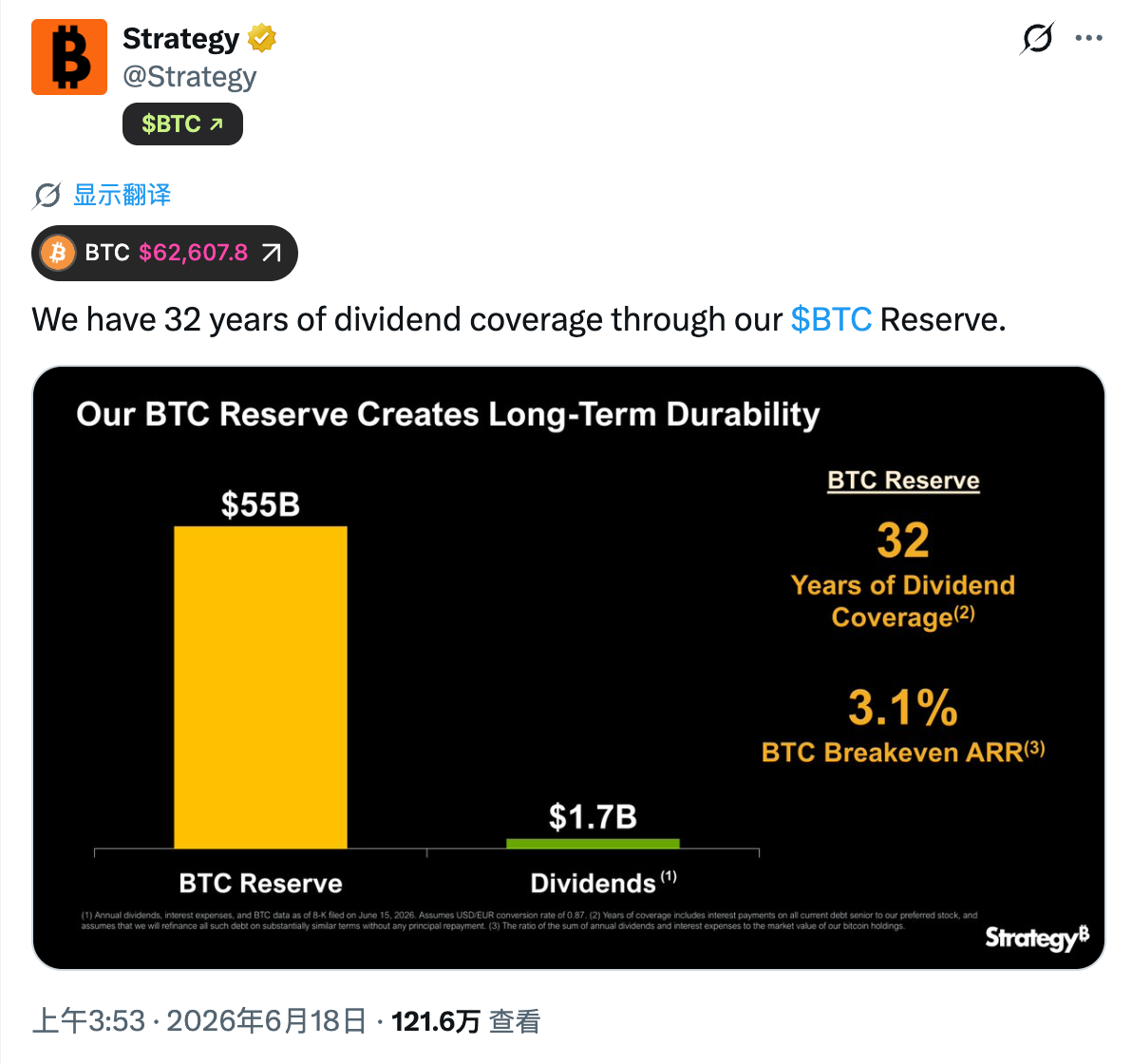
Leverage-driven selling alone does not fully explain the current market behavior. For many investors, the deeper concern lies in Strategy’s liquidity reserves. Earlier this month, JPMorgan released a research report stating that Strategy has about $1.7 billion in annual dividend payment obligations. Based on the current level of cash reserves, the company’s book cash is sufficient to cover only around 6.3 months of preferred-share dividend payments.
Strategy has offered a very different explanation. The company said in an official post on X that, if its large Bitcoin reserves are included in the calculation, it has enough resources to cover 32 years of dividend payments. This response goes directly to the most sensitive part of the debate: whether Bitcoin reserves should be treated as effective liquidity for obligations tied to preferred shares.

That sensitivity increased earlier this month when Strategy sold Bitcoin from its holdings for the first time. The sale involved only 32 BTC, and the company described it as an “active market desensitization test,” while also saying that it would “buy back more in the future.” Even so, the move had a strong effect on market perception. For years, Strategy and its founder Michael Saylor have communicated a core narrative: Bitcoin is a long-term strategic reserve asset, and the company raises operating capital through capital markets rather than relying on Bitcoin sales.
Once the market saw Strategy actually sell Bitcoin, investors had to reassess the risk level of the related securities. If financing conditions tighten in the future, the question becomes whether Strategy would need to rely further on Bitcoin sales to meet dividend obligations. If that answer is not an absolute no, the risk profile of STRC and related instruments must be evaluated differently.

From this perspective, STRC’s persistent de-pegging is not only about one preferred share trading below par. It reflects a broader reassessment of the strength of Strategy’s capital structure. The largest direct impact for Strategy is the weakening of STRC’s financing function. Over the past several years, Strategy expanded its Bitcoin reserves by issuing shares, convertible notes and preferred shares, then deploying the proceeds into BTC. STRC has been a major financing tool in that system. When it trades below the $100 target par value for an extended period, the market is demanding higher risk compensation and the company’s financing capacity is temporarily impaired.
The path of STRC back toward par will therefore remain an important indicator for judging Strategy’s risk profile. If STRC stays discounted for a long period, financing remains constrained and cash reserves continue to be consumed, concerns over additional Bitcoin sales for dividend payments will intensify. That expectation would no longer be limited to STRC itself. As one of the most important marginal buyers in the Bitcoin market over the past several years, Strategy’s financing capacity and purchase rhythm have been deeply tied to market supply-and-demand expectations. A shift from buyer to seller would place heavy downward pressure on Bitcoin in the market narrative described by the source article.