
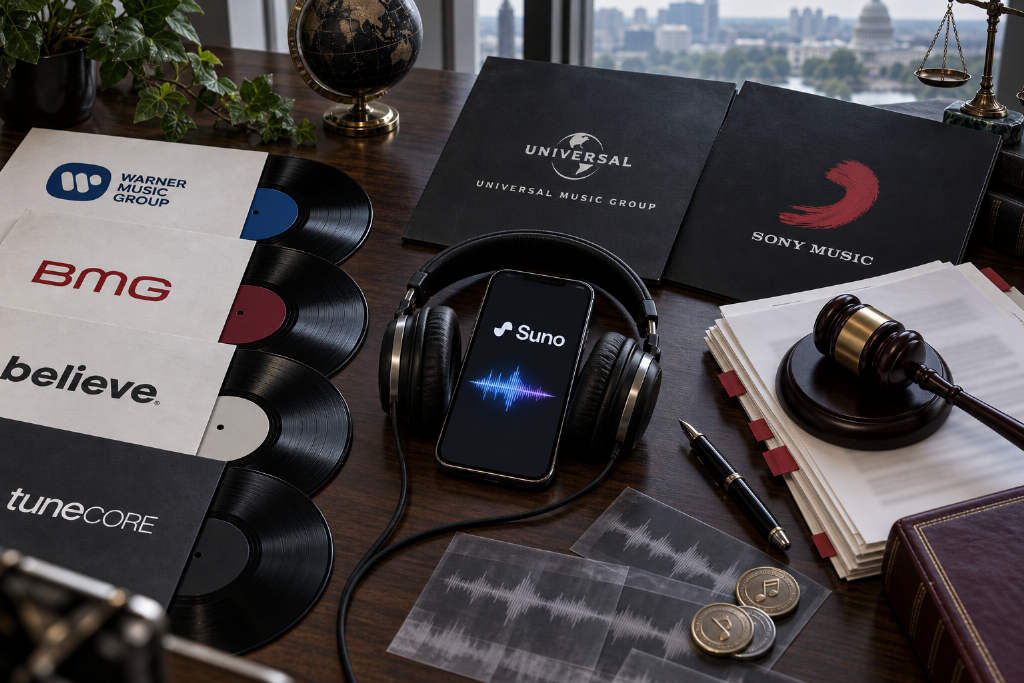
Suno on Wednesday introduced its new v6 model family, the company’s first product trained in partnership with major record labels and distribution companies. Under the new setup, rights holders will be paid when users generate songs, though Suno has not disclosed the size of those payments.
Suno ties v6 rollout to licensed training and royalty sharing
Jack Brody, Suno’s chief product officer, told Bloomberg that 「the future of music must be built with the music industry and musicians」 and described the release as the company’s 「crucible moment」 marking the start of a new chapter.
According to Brody, the v6 series does not allow users to directly enter the names of real artists in prompts, a change from earlier versions. He also said v6 will replace older models that did not share revenue with rights holders. If a song is generated through v6, the copyright owners behind the material used in training will receive payment.
Brody said the money will first go to record labels and distributors, which will then decide how to divide it among their artists and creators. Suno does not take part in setting those internal splits.
The rights holders confirmed to be part of the training program include Warner Music Group and BMG Rights Management, the Bertelsmann-owned record and publishing company. Music from independent platform Believe and artists on its TuneCore network will also be added to model training over time.
Three-model v6 family targets free users and subscribers
In a blog post, Suno said v6 delivers faster generation and better quality. The launch includes a full model family rather than a single release: the standard v6 for general users, an experimental v6-wild version for Pro and Premier subscribers, and v6-mini, which is available free to all users.
The feature set has expanded as well. Users can generate songs from an audio clip, an image, or even a video, and can combine multiple genres and source materials inside one prompt.
Brody said a feature that would let general users directly cover or remix existing works by real artists is still in development. He added that functions involving imitation of another person’s voice have long raised strong concerns among musicians unless enough safeguards and compensation commitments are in place.
Warner says per-user payouts should top streaming rates
Warner Music Chief Executive Officer Robert Kyncl said in an earlier Bloomberg interview that Suno’s future per-user royalty payments to Warner and its artists would exceed current levels paid by streaming platforms such as Spotify Technology.
For Warner, the calculation is that turning AI music generation into a new revenue stream may be preferable to staying locked in court battles with Suno.
The relationship between Warner and Suno dates back to their settlement and cooperation announcement on Nov. 25, 2025. That was Suno’s first licensing agreement with a major record company. Under the deal, participating Warner artists could allow their names, likenesses, voices, and existing works to be used in AI music training in exchange for compensation. The v6 rollout now puts that agreement into an actual product.
Suno’s valuation climbed to $5.4 billion after Series D
Suno’s position has strengthened alongside those agreements. In June 2026, the company raised $400 million in a Series D round led by Bond Capital at a $5.4 billion valuation. Six months earlier, in November 2025, Suno had raised $250 million at a $2.45 billion valuation.
That means Suno’s valuation nearly doubled in half a year, a period that overlapped with its Warner licensing deal and its push to establish a revenue-sharing model.
Universal and Sony are still pressing copyright claims
Universal Music and Sony Music, the world’s two largest record companies, still have not reached licensing deals with Suno. Both have sued the company for copyright infringement.
Several weeks before the Series D financing closed, Universal and Sony asked the court, based on discovery, to add more than 61,000 songs to their complaint. They argued that 「millions of songs」 used in Suno’s training came from their catalogs, far beyond the scope identified when the lawsuits were first filed.
Suno’s core defense remains fair use. The company argues that using copyrighted music to train AI models does not require prior authorization.
The litigation has been running since 2024. Over more than two years, the two sides have clashed repeatedly without reaching an out-of-court settlement, and the dispute has only widened as discovery has progressed.