
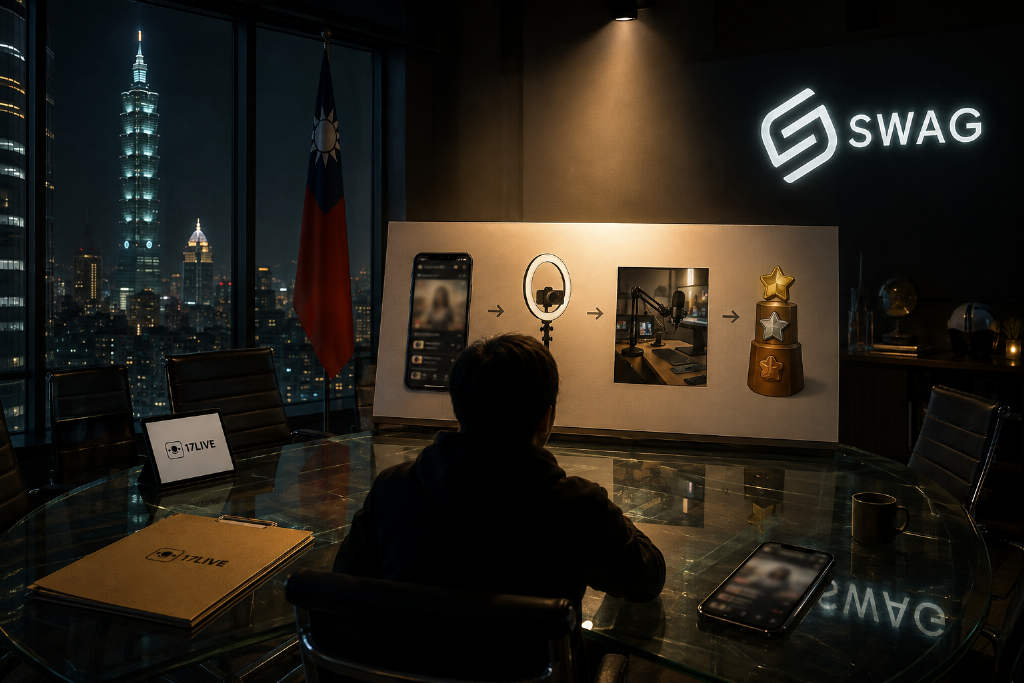
According to ABMedia, SWAG founder Sam used a long interview with Chen Hsiu-ping’s "Master Business School" to explain how he built the platform into a business with revenue at the NT$1 billion scale. Sam said SWAG was not originally planned as an adult platform. The business turned in that direction after creators themselves began posting more revealing material, and he then leaned into that shift by adding incentive mechanisms to increase the supply of content.
From a paywalled influencer project to an adult platform
Sam said SWAG started as a project under 17 Media, the company behind 17 Live. At the time, the team wanted to build around the "influencer economy." Since creators posting photos and videos on Instagram or Facebook could not easily monetize them directly, the idea was to create a paywalled content platform. Early on, he said, the business was not especially profitable.
The turning point came after Sam took over the platform and introduced a ranking system built around incentives. Creators could compare earnings against one another, and the platform offered prize money of roughly NT$500,000 to NT$600,000 over two weeks. Under that financial pressure, creators trying to win traffic pushed content further step by step, from exposed shoulders and bra straps to underwear and eventually full nudity. Sam said the platform changed dramatically within 10 days, and revenue jumped with it.
SWAG split from 17 Live as the parent company prepared to list
As SWAG’s content became more explicit, 17 Live was preparing for a listing and worried that owning an adult-content business would hurt the company’s valuation and asset mix. Sam said he negotiated with shareholders and put in some of his own money to buy SWAG at what the report described as a relatively low price, allowing the business to operate independently.
The report said Sam sold his original shares and added personal funds to acquire SWAG’s shares and operating control. With that separation, 17 Live focused on safer content, while SWAG moved fully into the adult market. ABMedia said Huang Li-cheng agreed to the arrangement during the negotiations with shareholders.
Product development moved from short clips to long-form video and live streaming
SWAG’s product roadmap shifted with user demand. It first offered 30-second clips that users could unlock through payment. Later, the team noticed that creators were cutting five-minute videos into multiple short story-style posts, a sign that users wanted longer content. SWAG responded by adding a long-form video format.
After that, Sam said users started to tire of long-form videos, and the platform added live streaming. He described that progression as a move away from a business based only on content consumption and toward one built on interpersonal connection.
Police search on April Fools’ Day brought legal scrutiny
ABMedia said SWAG was once hit by a large police search on April Fools’ Day in an unspecified year. Police were mainly focused on whether website classification rules had been properly enforced and whether minors could access the content. In the end, the platform was fined because a small number of Western creators had uploaded "hard content" that is considered illegal in Taiwan.
Sam says he learned to create "10 dollars of value with 1 dollar"
Before joining 17 Media, Sam had gone through several failed ventures, including e-cigarettes, sneakers and stock chatrooms. He said he knew how to make products but did not understand marketing and promotion. That changed, in his telling, after learning from Huang Li-cheng what he described as the idea of creating "10 dollars of value with 1 dollar."
Sam framed that as a leverage-based approach to business: use marketing’s multiplier effect to drive large traffic and attention with limited resources. He said the concept also made him think of Elon Musk taking Tesla pre-orders and then using those orders to secure bank financing to build factories. Sam added that this kind of high-leverage strategy only works when it sits on top of a very grounded research process. He said Huang would go deep into the platform every day, break down why individual streamers became popular, and listen carefully to user feedback.
Revenue sharing differs sharply from OnlyFans
Sam compared SWAG’s creator economics with OnlyFans. He said OnlyFans functions more like a self-operated platform where creators must bring their own traffic, but they can keep 80% of revenue while the platform takes 20%.
SWAG takes a different approach. Because it spends heavily to buy traffic and direct it to creators, the split is steeper on the platform side. Sam said SWAG keeps 60% to 70%, while creators receive about 30% to 40%.
Paid behavior is driven by emotional connection, not just viewing
Sam argued that watching videos alone is not enough to sustain long-term payment behavior. What matters, he said, is the emotional bond between users and creators. Users stay for interaction, private chat and affection, and those relationships lead to more spending over time.
He said private-message unlocks can range from NT$100 to NT$1,000. Fans also send gifts in livestream rooms and spend to compete on rankings. According to the report, top streamers on the platform can earn close to NT$10 million a year.
Sam also said SWAG has chosen not to follow rivals such as Madou in relying on gambling ads for monetization. His view is that producers rushing to cash out can damage production quality. SWAG instead wants to preserve an amateur-style feel and build a longer-lasting business around it.
Global competition is shaped by traffic concentration and payment barriers
On international expansion, Sam said it is extremely difficult to go head-to-head with large incumbents in the adult sector. SWAG’s answer, he said, is not direct confrontation but avoiding heavily monopolized areas where possible and going deeper on user relationships.
In Western markets, he said Streamate, Jasmin and Stripchat have dominated for about 20 years. Those companies control major traffic moats and have already integrated with Pornhub or locked up social traffic sources. If SWAG tries to buy traffic there directly, he said, it would mostly be left with lower-conversion inventory.
In Japan, Sam said DMM has effectively locked up high-quality production houses and agency resources. In Southeast Asia, he pointed to payment restrictions. Mainstream payment services such as Vietnam’s ZaloPay and Singapore’s PayWave, he said, refuse to work with adult businesses, hurting user conversion and return on investment.
Interview also touched on Taiwan’s startup limits and Sam’s next focus
ABMedia said Sam, speaking as a local entrepreneur from Taiwan, described the startup environment there as limited. He said he plans to keep exploring frontier AI fields and continue taking care of creators on the platform. The interview tied together SWAG’s commercial transformation, its legal issues, its split from 17 Live and the competitive constraints it faces outside its home market.