


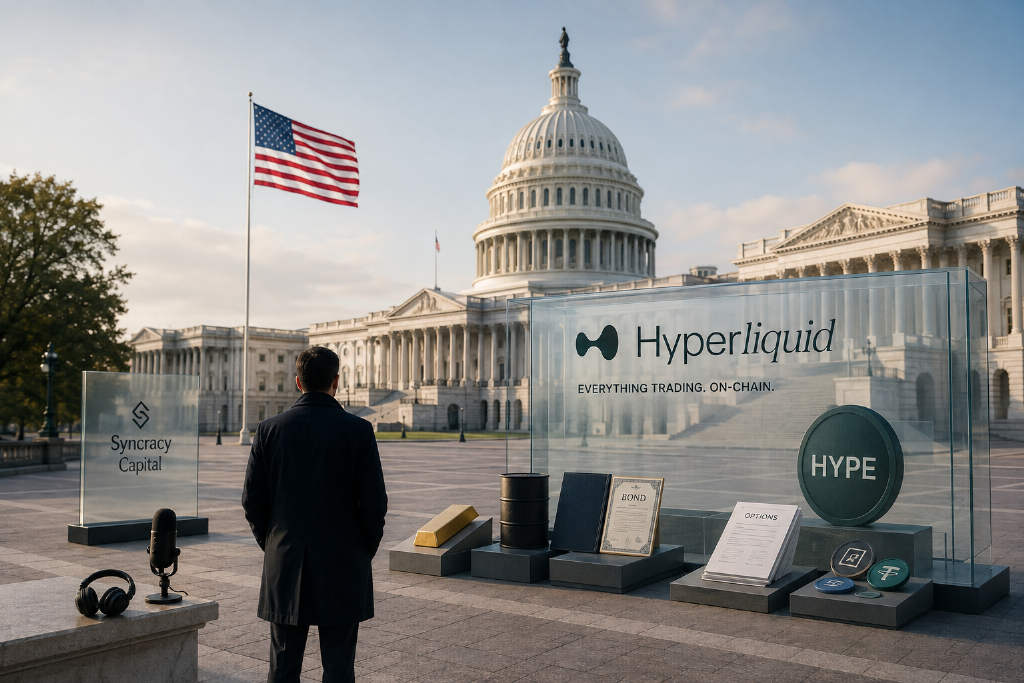
Ryan Watkin, co-founder of Syncracy Capital, said on The Rollup podcast that HYPE’s surge should not be read as a one-off move. In his telling, Hyperliquid is moving toward a much broader onchain financial system, with U.S. market access, spot trading, HIP-3 and compliance-related frameworks all feeding into that direction.
Political attention changed the regulatory conversation
Watkin said he was sitting in the same place, on a call with co-founder Dan, when messages started pouring in from the team saying HYPE had jumped to around $70. Minutes earlier, he had seen it trading near $59. The move looked vertical, and at first they did not know why. They later learned that Trump had mentioned Hyperliquid directly during a televised press conference.
Watkin called it a crazy moment. But he said the setup had been developing for some time. Back in July and August, Hyperliquid had already deployed Stars-related features on public testnet. Based on the team’s own analysis, the project typically takes about three months on average to move from public testnet to mainnet, with the outer bound at less than six months. That led them to think the rollout was already in motion, even if they had not expected a public mention from a senior political figure.
For him, the central question from investors had never been whether Hyperliquid had growth. It was whether that growth could continue if U.S. regulators moved to restrict the platform. He argued that this overhang is now starting to fade. Because the U.S. capital market remains the world’s largest and most important center of financial liquidity, clearing that hurdle would materially raise Hyperliquid’s long-term ceiling.
The original investment case was straightforward
Watkin said the early thesis was relatively simple. At launch, Hyperliquid was valued at roughly $3 billion, was already generating about $200 million in annualized revenue, and still had a steep growth curve.
He added that, aside from airdrop recipients, very little token supply was freely circulating at the time. The only path to acquire the token was to bridge assets onto Hyperliquid itself. He described that as a strategically powerful design choice: any fund or individual that wanted to build a position had to become a real user of the platform first. At the same time, there were no institutions sitting on preallocated, cheap inventory.
In the industry ranking at that point, he said Hyperliquid was already among the top four crypto applications and chains by revenue, while several assets above it did not appear to have durable fundamentals. That is why he believed the token had substantial room to rerate and could still be undervalued even after a 3x to 5x move.
From onchain perpetuals to a venue for trading everything
Watkin said Syncracy had long been working through a larger thesis: that permissionless public blockchains could support free trading in any asset globally, with derivatives serving as the most important long-term wedge.
By early 2025, after deeper conversations with core trading teams and market makers, he said his conviction had shifted into what he described as a generational holding view. In his opinion, the market still tends to frame onchain perpetuals as a niche product competing only within Web3. He rejects that framing. The first real objective, he said, is to take share from large centralized exchanges such as Coinbase, Bybit and BN. The eventual comparison is not a crypto-native peer. It is a traditional incumbent such as CME.
That is why the key metric for his team has not been share against other onchain venues, but share relative to BN and Bybit. He said that figure has been trending upward and repeatedly setting new highs.
Watkin argued that Hyperliquid’s broader vision is becoming more concrete as portfolio margin, spot markets, HIP-3 and regulated HIP-3 and HIP-4 frameworks come into place. The endpoint, in his description, is a platform where users can post nearly any major asset as fully recognized collateral and trade financial products from anywhere in the world.
He said this is a structural advantage unique to blockchains: global assets settling on one permissionless ledger. Even within perpetuals alone, he noted, onchain penetration remains below 1% of global CFD volume or retail options activity, yet the protocol is already producing meaningful cash flow and revenue.
His broader point was that once a protocol has strong internal compounding, monthly fluctuations matter less. He contrasted that with earlier periods in crypto, when liquid capital often rotated through speculative narratives that disappeared as soon as macro conditions weakened. What matters now, he said, is that the number of real onchain traders, the scale of trading activity and the amount of commercial revenue captured by protocols are all rising on a compounding basis.
The four metrics he watches most closely
Watkin said no single data point is enough to evaluate the system. He prefers a full operating matrix:
- changes in market share versus top institutions including BN, Coinbase and Bybit;
- the platform’s penetration into global CFD, futures and options volume;
- absolute growth in trading volume and compounded growth in net protocol revenue;
- net deposit flows and the growth curve of average onchain account net worth.
As long as those business indicators keep compounding, he said, short-term token price swings are less important because the floor of intrinsic value keeps moving higher.
A barbell view: cash-generating protocols on one side, store-of-value assets on the other
The host described a barbell allocation that combines high-conviction positions in self-funding onchain businesses with large total addressable markets and sustainable token economics on one side, and pure store-of-value assets on the other. The portfolio, he said, centers on long exposure to Bitcoin, gold and HYPE, while avoiding infrastructure names without real moats and an oversupplied L1 and L2 middle layer.
Watkin said high-quality onchain businesses that function as profit machines are reshaping the narrative. In traditional finance, the point of an enterprise is to use capital to produce real profits. Crypto spent years detached from that discipline, with valuations driven more by shallow liquidity metrics and attention games. That environment has changed, he said. Crypto assets are no longer the only outlet for excess global liquidity, so protocols now have to prove why they deserve to be held.
He also drew a distinction between real revenue and immediate tokenholder distributions. Real revenue, he said, is one sign of a healthy business, but some protocols may retain cash flow and reinvest it entirely in expansion instead of switching on fees for tokenholders right away. He cited Morpho as an example, saying its lending balances and real demand have kept climbing sharply while the founder has chosen expansion over distribution.
Hyperliquid represents a different model, in his view, because it uses transparent onchain smart contracts to execute buybacks and burns programmatically, in a mechanism he compared with Ethereum’s deflationary settlement logic. The core question in either case is whether the system is creating positive economic value on an ongoing basis.
As that fundamental divergence becomes clearer, he said, capital should continue concentrating in a smaller set of businesses that actually work.
Store-of-value markets are brutally concentrated
Asked about Bitcoin and Zcash, Watkin said the rules of competition in store-of-value markets are harsh. The pattern tends to be winner-take-most, or even outright dominance by the leader.
He pointed to the long history of money and precious metals. Gold accounts for the overwhelming majority of value across a market measured in the tens of trillions, while silver and other secondary metals trail far behind. In a global, permissionless blockchain market, he said, that power-law dynamic should be even stronger. In practice, only one or two store-of-value assets are likely to persist across cycles.
Bitcoin, in his view, has already secured the core position through its first-mover advantage, its fixed cap of 21 million coins and its global liquidity network. If there is a candidate to exist alongside it, he said, it is less likely to be a single-purpose monetary fork and more likely to be the native asset of a leading smart contract network that carries real economic activity, deep liquidity and broad collateral demand.
He said a viable store-of-value asset needs a very large holder base, deep liquidation capacity and collateral usefulness on a global basis. Those conditions, he argued, tend to emerge only in top-tier smart contract networks.
On Zcash specifically, Watkin said the cypherpunk vision behind the project was highly idealistic, but that pure technical idealism has lost ground over several market cycles. He said some participants are now trying to reframe Zcash as an institutional-grade “private Bitcoin,” yet actual onchain behavior shows very little capital using it as a high-frequency privacy currency or as an everyday unit of stored value.
His argument is that privacy is fundamentally a feature module, one that can be added through upgrades within a general-purpose smart contract stack. Without overwhelming liquidity depth, he said, the market does not need a second Bitcoin with overlapping functional positioning. Monetary systems are built on strong network effects, and once those effects settle around the leader, they reinforce themselves nonlinearly.
Transparent ledgers and social trading are creating a native onchain loop
Watkin said in a recent essay he described today’s onchain trading ecosystem as the world’s largest MMORPG. The comparison was deliberate.
Whether the example is Hyperliquid, Pump or Solana, he said, the common thread is that always-on, globally liquid, low-friction trading remains blockchain’s clearest killer app. Once anyone in the world can issue and trade assets with low friction, large-scale financial games emerge naturally. Speculation, in his view, is not an accident of one cycle. It is embedded in the history of finance.
Older forms of social trading were fragmented. Traders discussed ideas on one platform, posted screenshots on another to prove performance, then asked followers to execute trades elsewhere. The new shift, he said, is that this process is being pulled into one onchain native loop.
Because the ledger is transparent and tamper-resistant, a trader’s historical profit and loss, position changes and entry points can all be cryptographically verified. Smart contracts can also let copy-trading instructions execute atomically at the same moment. Watkin said that combination of transparency, verification and real-time settlement is a structural advantage centralized platforms cannot reproduce in the same way.
He added that past crypto cycles also produced spectacular gains, but those gains were often attached only to isolated anonymous addresses. Without an identity aggregation layer, they did not convert into lasting social reputation. Now, persistent onchain identity tied to a transparent ledger allows individuals showing tens of millions of dollars in unrealized profit and loss to become widely recognized financial personalities. That, in turn, draws more capital and attention into the ecosystem.
He made a distinction here as well. Speculation driven by low-liquidity meme assets can be cyclical and zero-sum, but social trading as a product format has much broader commercial reach. Meme assets may serve as the entry wedge, yet as infrastructure improves, the same format can expand into mature perpetuals, tokenized equity-like instruments and traditional financial derivatives.
Within one transparent ledger architecture, he said, communities with different risk preferences will form naturally. He sees that vertical as still being in its earliest phase.
Creator incentives are turning traders into major brands
Watkin described creator rewards as a compliant and modernized upgrade to the old paid-group model. Under the older setup, weak or fraudulent operators could sell promises to less-informed users because there was no reliable audit of performance. Onchain transparency changes that. A trader’s reputation and economics become tied directly to verifiable strategy results and user conversion.
Top traders once worried that publishing their ideas would erode alpha. Now, he said, protocols can redirect trading fees and creator incentives back to strategy providers at scale, creating a more predictable income stream that can even exceed the swings in a trader’s own positions.
He said some leading platforms are already distributing creator rewards in the millions of dollars each week, with annualized capital accumulation above $100 million. Under that model, top strategy providers can earn several million dollars from creator revenue share alone.
The spillover effect is expanding beyond native platform payouts. Watkin said revenue splits with token deployers, business partnerships on and off platform, dedicated market-making support and invitations to high-profile offline summits are all pushing leading onchain traders toward the status of supercharged personal brands.
He also said the same framework can extend to much broader categories of financial expertise. Future onchain specialists may include credit analysts focused on fixed-income protocols, strategists in prediction markets or allocators specializing in tokenized real-world assets, not only leveraged traders.
His final point was that in a highly connected digital world, finance itself is becoming content. Even users who do not actively engage in high-frequency leveraged trading may still log in every day because real-time asset swings, publicly verified wealth shifts and visible battles between longs and shorts are compelling in their own right. As more asset classes move into onchain settlement, he said, that growth curve is only starting to show itself.