
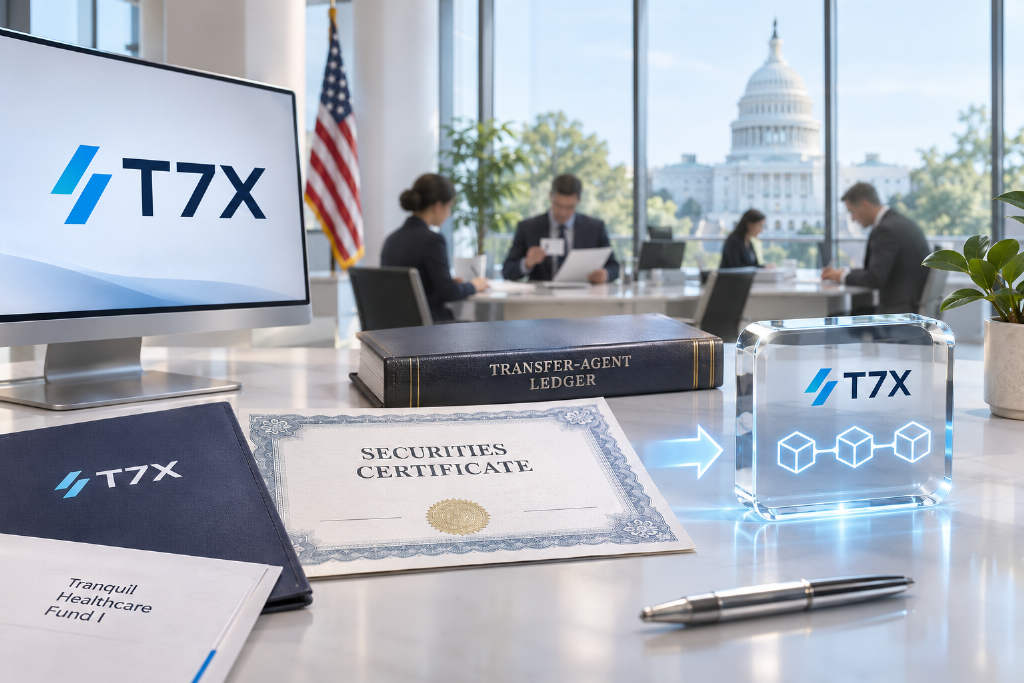
Most tokenized stocks are not issued natively on a blockchain, according to T7X. In an essay shared with Decrypt, Ivan Kan, chief marketing officer of the tokenization platform, said the market has largely taken conventional securities structures and reproduced them on-chain rather than rebuilding them from first principles.
In the model Kan described, a traditional share is first held with a broker or custodian, and a separate token is then issued to represent it. That token may follow the value of the underlying stock, he wrote, but the token holder is not necessarily the shareholder of record. Price exposure and legal ownership are not always the same thing.
The U.S. Securities and Exchange Commission outlined three models in January: issuers tokenizing their own shares, third parties issuing tokens backed by shares held in custody, and firms issuing a separate security that provides synthetic exposure.
Kan also pointed to research from Pantera Capital that he cited in an August article for Forbes Technology Council. The research covered 593 tokenized assets across 11 asset classes, and 77.6% of them were classified by Pantera as digital wrappers built around traditional infrastructure rather than securities in their own right.
One token, one security, one authorized issuance
Kan framed the central question this way: what does the token legally represent, and who authorized it? The answer T7X Equities is pursuing is what it calls native issuance. In that approach, the token is not an add-on layered over an existing security. It is part of the authorized issuance from the beginning.
T7X argues that a security exists because an issuer authorizes it, and that blockchain does not remove the corporate-law and securities-law requirements attached to that process. Under the structure the company describes, the workflow runs from issuer authorization to investor verification to transfer-agent validation, with the goal of creating one security, one authorized issuance, one ownership record, and one digital representation.
Kan said corporate law in Wyoming, Delaware, and Nevada recognizes a "certificate token," allowing shares to be represented electronically on a blockchain. T7X is incorporated in Wyoming and says it structures its issuances within that framework. In that setup, blockchain becomes part of the infrastructure supporting the capitalization table rather than a separate instrument placed on top of the existing system.
The transfer agent keeps the official master securityholder file, while the blockchain records transactions. The legal record of ownership remains where regulators expect it to be.
For T7X’s administrated offerings, that transfer agent is T7X Equities. Transfer agents register with the SEC and maintain the authoritative record of who owns a security, process transfers, and keep the master file. T7X’s position is notable because the company is not only advocating the model but also operating inside it.
The first example cited by the company is Tranquil Healthcare Fund I, a Tier 2 Regulation A+ offering of up to $75 million that the SEC qualified on June 29. T7X said T7X Equities issues tokens representing the fund’s shares on Trusted Smart Chain and delivers them to investors’ wallets.
Speaking at Consensus in Miami earlier this year, T7X Chief Executive Pablo Penaloza said, "There’s a registered, SEC-regulated gatekeeper that determines who owns which security at any point in time. As long as you have a transfer agent involved, there is no way that securities can disappear without trace."
RWA+ and the legal meaning of the token
Kan uses the term RWA+ for the broader category. He said the plus does not refer to a single rule. Instead, it points to a structure in which compliance and oversight are real and built into the product. He breaks that into three elements.
- Native issuance, where the token is created as part of the security’s authorized issuance.
- Integrated compliance, where investor verification and disclosure are built into the instrument from the start rather than added later.
- Legally enforceable ownership, where the token holder appears on the transfer agent’s record.
In his Forbes article, Kan wrote, "A receipt is not an asset. It is a claim wrapped around one, dependent on an intermediary to honor it." He also argued that synthetic "PreStocks" tied to SpaceX and Anthropic were never valid claims because neither company authorized the transfers.
His broader point is that, if the structure is done properly, ownership, compliance, and settlement become the same fact.
That distinction is also showing up in other regulatory and market settings. The SEC’s new innovation exemption covers tokenized stocks that carry dividend and voting rights, while excluding synthetic products that only track price. Nasdaq’s arrangement with Kraken also depends on tokens conveying the same voting rights as ordinary shares.
Why T7X sees Regulation A+ as the near-term opening
Penaloza said the immediate opportunity lies with companies raising less than $100 million, usually between $50 million and $75 million, through Regulation A offerings.
Kan argued that Regulation A+ fits the model because it allows public solicitation and participation by non-accredited investors, while also requiring audited financial statements and ongoing disclosure. By contrast, most tokenized assets rely on Regulation D placements, which are limited to accredited investors.
Penaloza added that Reg A can also open the door to retirement accounts. Unregistered securities can legally sit in a self-directed IRA, but many brokers will not hold them and most investment advisers steer clients away from them. "The money is sitting in the older generations’ retirement accounts," he said, adding that a registered investment is what makes an individual retiree more comfortable holding it.
Liquidity is part of the pitch
For investors who already hold these securities, Penaloza said the benefit is an exit path. Shareholders in Reg A and Reg D placements typically receive a paper certificate and then have to find someone willing to provide liquidity.
He said a native digital security can trade on a secondary market and settle wallet to wallet without a custodian in the middle.
Giving Reg A and Reg D holdings a place to trade would, in his view, "incredibly speed up not only the rate of capital formation, but also the liquidity in the market."
Penaloza also made a five-year forecast, saying that "the total tokenized portfolio will far surpass the existing market capitalization of what is currently trading on all the public markets."
Decrypt noted at the end of the article that readers can learn more about T7X’s real-world asset tokenization platform at t7x.com.




