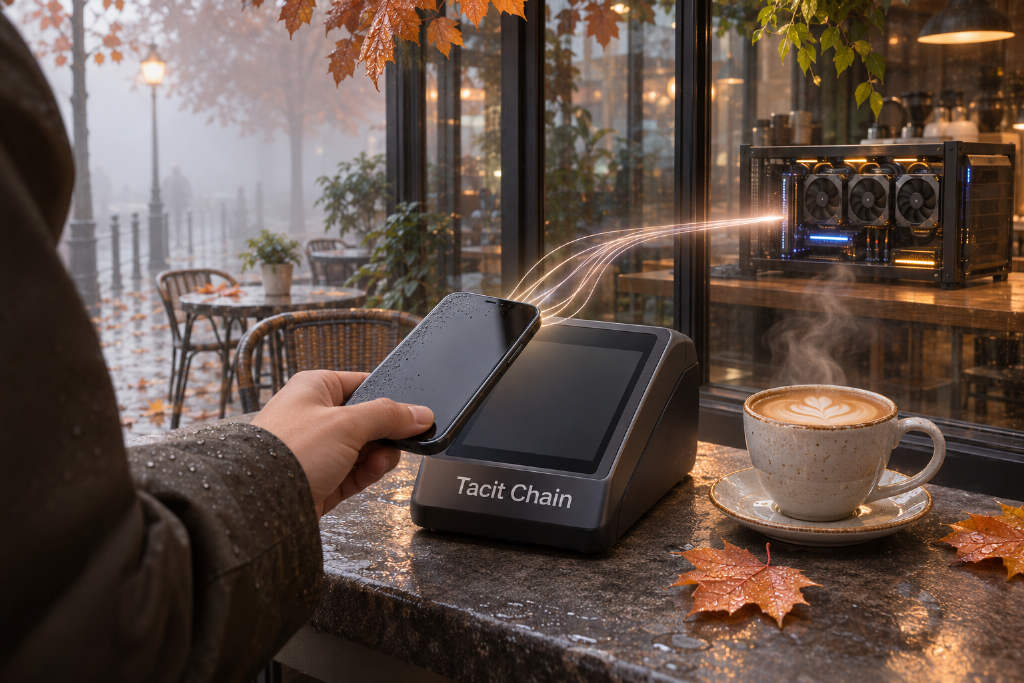
Tacit Chain is presented as a payment-focused privacy zk-rollup built around three requirements: fast settlement, default transaction privacy and protection against future quantum decryption. The article is by ross.wei (@z0r0zzz), compiled by AididiaoJP and published by Foresight News.

A practical test for crypto payments is whether they can buy a cup of coffee. Merchants want to receive funds quickly and move on. Users also need ordinary purchases to avoid exposing their daily routines. Because blockchain records can remain available permanently, a payment system must also consider whether information captured today could be opened by more powerful machines in the future.
What sidechains and state channels trade away
The simplest route to faster payments is a sidechain. Users lock assets on a main chain and receive a pegged balance on another ledger controlled by a consortium or an operator. Liquid uses this model for Bitcoin, with custody handled by a group of companies through a multisignature arrangement. Trust assumptions vary widely across sidechains. The main chain generally cannot see what happened inside the sidechain or protect the balance there.
The article compares a sidechain balance to a gift card: a company issues a virtual balance that can theoretically be invalidated, leaving users dependent on the operator’s incentives and risk controls. A state channel is closer to a bar tab. A user and a merchant first lock funds in a shared mainchain account, then exchange signed messages representing obligations. At settlement, the newest signed balance replaces the old one. The Lightning Network is a prominent example. It reduces trust in an intermediary, but users must monitor the channel online to guard against an outdated state being used fraudulently.
These systems make different compromises around speed, trust and convenience. Tacit Chain narrows the scope to payments and uses a zk-rollup to handle privacy and verification.
Optimistic rollups and zk-rollups have different exit assumptions
A rollup runs a separate ledger, compresses transactions into batches and submits the records to Ethereum. The batch still has to be verifiable, much like a fruit roll-up that compresses fruit but can be pulled apart to check what is inside.
Optimistic rollups assume that a submitted batch is valid. That keeps submission costs lower and the experience faster, as seen in the examples of Base and Robinhood. A sequencer determines transaction order, while an operator or partner sends the batch and its result to Ethereum. If someone finds double spending or an inconsistent balance, that party can replay the transactions and open a dispute. The offending party’s deposit is penalized and the challenger receives a reward. The drawback is the challenge period: users commonly wait about a week to exit.
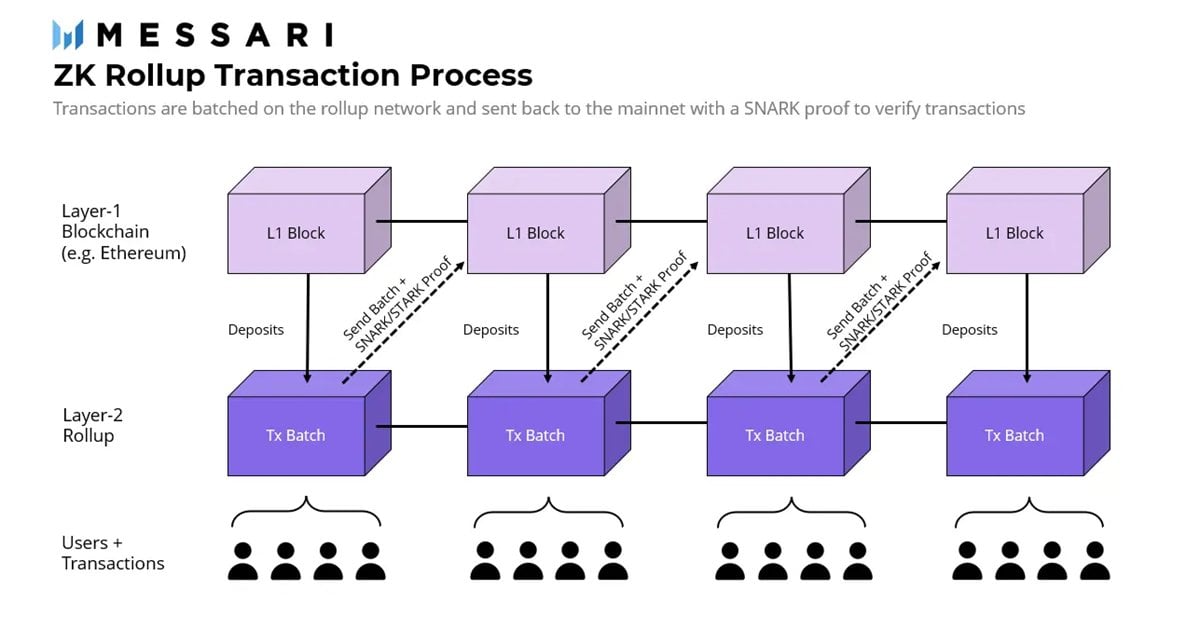
zk-rollups take a different route. They generate a validity proof before submission. Ethereum checks the proof when it receives the batch, and a batch that fails verification cannot be posted to the mainnet. There is no need to accept the batch first and wait for a later dispute process.
Payment processing inside a privacy proof
Tacit Chain uses the zk-rollup model but limits its scope to payments. Payments require relatively little computation, allowing a user device to prove that its own payment is valid while a GPU community processes the block batches. The rollup verifier does not need to learn who paid whom or how much was sent. A second proof checks that the entire batch was processed correctly before Ethereum accepts it.
The sequencing role is called a leader. The scheduled leader orders payments and submits a block to the TacitBlocks.sol verification contract on Ethereum. The contract records the block, checks validity and provides the basis for withdrawals. A participant holding 1,000 TAC seats can receive a scheduled turn. If that leader does not work, anyone can take over after 10 minutes.
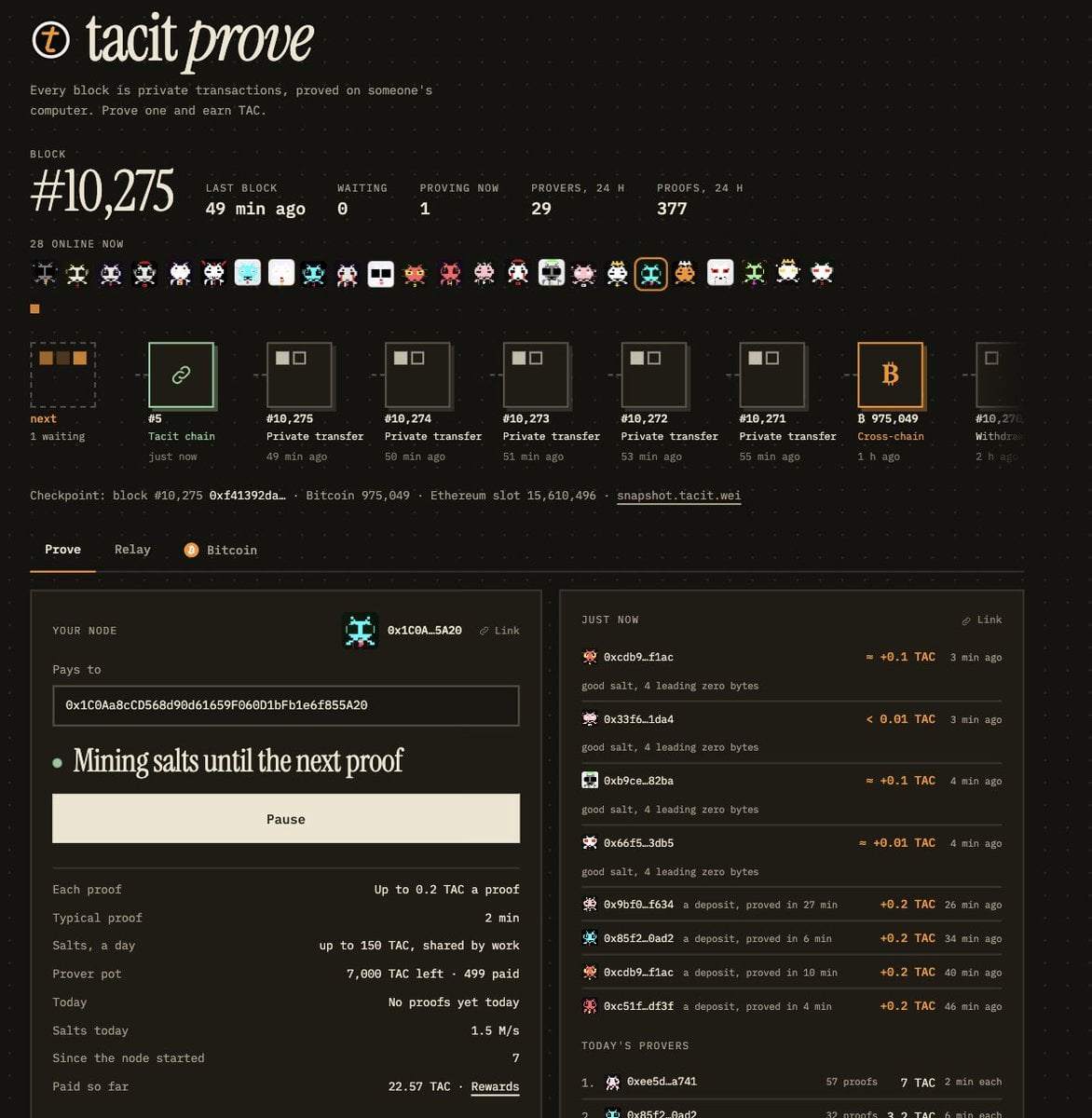
Leaders charge in TAC, which also serves as the rollup’s currency. Provers receive TAC through a reward program for producing useful proofs rather than spending computation on hash puzzles. Anyone with a GPU can join the proving process.
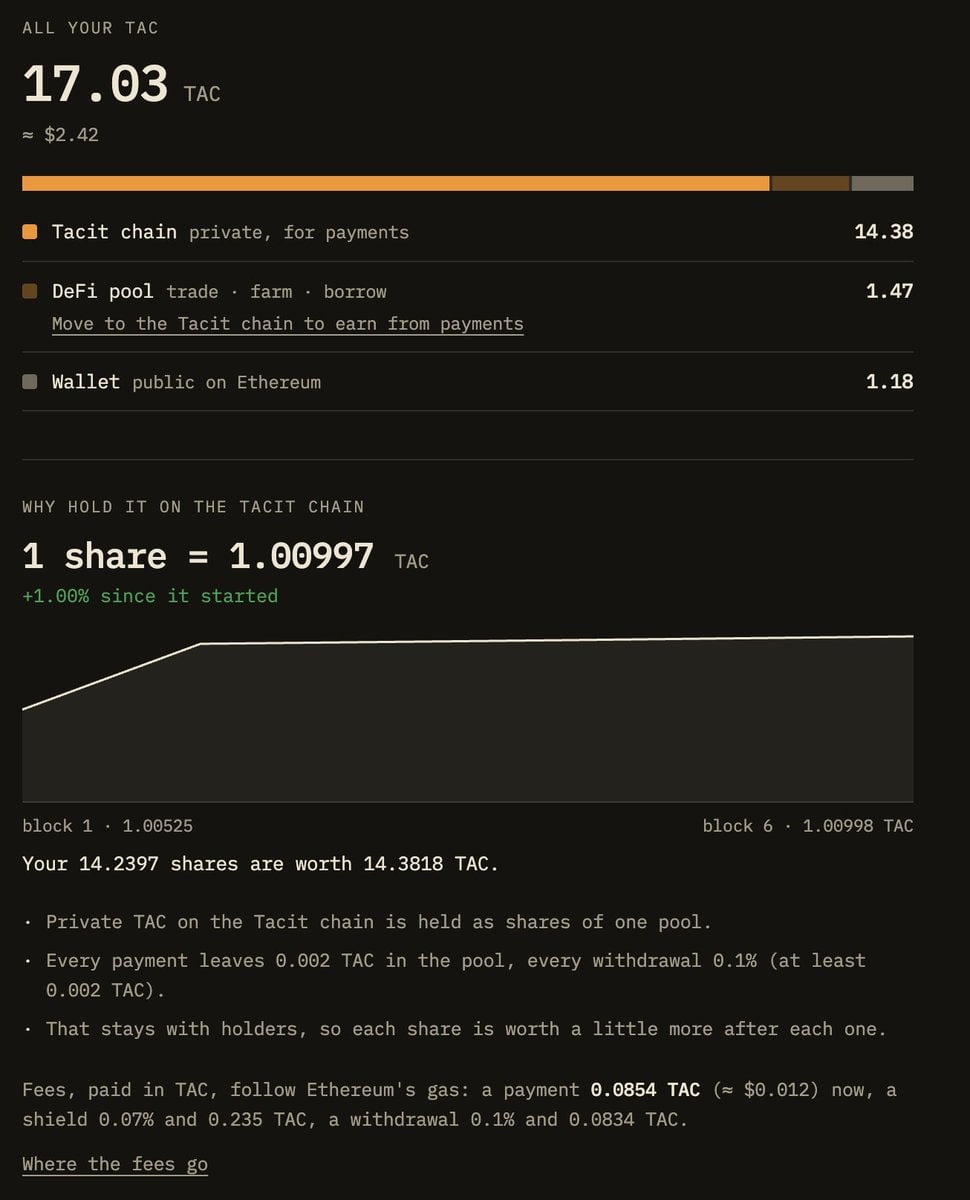
Fees are also paid in TAC. Users enter the network with shares. Part of every payment and the small fee charged for each exit remains in a shared pool instead of going to an intermediary. The design can reward users who keep funds in the system and expand the anonymity set. When more payments fit into one block, the Ethereum posting cost can be divided across more transactions, which may reduce the cost per payment.
The protocol does not take a cut. Anyone can run a leader node and earn fees sent to it. If TAC appreciates, leaders and provers need to sell less TAC to cover ETH gas and GPU costs.
Routes in and out through Ethereum and Bitcoin
Users can enter Tacit Chain from Ethereum. Holders of a TAC airdrop can use an EIP-2612 permit meta-transaction without preparing gas. Users without TAC can buy it on a DEX, complete tasks or earn it by proving transactions.
Bitcoin users can enter through a fast bridge and complete an atomic swap with a liquidity provider, or use a conventional bridge. Tacit Chain is not described as a separate network intended to split BTC and ETH liquidity and dapp access. Its stated design is a zk-rollup with a native currency, a trust-minimized bridge to Ethereum and a bridge to Bitcoin. An immutable privacy pool shields BTC, BTC-derived tokens, ETH and ERC20 assets from both chains.
Exits do not require a week-long challenge period. Users can exit immediately into ERC20 TAC, place that TAC into the Tacit bridge to return to Bitcoin, or use it for internal DeFi activities such as providing liquidity and swapping.
Forced exits use a separate queue. A user calls force() on Ethereum to enter the queue. If a block skips an entry that has exceeded the one-hour FORCE_DELAY, QueueOverdue() is triggered and the block is rolled back. Under the design described in the article, a leader can delay the process for about one hour at most, plus the applicable window.
ML-KEM for payment memos that remain private
Maintaining privacy today is different from maintaining privacy in the future. Once a transaction is posted, it becomes a permanent record. Tacit Chain formats the memo attached to a payment for resistance against quantum computing. The memo is an encrypted message to the recipient that records the receipt and the amount.
The memos are encapsulated with ML-KEM, which won the NIST post-quantum cryptography standards competition. The article says that even if someone captures all onchain payment records today, the memos should not be easy to open once quantum computers mature.
The author considers Tacit Chain compliant with the “stage two” standard for L2s. Core contracts including TacitBlocks and TacitSeats have no owner, upgrade path or multisignature control. The verifier, block keys, delays and token are immutable. The verifier is fixed as an SP1 Groth16 verification leaf rather than an upgradeable gateway.
Stage two requires a 30-day exit window before an upgrade that users do not want. Tacit Chain has no upgrade path that would require such a warning. At the proof layer, it is a validity rollup and does not rely on a decentralized set of fraud-proof participants. During the first 10 minutes after each posting, only the leader can submit a block; after that, anyone can submit one.
Data is sent to Ethereum through calldata, allowing nodes to reconstruct the complete state. Cross-pool transfers and migrations pass through the confidential V1 pool, so users must trust the construction of that pool. The V1 pool is also immutable and has no upgrade path, and it cannot take balances away. A withdrawal to Ethereum is an ordinary TAC transfer inside the contract and does not depend on V1.
Confirmation targets and optional migration
According to the article, a coffee payment through Tacit Chain can appear to the merchant at the moment it is sent and reach final confirmation on Ethereum in about one minute. As the participant and proving pools become stronger, confirmation could approach 30 seconds. Blobs are already built in, and costs could fall below one cent.
Merchants can withdraw TAC to Ethereum or Bitcoin. Merchants that do not want to hold TAC can exchange it for another currency inside the internal DEX’s confidential pool.
Longer-term directions include running programs, internal smart contracts and support for additional assets. Tacit Chain has designed a migrate operation for an upgrade to a new version, but migration occurs only for users who choose to join. The upgrade is not meant to break anonymity: it would not reveal which memo moved or how much was moved.