
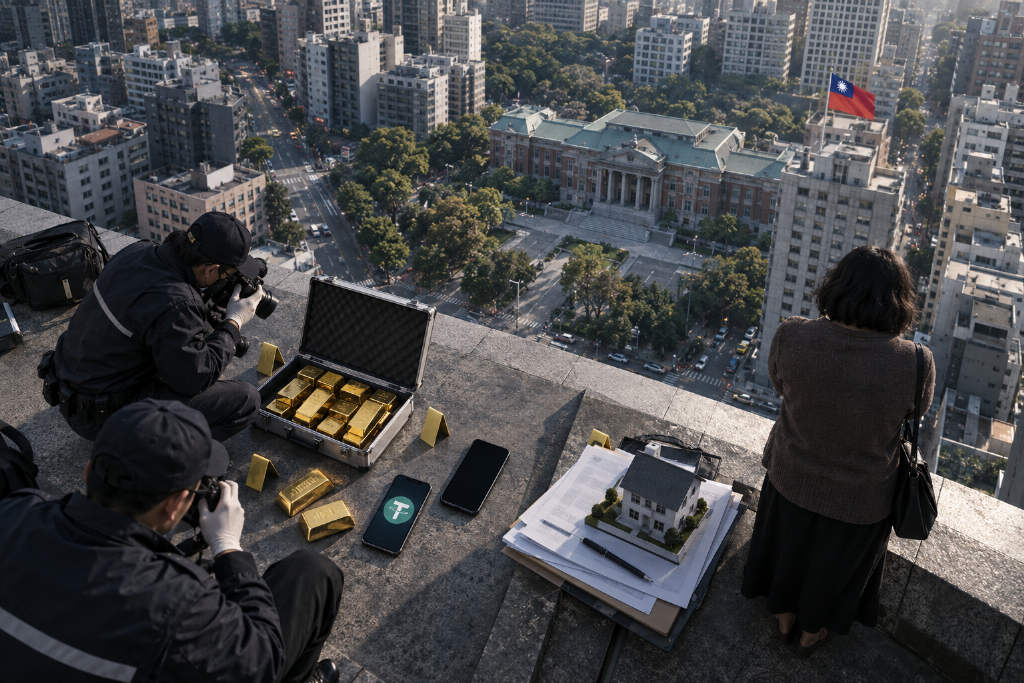
A woman in Taichung’s North District lost more than NT$15 million after falling for a fake investment scheme that used a 「gold-for-USDT」 pitch. Police said she borrowed money through personal credit loans and a mortgage on her home to buy gold bars, then handed the bars to a designated 「contracted physical crypto dealer」 named by the fraud ring. She discovered the scam only after her withdrawal request was rejected.
Police disclosed the case during a radio interview
Wang Kuo-feng, chief of Taichung’s Second Precinct, disclosed the case on Sept. 22 during an interview on Police Broadcasting Service program 「945 會客室」. Police said the victim, a woman surnamed Lin and about 40 years old, joined a Facebook sports group where members repeatedly shared posts showing supposed investment gains. She then asked for investment information on her own.
The fraudsters introduced a process in which gold would be exchanged for Tether’s USDT and then placed into an investment platform. Lin was told to buy gold bars first and hand them to a designated in-person dealer. According to the pitch, the gold would be converted into USDT and deposited into the platform for trading. Believing the story, she kept putting in money raised through personal loans and real-estate-backed borrowing.
When she later tried to cash out, the platform would not allow withdrawals. The other side then asked her to put in even more money. That was when she realized she had been deceived. Police said the money used to buy the gold bars came from loans and mortgage borrowing, and those debts still have to be repaid by Lin herself.
Fraud losses in the precinct fell, but the case was still large
Wang also released fraud statistics for the precinct. From January to August this year, the Second Precinct handled 1,007 fraud cases, compared with 1,436 in the same period last year. Financial losses fell from NT$686 million to NT$426 million, a decline of about NT$260 million, or 37.9%.
As of the end of August, the precinct had blocked 67 fraud cases involving more than NT$66 million. Lin’s loss alone accounted for more than one-fifth of that amount. Wang said the three categories causing the highest losses in the precinct were fake investment scams, impersonation of police or prosecutors, and romance scams combined with investment pitches.
How the scheme worked
Police said the scam began with repeated posts in a social media group showing supposed successful investments. After building trust, the fraud ring told the victim to buy gold bars and hand them to a designated dealer, claiming the gold would be converted into USDT and then used on an investment platform.
USDT is a stablecoin pegged 1:1 to the U.S. dollar and can be transferred directly between wallets across borders. Police said that feature made it easier for the fraud ring to package the process as something that looked like a legitimate virtual-asset investment flow.
Other gold handoff cases have appeared this year
Police said scams involving in-person gold handoffs for crypto have surfaced more than once this year. According to a July report by SET News, Taichung police’s eighth investigative unit broke up a fraud ring led by a 48-year-old man surnamed Chang. The group rented a house in an alley and disguised it as a 「virtual asset exchange」, asking victims to bring cash or gold in person. The case was indicted in June.
At the site, the group used a scale to weigh the gold and converted it into virtual assets based on the day’s gold price, then pretended to send the funds into a 「cold wallet」. In one case, a female factory owner in Changhua first brought dowry gold jewelry and gold bars worth more than NT$20 million. Over the next four months, she continued handing over cash and gold, with total losses reaching about NT$80 million.
Police said fraud rings ask for in-person delivery of cash or gold to avoid financial oversight and make fund tracing harder.
Police: licensed exchanges do not take cash or face-to-face gold deals
Wu Po-kuan, head of the technology investigation unit at Taichung’s Criminal Investigation Division, said licensed exchanges only accept bank transfers from accounts under the customer’s own name. They do not take cash, and they do not operate physical storefronts for in-person settlement. He said anyone claiming to buy or sell virtual assets for cash in person is usually a private over-the-counter dealer, or OTC trader, or an individual.
Wu also said that once illicit funds are converted into USDT and moved into a cold wallet or hot wallet, police often lose the trail at that stage. Transfer records on the blockchain can be checked, he said, but investigators cannot directly determine who owns a wallet.
Warning against 「guaranteed profit」 claims
Wang said fraud groups often use phrases such as 「guaranteed profit」 and 「sure win, no loss」, then pair those claims with success stories in social groups or fake investment apps to create the illusion of returns. He urged the public not to join unfamiliar investment groups and not to withdraw or hand over money or property based on instructions from strangers. People with doubts can call Taiwan’s 165 anti-fraud hotline for verification.