
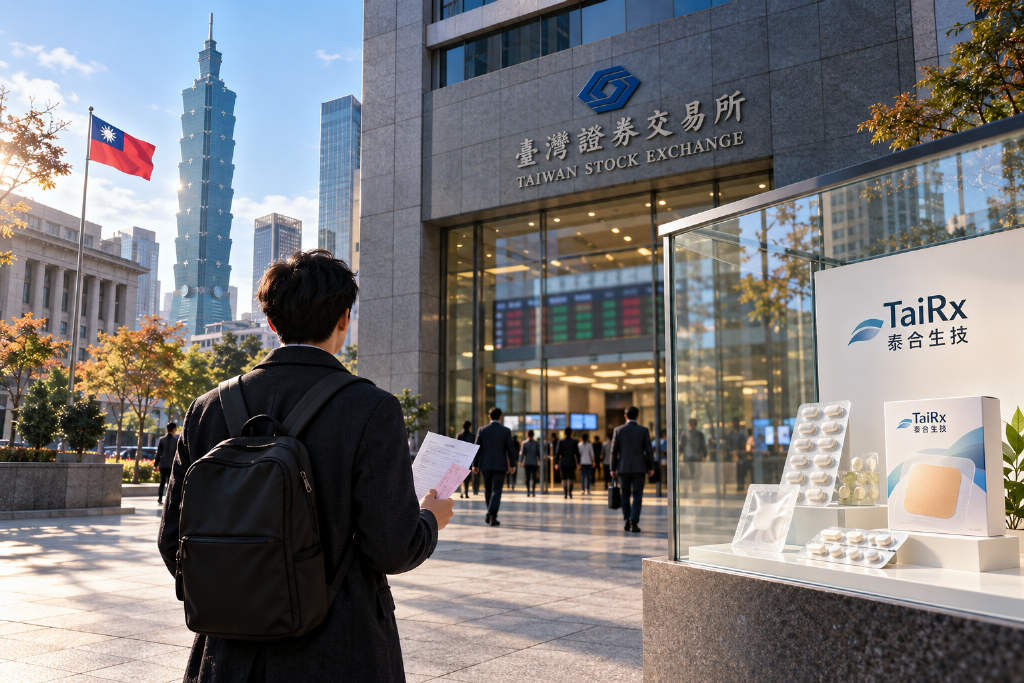
Taiho Biotech (6467), a biotech company focused on new drug-delivery formats, will open its public share subscription from Oct. 7 to Oct. 12. Using the tentative underwriting price of NT$105.6 and the roughly NT$241 Emerging Stock Board market price cited in the report, one winning lot would imply a potential gain of more than NT$134,000, or about 127%.

Taiho Biotech’s business and product focus
Founded in 2010, Taiho Biotech focuses on development and patent licensing for new formulation drugs under the 505(b)(2) pathway. The company says it has built its own transepithelial drug delivery system, or TDS, platform, with two core dosage forms: orally disintegrating films, or ODF, designed for patients with swallowing difficulties, and transdermal patches for long-acting and stable drug delivery.
Its key pipeline includes TAH3311 / Apixaban, described in the report as the world’s first antithrombotic oral film tailored for patients with dysphagia, along with antiemetic patches for chemotherapy and central nervous system drugs. After years on Taiwan’s Emerging Stock Board, Taiho has received approval from the Taiwan Stock Exchange and has started pre-listing capital raising and public underwriting procedures.
How the public subscription process works
In Taiwan, the formal name for stock lottery participation is public subscription. It is a mechanism through which companies issue new shares to the public to raise funds. When a company is preparing for an IPO or conducting a cash capital increase after listing, a certain portion must be made available for public subscription under local rules.
Investors submit applications through their brokerage trading platforms and must make sure their settlement accounts hold enough money for the subscription payment and related fees on the designated debit date. If total applications exceed the number of shares available, the Taiwan Stock Exchange conducts a computerized random draw to allocate them.
Costs and risks investors need to weigh
The main attraction for applicants is usually the spread between the underwriting price and the market price. Lead underwriters often leave room for a discount to make the deal easier to place. That said, applicants still need to account for the cost of capital being tied up. After the subscription deadline, the full subscription amount is deducted and frozen for several trading days until refunds are issued to unsuccessful applicants.
There are also direct transaction costs. Each application requires a NT$20 processing fee and a NT$50 mailing fee for the winning notice. If an investor does not win the draw, the principal and the NT$50 mailing fee are refunded, leaving NT$20 as the unrecoverable cost.
The report also warns that Taiho Biotech is moving from the Emerging Stock Board to a formal listing. Its current reference price comes from a market known for relatively lower liquidity and larger price swings. Because there is still a time gap between subscription, drawing, and official listing, there is no certainty that the share price will remain at the current level once the stock starts regular trading.
Key dates for this deal
The tentative underwriting price for Taiho Biotech’s public subscription is NT$105.6. Based on the recent Emerging Stock Board price used in the source report, the paper gain on one winning lot would exceed NT$130,000.
According to the report, existing shareholders have given up their priority rights to subscribe to the new shares, and the entire allotment has been handed to securities underwriters for the pre-listing public offering. A total of 1,594 new share lots will therefore be available to public investors. The article notes that this may raise the chances of winning, while also saying the reason behind the arrangement deserves attention.
Applications can be submitted through a brokerage app’s stock lottery section before 2 p.m. from Oct. 7 to Oct. 12. Investors need to place NT$105,670 in the settlement account before the debit date. Funds will be debited on Oct. 13, and results will be announced on Oct. 14.