
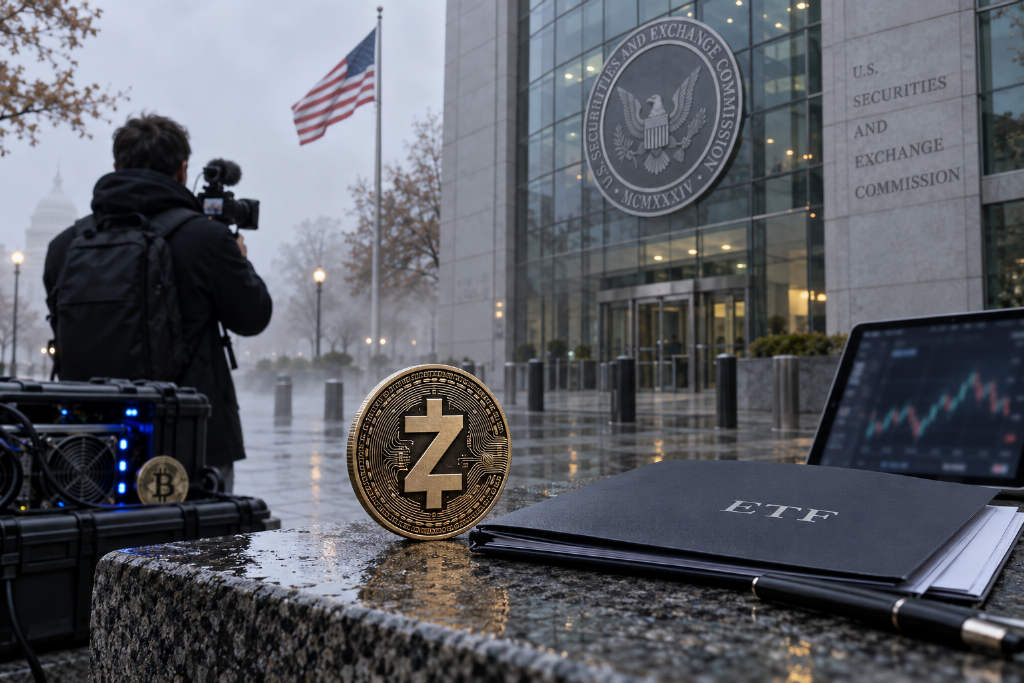
Crypto trader and YouTube creator Taiki Maeda says he’s still all-in on Zcash after ZEC pushed above $1,000, according to a MarsBit article put together and translated by TechFlow from his Sept. 11, 2026 video, Zcash: All-in with my Net Worth.

The piece says the video was a standalone presentation, not an interview, and it lasted about 35 minutes. In it, Maeda said he is long ZEC, HYPE, and LIT, still mining through Variational, and running the paid Discord group HFA Premium. It also says these are his personal opinions, not investment advice.
From a brutal June exit in Zcash to doubling down after $1,000
MarsBit’s summary says Maeda had used a July video to go over his own failed Zcash trade. He said he dumped his whole position near the bottom during the June panic tied to the Orchard pool vulnerability, then had to buy back higher once the market bounced.
Two months later, ZEC was above $1,000, and the ZEC/BTC ratio had gone from roughly 0.8% then to 1.6%. In the new video, he zeroed in on two things: answering common attacks on Zcash from both Chinese- and English-speaking crypto Twitter, and saying in public that he is now "all-in." He said a portfolio of HYPE, LIT, Zcash, and Variational mining is what he means by being "locked in."
Maeda said, "What does my being locked in mean? Buying HYPE, buying LIT, buying Zcash, adding more, mining Variational, and not selling. Not that kind of Degen-circle thing where people say, 'I bought some random meme coin on the Robinhood chain, so I’m locked in.'"
His three-part case: reflexivity, institutional access, and the reverse argument
The article lays out Maeda’s bullish case for Zcash in three main parts.
- First, reflexivity. He said that when Zcash goes up, the dollar value inside the shielded pool gets bigger, which makes it easier for new money to access what he sees as real privacy. Better privacy then pulls in more users and more capital.
- Second, institutional rails are open. He said the U.S. Securities and Exchange Commission has dropped its lawsuit against Zcash Labs, a Zcash ETF is already trading, and that ETF’s assets under management have topped $500 million. He also said he has noticed Zcash often starting to move when the U.S. stock market opens, which he takes as an indirect hint of institutional flows.
- Third, his reverse argument. He said older proof-of-work coins like Litecoin and Doge have not managed anything similar, so a roughly 10-year-old PoW asset probably does not break out like this on a fake story alone. In his view, that survivor effect points to actual demand.
How he trades the four-year cycle without buying into it
Maeda also explained the broader cycle framework he uses. He said he does not believe in the four-year cycle itself, but he still respects it because 50% to 70% of the crypto market believes in it. So, in his view, it becomes a self-fulfilling prophecy powered by crowd behavior.
He said that in the third quarter of last year, while a lot of traders were calling for a strong fourth quarter, he sold everything and went short. This year, he said, the setup had reversed: now that many people are calling for a Q4 collapse, he decided to go fully long instead.
His logic was simple. If he does not believe in the cycle but most people do, then he wants to get in front of them and take the other side. He said anyone waiting for a Q4 breakdown is also future buy support on the way down, because those orders would cushion price if it falls.
The article says he is still following that framework. With BTC now a bit above $80,000, Maeda said a real move above $84,000, along with four-year-cycle bears turning bullish, would be the kind of right-side confirmation he wants.
His view of the cycle winners: HYPE, LIT, Zcash, plus a BTC core holding
Maeda brought in what the article called a Munger-style inversion framework. He started with the losers. Stuff with no fundamentals. Assets that only go up when BTC goes up. Venture-backed tokens maybe making $10 a month in revenue while trading at a $2 billion valuation. That kind of thing.
By contrast, he said the winners should have real fee revenue, real buyback mechanisms, and the ability to keep printing new highs even when they break away from BTC and ETH.
Using that framework, he named HYPE, LIT, and Zcash as the winners he sees. He also said he still holds BTC as a base position. The article adds that he acknowledged headwinds around BTC, including selling pressure from Saylor and quantum-related threats, but still said "BTC is BTC" and that he plans to keep that core allocation.
His takeaway was blunt: the market has already picked the winners by sending them to new highs. Now the job, in his view, is to buy them and hold them. At this point, he said, the really counterintuitive trade is not buying dips. It is buying what is already winning.
ZEC above $1,000 and the start of price discovery
Maeda was very clear about what breaking through $1,000 meant to him.
He said, "Last week we broke 1,000 like a hot knife through butter, with no resistance at all. Everyone who bought below 1,000 was aiming to hold for several times higher. We have already entered pure price discovery."
Before that level, the article says Zcash had been dealing with a few structural constraints. The dollar value inside the shielded pool was still not big enough, which made new funds easier to identify. The SEC case against Zcash Labs was still unresolved. And price had spent a long stretch going sideways while the broader market mostly ignored it.
According to Maeda, clearing $1,000 unlocked three signals at once.
- Technical signal: Zcash broke above multi-year highs and entered pure price discovery.
- Narrative signal: The ZEC/BTC ratio moved above 1%, turning "Zcash at more than 1% of Bitcoin’s market cap" into its own talking point.
- Institutional signal: The SEC dropped its lawsuit against Zcash Labs, a Zcash ETF launched, and AUM moved past $500 million.
From there, he said, the path from $1,000 to $3,000, $4,000, and $5,000 gets much easier. He did not present that as lazy straight-line extrapolation. Not that. He framed it as a reflexive loop: higher prices increase the value locked in the shielded pool, that improves privacy for new entrants, more capital comes in, and price rises again.
Maeda said, "Zcash fundamentals are a function of price. The more dollars there are in the shielded pool, the easier it is for new entrants to get real privacy. The more price rises, the better the privacy. The better the privacy, the more people buy."
He also used a market-cap comparison to argue the move is less extreme than it looks.
He said, "Zcash is now 1.6% of BTC’s market cap. From that angle, it’s not that crazy. Silver is 13% of gold’s market cap, while Zcash is 1.6."
Zcash versus Monero
The article says two of the most common attacks against Zcash on Twitter are that nobody uses it and that Monero is better because criminals use Monero. Maeda went at both points.
On privacy design, he said Monero depends on ring signatures, producing decoy transactions every time someone sends a transfer. His concern was that stronger AI-driven blockchain analysis in the future could make those decoys easier to unravel.
By comparison, he said Zcash uses an optional shielded pool, where privacy improves the longer funds stay in the pool and the bigger the pool becomes. He presented that as a built-in trade-off in privacy protocol design: Monero offers default privacy but may be more exposed to future analytical breakthroughs, while Zcash offers what he called compliant privacy, though it needs time and capital to build up inside the shielded pool.
Maeda said, "Monero uses ring signatures, and as AI gets stronger, those fake transactions could possibly be cracked. Zcash uses an optional shielded pool. The longer funds stay there and the bigger the pool gets, the better the privacy. That is the inherent trade-off in privacy protocols."
On institutional access, his view was even more direct. He said institutions will not buy Monero because regulators will not allow it. Zcash, he argued, sits in a different bucket because it now has an ETF and because the SEC case against Zcash Labs has been dismissed.
He said, "Institutions will not buy Monero. Regulators will not let them buy it. Zcash has an ETF, it is compliant privacy, and the SEC has already dropped the case. The size of the market it can carry is completely different."
He also framed the investment question around future demand, not present-day users.
He said, "Stop saying, 'Criminals use Monero, so Monero is better.' You do not make money based on who is using something right now. You make money based on whether the whole world will care more and more about privacy in the future, and then put money into the asset with the strongest privacy properties."
His factual comparison was pretty plain: in this phase, the market had already picked a favorite, with Zcash moving above $1,000 while Monero had not.
His answer to the "fake narrative pump" argument
Another criticism he took on was the claim that the Zcash move was just a coordinated narrative push by a small group, including Naval, Balaji, and Maeda himself. His answer leaned on comparisons with two other older PoW coins.
First: Litecoin. He said Litecoin is also proof-of-work, also old, and also around a decade old, yet repeated stories around it have not been enough to force a similar move.
Second: Doge. Maeda said that even with Elon Musk openly supporting Doge, plus the symbolic boost around the Department of Government Efficiency, or D.O.G.E., Doge still failed to break its prior-cycle high.
That was his point. If even Elon Musk could not push a 10-year-old PoW asset into that kind of breakout, then saying Zcash got there only because of a handful of influential social media accounts is a stretch. In his view, the market had already shown this was not just a narrative pump. Real money was coming in.
He added one more observation. Zcash often starts rising around the U.S. equity market open. He called that an indirect sign of institutional price-setting. He also said the Zcash ETF’s more than $500 million in AUM is just the start, and that when 13F filings later reveal actual institutional holdings, the picture may look a lot more obvious.
He said, "The Zcash ETF’s AUM has already exceeded $500 million. I’ve noticed something recently: every time the U.S. stock market opens, Zcash starts moving higher."
What "locked in" means to him, and the Joy Miller framework
In the last part of the video, Maeda reworked what he meant by being "locked in."
He offered a self-test: if he sold everything right now, would he buy back the same portfolio in the same shape? If the answer is no, he said, then the portfolio and the investor’s conviction do not match. If the answer is yes, then the investor is truly locked in.
He said, "If you liquidated everything right now, would you buy it all back in the same allocation? If not, then you are mismatched. I would buy it back the same way I hold it now, so I know I am locked in."
He then pointed to what the article described as a position-building lesson from Joy Miller: start small to test the thesis, and once the market confirms that thesis, add size aggressively.
Maeda said, "Joy Miller put it most clearly: start with a small position to build the thesis, and once the thesis is validated by the market, that is when you should add heavily. That is exactly how I did it."
He said his Zcash trade followed that exact path. He first noticed the asset when it climbed from $30 last year to $600. He did not buy on the way down. During the June panic around the Orchard pool issue, he sold at the lows. Then he bought back higher, added more after ZEC/BTC broke 1%, and eventually got to what he called "All-in with my Net Worth." In his framing, this was not bottom-fishing. It was scaling up as the market validated the thesis step by step.
He said, "I noticed it when it ran from $30 last year all the way to $600. Later it came back down, and in June I sold at the bottom, then chased back in afterward. I do not know if I am completely locked in, but I feel like I understood what the market was saying."
His own risk warning
For all the conviction, Maeda still ended on a warning. The article says he openly admitted that in past bullish calls, he never actually held all the way to his stated price targets and stopped out early every time.
He said viewers should take that as a reminder to apply their own risk discount, not blindly mirror his all-in stance.
He described his execution framework as going heavy early, then trimming gradually later. He said he is willing to size up now because he believes the market is still in the early stage of a bull run and most participants are not fully positioned yet. Once the market as a whole is fully loaded and risk starts getting underpriced, he said he will begin cutting back. He also said he cannot predict that turning point ahead of time and will wait for market-based confirmation instead.
The MarsBit article credits the piece to TechFlow’s compilation and translation, names Taiki Maeda’s YouTube channel as the source, and says the video aired on Sept. 11, 2026.