
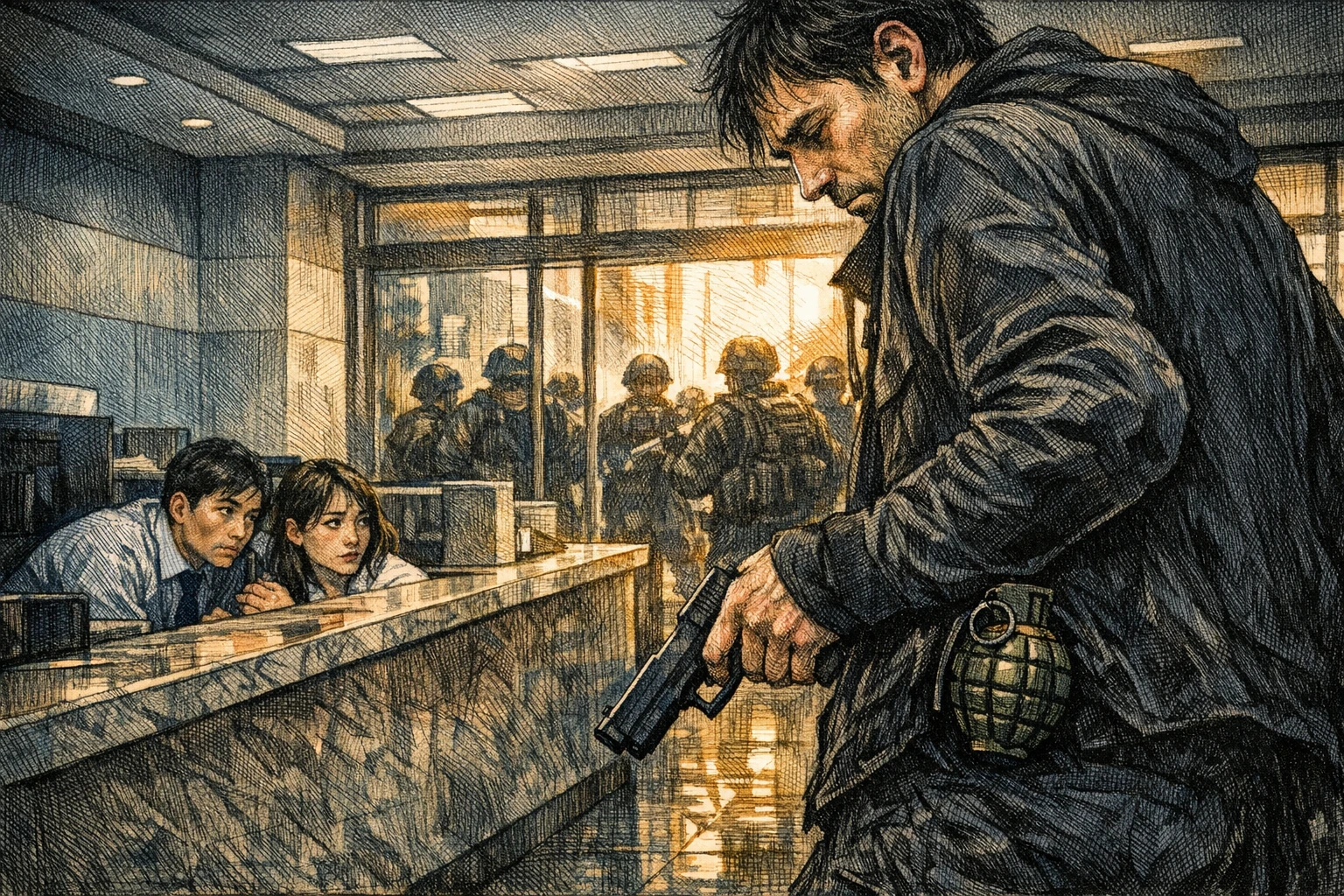
A man who entered CTBC Bank’s Daan branch in Taipei on April 24 and took a staff member hostage was eventually subdued after police surrounded the scene. What drew immediate attention was not only the suspected fake handgun recovered from him, but also a grenade. The case stood out because the branch sits in one of Taipei’s busiest districts, a place that offers little room for escape.
A downtown branch with heavy traffic and fast police access
The incident took place on Section 4, Zhongxiao East Road in Daan District, an area packed with pedestrians, buses, scooters, nearby metro stations, and visible police presence. The bank itself also had security at the entrance. According to the source article, this is one of the least practical locations for a bank robbery if the goal is to flee. Police moved in quickly after receiving the report, and the standoff ended with the suspect in custody.
The article places the event in the context of Taiwan’s past bank robbery cases. Armed robberies that end in a successful escape have become rare. It cites the 1982 Lee Shih-ke case, in which more than NT$5.3 million was stolen, and the string of robberies committed by Wang Yuan, known as the “Raincoat Bandit,” between 2002 and 2012. Wang was linked to seven armored car and bank robbery cases involving more than NT$40 million in stolen funds, and he was later arrested and sentenced to life imprisonment in 2013. More recent cases in Taipei have been limited, with only scattered incidents in 2020 and 2021.
Modern bank security leaves little room for a clean getaway
The source says bank branches now commonly operate with 8 to 12 CCTV cameras, with facial recognition systems capable of uploading footage in real time. Much of the cash behind the counter is kept in time-lock safes that staff cannot open on demand. The rise of electronic payments has also reduced the amount of cash available at branches. Some smaller branches may hold only around NT$10 million in banknotes on a given day.
Once an emergency alert is triggered, police often arrive within five minutes, according to the article. After that, any escape route can be traced through roadside cameras, vehicle plates, clothing, shoes, and even walking patterns. Against that backdrop, the article argues that bank robbery in Taiwan now offers almost no realistic chance of getting away.
The grenade pushed the case into a more serious category
The grenade is what changed the nature of the incident. The article says armed bank robbery in Taiwan can bring a prison term of at least seven years or life imprisonment under robbery statutes, while possession of a handgun can trigger separate firearms charges. Possession of a grenade falls under offenses involving explosives, carrying a minimum sentence of five years and a possible fine of up to NT$15 million. Displaying such an explosive in a public setting can also lead to aggravated treatment.
That is why the article treats the suspect’s choices as highly unusual. If the goal had been to seize cash and run, bringing a grenade would have sharply increased the legal risk without improving the odds of escape. Showing it at the counter would only elevate the case from robbery to something much more severe. If it had been detonated, attempted murder and public endangerment charges could have followed.
The article suggests the suspect may have wanted arrest, not cash
Based on the timing, location, and equipment involved, the source presents one possible reading: the suspect may not have been trying to escape at all. It points to several details — choosing a branch in a dense commercial district, entering during business hours, confronting police after taking a hostage, and making no visible effort to flee through a back exit or blast open a path out.
The article says that pattern looks less like a planned getaway and more like an act designed to guarantee detention. It links that idea to cases in which people under threat from debt, criminal networks, or retaliation may see incarceration as a form of short-term protection. Still, the piece is careful on one point: police were still questioning the suspect, and no official motive had been announced. The theory remains only a suspicion drawn from the unusual facts already in public view.