
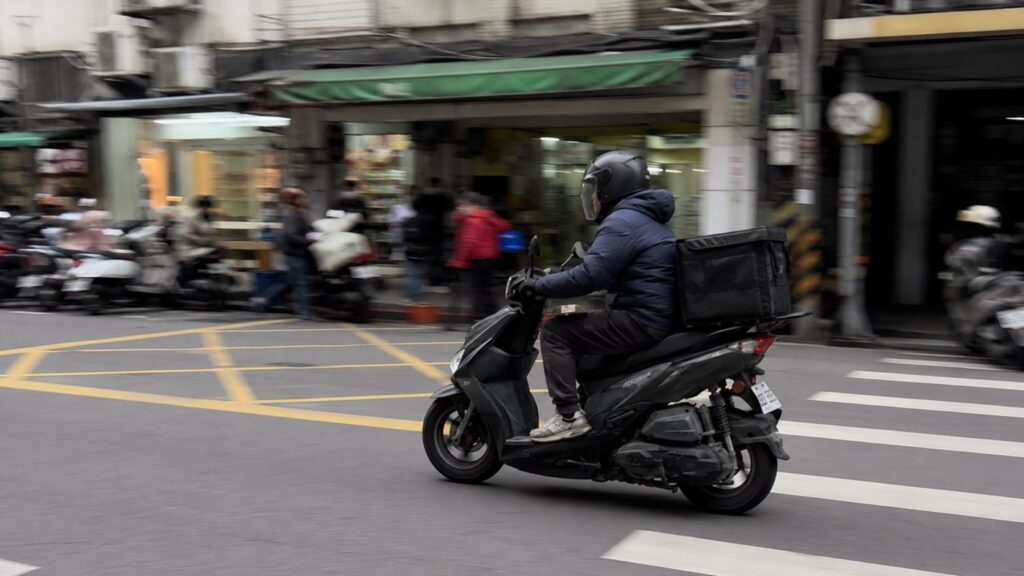
Taiwan’s first dedicated law for food delivery workers will take effect on July 21, 2026, setting a NT$45 minimum payment per order, requiring stacked deliveries to be priced one by one, and imposing new rules on insurance, dispatch transparency, and account suspensions. The law, the Delivery Worker Rights Protection and Delivery Platform Management Act, is expected to cover about 150,000 delivery workers across Taiwan. It does not, however, settle the long-running dispute over whether riders are contractors or employees.
Two fatal crashes in 2019 pushed the issue into public view
The report traces the debate back to two fatal traffic accidents during Taiwan’s National Day holiday in October 2019.
Late on Oct. 10, a 29-year-old foodpanda rider surnamed Ma was killed in Taoyuan after colliding with a light truck. It was his second day working deliveries. Three days later, on Oct. 13, an Uber Eats rider in his 20s surnamed Huang was fatally struck by a car in Shilin while heading home after work.
On the Monday after the holiday, Taiwan’s Ministry of Labor moved quickly, classifying both cases as employment relationships and saying the riders should have labor protections. It then launched labor inspections and fined the two platforms. The companies said they would handle compensation and provide assistance, but both maintained that their riders were contracting partners rather than employees.
That was the first time the dispute drew broad public attention. Nearly six years later, the new law is finally set to take effect.
Why the contractor-versus-employee distinction matters
According to the report, the difference between contracting and employment status determines the scope of legal protection available to riders.
If a rider is treated as an employee, the employer must help enroll that worker in labor insurance, bear most of the premium burden, and provide access to labor pension contributions and statutory occupational accident benefits. If the relationship is treated as contracting, the rider is closer in legal terms to an independent worker. In that case, labor insurance generally has to be arranged through a union, most premiums are borne by the worker, there is no labor pension account, and occupational accident protection depends on whether the platform has purchased commercial insurance, which may deny claims.
The report says delivery platforms in Taiwan have, for more than a decade, generally classified riders as contracting partners. It adds that foodpanda’s contract even required riders to agree not to bring employment-related claims arising from the services they provide.
At the same time, riders occupy a gray zone. They can log in freely and reject orders, which resembles contract work. But their pay calculations, dispatch priority, and account suspensions are all shaped by platform algorithms. As the report puts it, they have the freedom of freelancers without the bargaining power freelancers would normally expect.
Minimum pay, stacked-order pricing and suspension appeals written into law
The law creates several hard floors for the job.
On pay, each order’s base compensation cannot fall below 1.25 times the pro-rated minimum hourly wage during the service period, and every order is guaranteed at least NT$45. That floor will be adjusted in line with changes to the minimum wage. Platforms must pay compensation in full directly to riders, issue payments at least twice a month, and provide statements that can be checked against actual orders.
The treatment of stacked orders is another central change. Previously, a platform could assign several orders to the same rider while compressing the unit price through bundled pricing. Under the new law, each order is defined as one pickup point and one drop-off point, and compensation must be calculated order by order even when multiple deliveries are assigned at the same time.
The legislation also targets algorithmic management. Platforms will have to disclose how dispatching and compensation work. On suspensions, a platform that blocks a rider must explain why, carry the burden of proof, offer an appeal path, and establish an independent review group that includes union representatives.
Insurance becomes mandatory before riders can be dispatched
Safety requirements form another major pillar of the law. Platforms must provide group accident insurance and liability insurance for riders. If insurance is not in place, dispatching is not allowed. They must also pay the premiums for workers’ participation in occupational accident insurance.
The report frames these provisions as a response to the legal vacuum exposed by the two fatal accidents six years ago.
It also says the law reaches beyond riders. It sets management obligations for platforms, protects merchants from arbitrary revenue-sharing adjustments, and gives consumers more clarity on where their payments go. In that sense, this is Taiwan’s first central-level law to place riders, platforms, merchants, and consumers under the same set of rules.
The law keeps both contract models in play, and labor groups are not satisfied
Even with implementation days away, opposition has not faded. The deepest disagreement still centers on contractor status.
Rather than forcing a legal determination of whether delivery workers are contractors or employees, the law takes a different route: platforms must provide minimum protections regardless of contract form. Labor Minister Hung Sun-han said newer platform models may also hire riders as employees in the future, so the law should retain enough flexibility to accommodate different types of relationships.
That compromise may be practical, but labor groups worry it could harden the contractor model. If baseline protection can be delivered inside a contracting framework, platforms may have even less reason to convert riders into formal employees. In that case, workers gain a safety net but remain outside full labor-law protection, including pension contributions, severance, and complete employee status.
Fee increases and matching-fee talk have opened a new front
After the bill passed, one immediate question was whether delivery fees would rise. The Consumers’ Foundation said platforms may pass higher compliance costs on to consumers.
Uber, citing research by Taiwan’s Fair Trade Commission, warned that a 5% increase in delivery fees could lead 34% of users to stop ordering delivery, which could in turn reduce order opportunities for some riders. Platform operators have also openly said higher compliance costs make fee increases unavoidable.
The report adds that around the law’s rollout, the market has seen talk that platforms may raise delivery charges by 30% and may even seek to charge riders a “matching fee.” Unions criticized the idea sharply, saying the added costs were being pushed back onto the side with the weakest bargaining power.
That leaves the new law facing a practical test as soon as it takes effect: whether a measure designed to protect delivery workers also becomes a basis for price increases and cost pass-throughs.