
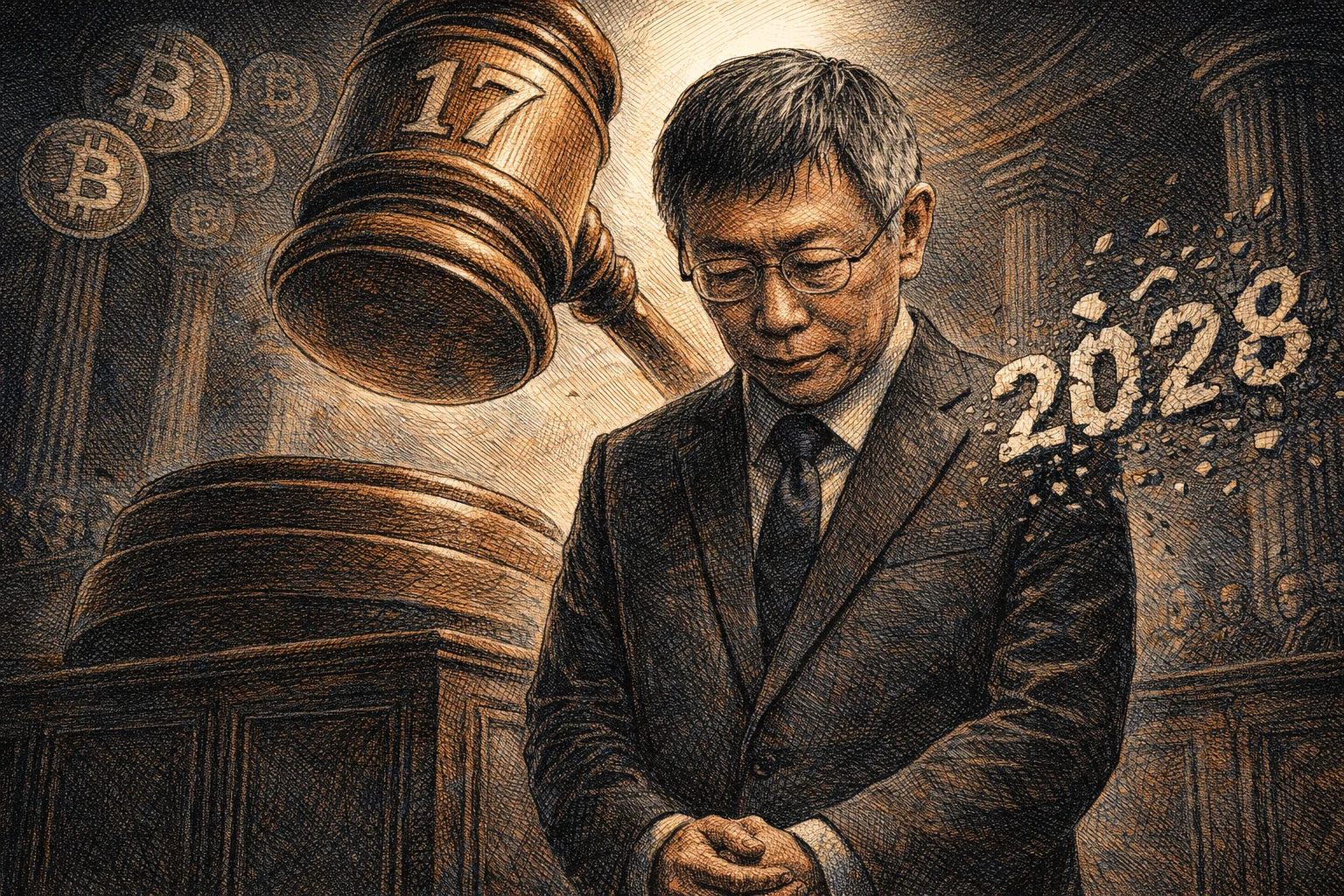
The Taipei District Court on March 26 sentenced former Taipei Mayor Ko Wen-je to 17 years in prison with six years of deprivation of civil rights for his role in the Core Pacific City development scandal. The sentence was lower than the 28.5 years sought by prosecutors but effectively ends Ko's political career and his potential 2028 presidential bid.
Verdict Details: Three Guilty, One Acquitted
The court found Ko guilty of accepting bribes, breach of trust, and two counts of embezzlement of public funds. The bribery charge was based on NT$2.1 million (about $67,000) in political donations from the Wei Hsiung Group, linked to the controversial zoning bonus that increased the site's floor area ratio from 560% to 840%. The judge acquitted Ko on charges of illegal profiteering for public officials, citing insufficient evidence to meet the legal threshold.
The 1,500 Bitcoin Puzzle: No Evidence Found
One of the most sensational allegations in Taiwanese legal history — that Ko secretly held 1,500 Bitcoin (worth roughly $108 million at current prices) — collapsed in court. Prosecutors presented only an Excel entry reading "2022/11/1 Xiao Shen 1500 Shen Ching-ching" found on a USB drive, which the court ruled as an "extrajudicial confession" lacking corroborating evidence. Ko, who was released on NT$70 million bail in September 2025, has repeatedly denied the claim, calling it a "false imprisonment." No blockchain addresses or exchange KYC records were ever produced.
Broader Fallout: Political and Judicial Implications
Ko's silence during 16 court appearances was cited as an aggravating factor. The ruling reshapes Taiwan's political landscape: the Taiwan People's Party, which Ko founded, now faces an existential crisis. Meanwhile, the case underscores how digital assets complicate criminal investigations — without wallet access or on-chain proof, even high-profile accusations can remain unproven. Sentencing for 11 defendants ranged from 15.5 years for the middleman Ying Hsiao-wei to acquittals for two architects. The presiding judge, Chun-Yen Chiang, previously handled the im.B cryptocurrency fraud case and is known for heavy sentences.