
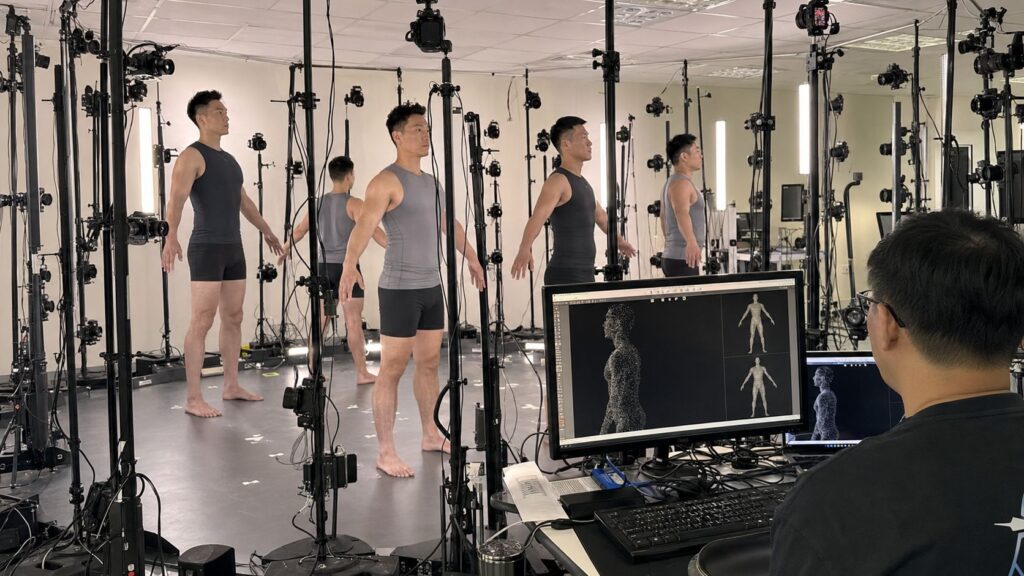
A male model in Taiwan has accused apparel brand Life8 of posting AI-generated product images that copied his appearance without consent, opening a wider debate over portrait rights, copyright, and the legal status of AI-made commercial visuals.
The model said he recognized himself through specific features
According to the report, the model, identified by the surname Lin and the social account iamgalin, published a video on the 17th saying he discovered the images because they preserved details tied closely to his own look. He pointed to the single eyelid he had before surgery, a tattoo in the same position on the right side of his neck, and a pose and head angle he said matched the way he typically worked in shoots.
He said, “I was replaced by an AI built from my own photos.”
Lin said the problem was not only resemblance. If clients saw the website images, he argued, they could wrongly assume he had changed his appearance and decide not to work with him. He called on Life8 to remove all of the images and explain how they were made.
Life8’s two responses drew scrutiny
Life8 first replied in social media comments that the images were generated by AI from prompts and were not created with any specific person as the subject. It also said it had not intentionally used any particular person’s photos or data, had stopped using the images, was reviewing the content, and apologized for the trouble caused.
That response did not settle the matter. The brand later commented again under the model’s social post, saying it had privately messaged him to handle portrait-rights issues and follow-up authorization. Online critics quickly focused on the gap between the two statements: if no specific person had been used as the basis, whose authorization was now being discussed?
The report says the public-relations problem did not come from the technology itself, but from the company’s explanations failing to line up. As the issue spread, other models also began sharing similar experiences. The article says that if Lin files suit, the case could become Taiwan’s first AI portrait-infringement lawsuit.
Chinese apparel e-commerce has already pushed AI image generation at scale
The article places the Taiwan dispute in a broader industry context by looking at China’s apparel e-commerce sector, where AI image generation has already been widely adopted. It says a typical human model in China may be paid about RMB 100 to RMB 300 per item, and once photographers, makeup artists, and studio costs are added, shooting dozens of products in a day can easily push total spending above RMB 10,000.
With AI tools, by contrast, the cost of a single image can be cut to just a few jiao, with output produced in minutes. The savings are not limited to model fees. They also reach photographers, makeup artists, lighting crews, and venue costs across the whole production chain.
The report says many companies in China’s apparel business see a large efficiency gap between AI workflows and traditional shoots. AI does not require schedule coordination, waiting for a model, or working around weather. One industry description cited in the article says an hour can produce 8,000 retouched images. Even if 99.99% are unusable, finding one usable image can still make the process worthwhile. For fast-fashion sellers with very high listing frequency, work that once took half a month can now be completed in a day.
On the platform side, Alibaba announced on January 15 this year that it had integrated Qwen applications into Taobao and opened public beta access to AI shopping services for all users. The Taobao app has also fully deployed AI virtual try-on tools, allowing users to test and match multiple clothing items.
Still, the report notes that the technology has not fully met user expectations. After Taobao’s AI try-on feature went live, some users complained that they expected to see themselves wearing the clothing, but instead received results that looked more like the same catalog model with slightly altered jawlines.
In Taiwan, the core legal claim is usually not photo copyright
The article says one of the most common misunderstandings in Taiwan is that a model in this situation would be claiming copyright in the photos. In fact, under Taiwan’s copyright rules, copyright in a photographic work generally belongs to the photographer who created it, not the person being photographed.
Citing Articles 11 and 12 of Taiwan’s Copyright Act, the report says an employed photographer is the author while the employer holds the economic rights, and an independent contractor photographer is both the author and economic-rights holder, with the commissioning party retaining rights to use the work. The person appearing in the photo is not the creator and so is generally not the author.
What a model may actually be able to claim is a personality right. The report says Taiwan’s Civil Code does not explicitly use the term “portrait right,” but practice treats it as one of the personality rights protected under Article 18, paragraph 1, and ties it to Article 195 for claims including cessation of infringement, restoration of reputation, and damages.
The key issue is scope of use. Agreeing to be photographed once does not mean agreeing that one’s likeness can be used for another purpose. Once use goes beyond what the person photographed could reasonably have expected at the time, the article says there may be room for a legal claim.
Training-image disputes may point to photographers or brands, not the model
The report says copyright law is not irrelevant, but it would likely be invoked by a different rights holder. If copyrighted photos are deliberately fed into an AI system for training, that can amount to reproduction under copyright law and would generally require authorization unless fair use applies.
But those rights belong to the copyright owner of the photos, meaning the photographer or the brand that financed the original shoot, not the model. In practical terms, if a business used photos shot for another brand as training or reference material, the party that could raise a copyright claim might be that other brand rather than the person depicted in the image.
The article also points to a less discussed angle: an original tattoo design in Taiwan is treated as an artistic work, and its copyright generally belongs to the tattoo artist. If an AI-generated image fully reproduces that design, the image could, in theory, also raise a separate copyright issue involving the tattoo artist. That would be distinct from the model’s own portrait-rights claim.
Life8’s AI explanation also raises questions about copyright in the generated images
The report says Life8’s statement on social media opens another issue: whether the AI-generated product images themselves are protected by copyright. Under guidance from Taiwan’s Intellectual Property Office at the Ministry of Economic Affairs, the answer depends on whether there was real human creative input in the process.
If an output is produced entirely by AI computation and the user only gives simple prompts without substantial creative contribution, the result is generally not protected by copyright. Following that logic, if Life8’s account is accepted — that the pictures were generated by AI from prompts and not based on any specific person — then the brand may also be undermining any future claim that the image set is protected work. If competitors copied the set and reused it, asserting rights could become difficult.
Taiwan has passed an AI Basic Act, but it remains a framework law
On the regulatory side, the article says Taiwan has recently added a broader legal framework. The legislature on December 23, 2025 passed the 20-article Artificial Intelligence Basic Act in its third reading, with the National Science and Technology Council named as the central competent authority.
The law says the government should promote AI under seven principles: sustainable development and welfare, human autonomy, privacy protection and data governance, cybersecurity and safety, transparency and explainability, fairness and non-discrimination, and accountability. It also requires appropriate disclosure or labeling for AI-generated output.
At the same time, the article stresses that this is a basic law rather than a detailed enforcement statute. Questions about penalties and execution still need to be handled through more specific legal regimes.