
Taiwan’s economic expansion lost some speed in October, with both manufacturing and services indicators easing from the previous month. Data released by the Chung-Hua Institution for Economic Research on Nov. 2 showed manufacturing PMI falling to 62.5 from 63.4, while the non-manufacturing index, or NMI, dropped to 55.4.
CIER President Lien Hsien-ming said both readings remained above the 50 mark, which means manufacturing and non-manufacturing activity continued to expand. The change, he said, was in the pace. Growth continued, but more slowly than in the previous month. In manufacturing, difficulty securing key raw materials and components has started to limit production and shipments for some products.
CIER says one month of data is not enough to call a peak
Lien said it is too early to conclude that Taiwan’s economy has peaked just because PMI and NMI both softened in the same month. PMI reflects changes from the prior month, he said, so a lower reading does not mean the economy has entered a downturn. It points to slower expansion, not necessarily a reversal.
He also said the AI industry started from a relatively low base, which made high growth rates easier to achieve in the early stage. As capacity expands year by year, keeping annual growth at 20% to 30% will become harder. The industry is unlikely to move in a straight line, and sharper swings may become more common.
Supply bottleneck is moving from memory to IC substrates
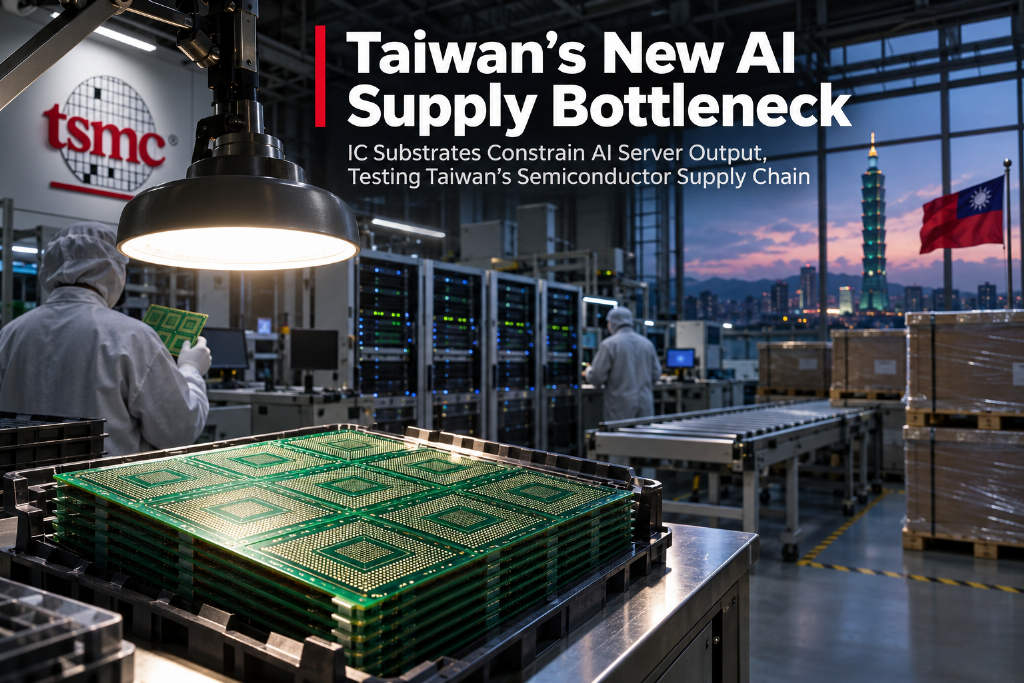
Lien said Taiwan remains a major global shipping hub for AI servers, but server production depends on a large number of components. A delay in any one of them can slow final assembly and shipment. Market attention had previously focused on tight memory supply. More recently, he said, shortages in IC substrates have become the clearer constraint.
He cited two reasons. One is limited production capacity within the substrate segment itself. The other is that some upstream materials used in substrates depend on Japanese suppliers, creating layered constraints across the supply chain. Taiwan mainly handles final manufacturing and assembly in the AI server chain, while upstream materials involve multiple countries and suppliers. If any part of that chain runs short, the impact moves downstream and affects overall shipment performance.
Orders are diverging across industries
CIER Associate Research Fellow Chen Hsin-hui said the industry still holds a positive long-term view on AI demand, but sentiment now differs sharply across sectors and companies. In power and machinery equipment, demand tied to AI infrastructure and power conversion equipment has pushed order visibility out to the end of 2027.
Consumer electronics companies are more cautious about 2027. Chen said those businesses are closer to end consumers and are concerned that buyers may not be willing to absorb steadily rising component costs.
Procurement behavior turns more cautious
On the procurement side, Pai Tsung-cheng, an adviser at the Chinese Association of Purchasing and Supply Management, said companies are taking a wait-and-see approach in response to international uncertainty, including the U.S. election, the Israel-Iran conflict, and the Russia-Ukraine war. Many are choosing smaller and more frequent purchases to meet short-term demand rather than making large procurement commitments too quickly.
Pai added that many downstream companies had already built inventory earlier. As a result, even with international oil prices rising, they have been unwilling to accept price increases proposed by upstream suppliers. That means pressure from higher raw material costs has not yet shown up clearly in the purchasing price index.
AI search and AI agents may reshape business models
CIER Vice President Chen Hsin-hung said AI is also changing existing business models. Using Google as an example, he said advertising revenue came in below expectations, which may be related to the rise of AI search as users click traditional search links less often. Over time, wider adoption of AI agents could also affect the revenue and billing models of cloud service providers, or CSPs.
Even so, Chen said capital spending still points to ongoing AI demand, though supply chain bottlenecks are getting in the way. In his view, ups and downs are a normal part of industrial development.
Overall, the latest slowdown in Taiwan’s PMI looks more like a supply-side deceleration caused by component shortages than a weakening in AI demand. Whether IC substrate supply and upstream materials from Japan improve will be a key factor in tracking future AI server shipments.



