


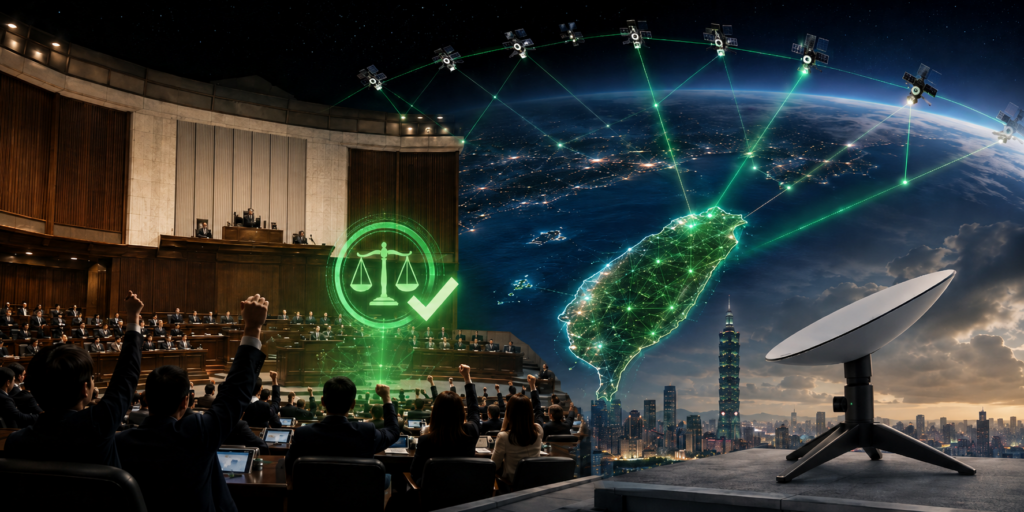
Taiwan’s legislature has moved to relax two legal restrictions that have stood in the way of Starlink’s commercial launch in the market, after the Transportation Committee cleared a proposed amendment to the Telecom Act in first review on July 13.
The amendment is seen as paving the way for SpaceX’s satellite internet business, which has not yet started commercial service in Taiwan. According to the source report, the main obstacle has not been technology but a clash between Taiwan’s telecom rules and Starlink’s preference for operating on a wholly owned basis.
Under the existing framework in Article 36 of the Telecommunications Management Act, direct foreign ownership cannot exceed 49%, combined direct and indirect foreign ownership cannot exceed 60%, and the chair must hold Republic of China nationality. The report said Starlink held talks with Taiwan’s National Communications Commission, or NCC, in 2021, but negotiations broke down after the company insisted on a 100% wholly owned structure that conflicted with the rules in force at the time.
Two restrictions were loosened
The draft amendment approved in committee changes two points.
- The chair of a telecom business owned by a satellite communications operator would no longer need to hold Republic of China nationality.
- Foreign ownership, whether direct or indirect, would be capped at 60%.
That would remove part of the legal barrier that has kept foreign satellite operators such as Starlink out of the market. The bill now moves to cross-party negotiations and further legislative discussion. It has not yet reached a third reading.
Japan’s model featured heavily in the discussion
The report compared Taiwan’s approach with Japan, where the country’s three largest telecom carriers — KDDI, NTT DOCOMO, and SoftBank — have already partnered with Starlink. Those partnerships brought direct-to-cell satellite capability into existing telecom services and public safety networks.
In that setup, the foreign satellite provider does not enter the market on a standalone basis. Instead, the service runs under local licensed operators. The report described that model as a repeated point of reference in Taiwan’s current legal debate.
Local carriers backed the bill, with conditions
Taiwan’s three major telecom operators — Chunghwa Telecom (2412), Taiwan Mobile (3045), and Far EasTone (4904) — all backed or respected the direction of the amendment, while attaching conditions tied to national security, cybersecurity, communications resilience, regulation, and industry development.
Chunghwa Telecom said it has already built positions across high-, medium-, and low-Earth orbit satellite services and is developing a layered backup network covering sea, land, satellite, and air. Far EasTone, according to the report, argued that data localization, ground stations, and cooperation with local operators should be written into the legal framework.
The source report said satellite service cuts both ways for telecom carriers: it could compete for remote-area and maritime users, while also serving as a partner in disaster communications and coverage gap support. That helps explain why the local carriers favor a structure in which foreign operators work with domestic companies instead of entering Taiwan and serving end users directly.
Next fight shifts to the details of security safeguards
With the first review complete, the next stage will center on how national security conditions are handled. One of the main questions is whether those safeguards will be written directly into the statute or left to future rules drafted by the competent authority.
The bill still faces party negotiations and additional committee discussion before any final passage. For Starlink, the legal door is not fully open yet, but part of the barrier has now been moved.