
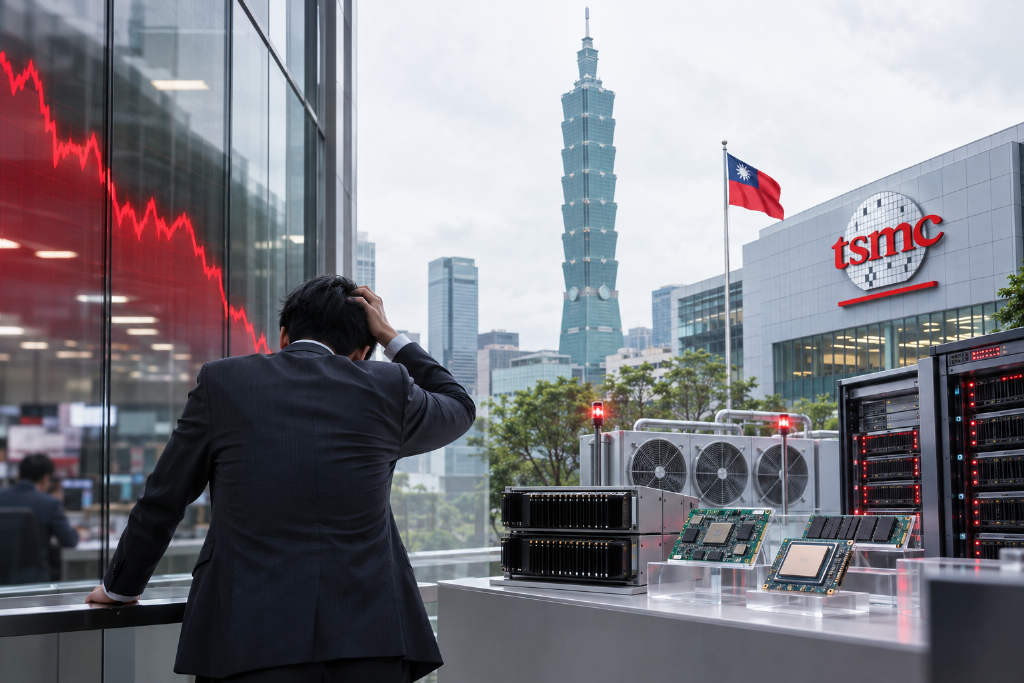
Taiwan stocks opened sharply lower on Nov. 5, with the benchmark index dropping more than 1,000 points within the first half hour of trading. TSMC proved relatively resilient, but many AI data center supply-chain names in memory, printed circuit boards and cooling equipment hit limit down during the session.
According to Taiwan Stock Exchange data, the weighted index had closed at 42,948.91 on Nov. 4. Less than 30 minutes after the open on Nov. 5, it fell to an intraday low of 41,866.10, down 1,082.81 points, or 2.52%. By 10 a.m., the index had recovered part of the decline and stood at 42,203, down 745.43 points, or 1.74%.
TSMC holds up while AI-linked suppliers take the brunt
TSMC closed at TWD 2,260 the previous day. It fell to TWD 2,245 at the session low and was quoted at TWD 2,255 as of 10 a.m., down 0.22%.
The heavier losses were concentrated in another group of companies tied to AI infrastructure. Elite Material, quoted at TWD 4,100, Alchip at TWD 6,405, Nan Ya PCB at TWD 972, Auras at TWD 1,170, TUC at TWD 1,005, and OTC-listed UDE at TWD 1,890 all touched limit down intraday.
Memory names were among the weakest. Nanya Technology fell as much as 9.64%, Winbond 9.54%, and Phison 9.36%. In the PCB segment, Unimicron and Gold Circuit Electronics dropped as much as 9.01% and 8.92%. Cooling supplier AVC fell 8.69% at its intraday low.
IC design services were also hit. ASIC company Alchip-KY fell as much as 8.33%, while MediaTek dropped 5.25%. In server components, Aspeed Technology, which makes BMC chips, fell 9.19%, Jentech, known for server rails, dropped 9.01%, and Delta Electronics fell 7.79%.
Assembly makers, financial stocks and telecom shares were relatively more stable.
Election-driven expectations around data center expansion
The report linked the sell-off to market positioning after the U.S. midterm election on Nov. 3. According to the article, Democrats won control of both chambers of Congress. U.S. stocks then split on Nov. 4: the Dow Jones Industrial Average rose 3.03%, while the Philadelphia Semiconductor Index fell 3.13%.
Among individual names, Micron dropped 7.00%, Dell fell 8.82%, and data center power and cooling company Vertiv lost 12.89%. On the other side of the trade, Microsoft rose 6.68%, Amazon gained 6.12%, and Alphabet added 3.18%.
The article laid out three lines of reasoning behind that market reaction.
Texas becomes one focal point
The first centered on Texas. NBC's election page projected that Democrat Gina Hinojosa defeated incumbent Republican governor Greg Abbott by 52.8% to 45.7%. A July statement from Hinojosa's campaign team called on Abbott to sign an emergency executive order to pause new data center construction until the state legislature sets formal rules.
Those proposed rules included requiring union labor, allowing local officials to reject new projects, banning the use of non-disclosure agreements to conceal water and electricity consumption, and protecting consumers from electricity rate increases tied to those projects.
Local ballot measures enter the trade
The second line of reasoning came from local ballot initiatives. CNBC, citing Ballotpedia data, said 41 local ballot measures across 10 states sought to restrict data center construction. Voters opposed all but one of them, with the exception being a measure in Harwood, North Dakota. Ohio alone accounted for 21 of the 41 measures.
CNBC voter polling showed that 56% of voters said data centers were a key or major factor in their vote.
Cash flow drives the split inside tech
The third argument focused on cash flow. CNBC said Alphabet, Amazon and Meta had all moved into negative cash flow because of AI infrastructure spending, while Microsoft remained positive. The market's logic, as described in the report, was that if cloud giants are forced to slow data center construction, their cash flow could improve and their shares could rise. Companies selling into that capital expenditure cycle, including chipmakers, memory suppliers, power equipment makers and server vendors, would then come under pressure.
Aditya Bhave, head of U.S. economics research at Bank of America, wrote in a report that 「slowing construction is not entirely a bad thing」 and said AI-related capital spending has grown at a real annualized rate of 26% since early last year, calling the front-loaded investment wave a sign of overinvestment. RSM chief economist Brusuelas said in a report the same day that AI investment needs to slow to a more sustainable pace.
The article also stressed that these are expectations, not policy. The new Congress does not take office until January next year, and there is still no conclusion on how any pause order would be carried out or whether a state legislature would support it.
South Korea falls harder; Bitcoin miners had already sold off
South Korean equities fell even more sharply than Taiwan's. Naver real-time market data showed that at 9:34 a.m. Taiwan time, the KOSPI stood at 5,436.16, down 4.36%. SK Hynix fell 7.95% and Samsung Electronics dropped 6.08%. Japan's Nikkei 225 was quoted at 61,727.86 at 9:17 a.m. Taiwan time, down 0.74%, according to CNBC.
Bitcoin moved differently. On Binance, BTC/USDT traded at about $80,550 at 9:36 a.m. Taiwan time, up 4.62% over 24 hours. But Bitcoin miners that have shifted toward AI data center hosting were hit hard in U.S. trading on Nov. 4: Hut 8 fell 23.23%, Cipher dropped 19.95%, and IREN lost 11.24%.
A month-long correction leaves four near-term watch points
The correction has already stretched over several weeks. The weighted index closed at a high of 49,822.55 on Oct. 6. At 42,306.96 as of 9:36 a.m. on Nov. 5, it was about 15.1% below that level. Based on the morning low, the decline was about 16.0%.
The index has closed lower every day since Oct. 29, including a 1,612.60-point drop on Nov. 3. Using the Oct. 28 close of 47,035.58 as the reference point, the market had lost about 4,729 points by 9:36 a.m. on Nov. 5. If the market closed lower again that day, it would mark a sixth straight down session.
On positioning, Taiwan Stock Exchange data showed foreign investors were net sellers of TWD 149.899 billion on Nov. 4. Investment trusts were net buyers of TWD 27.258 billion, while dealers were net sellers of TWD 37.519 billion. The three major institutional groups combined for net selling of TWD 160.160 billion. Meanwhile, the near-month Taiwan index futures contract in night trading closed at 43,404, up 201 points, which did not reflect the sharp cash-market sell-off seen the next morning.
The report said the market is now watching four things:
- Whether the weighted index can hold the Nov. 4 low of 41,855.82. The Nov. 5 morning low was only about 10 points above that level.
- Whether foreign investors continue to sell.
- The U.S. October nonfarm payrolls report due on Friday, Nov. 6.
- The fact that the new Congress will not take office until January 2027, and that any Texas pause order would only become clearer after Gina Hinojosa takes office. For now, the market is reacting to expectations while policy itself has not changed.
The article said its information was compiled from intraday and after-hours data from the Taiwan Stock Exchange and Taiwan Futures Exchange, NBC News election results, CNBC reporting, and a statement from Gina Hinojosa's campaign team.



