
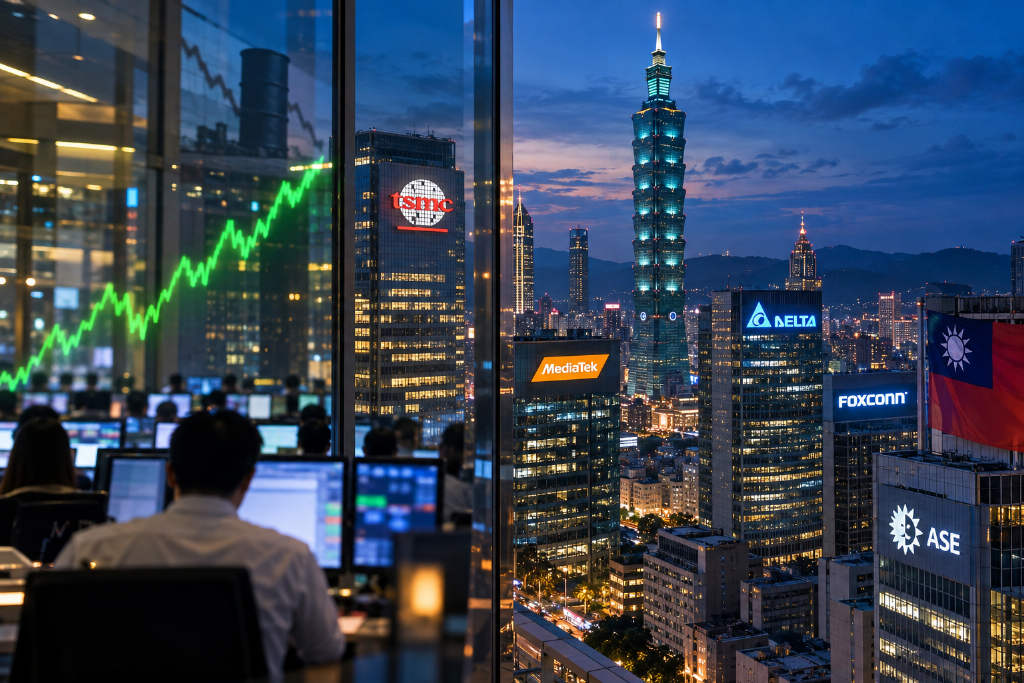
Taiwan stocks rallied sharply in early trading on Sept. 22, with the benchmark index climbing more than 880 points and reaching 48,601.53, a new intraday record. The move came after a strong session on Wall Street and a drop in oil prices following comments from Donald Trump that he might meet Iran’s president.
Taiwan shares open strong and extend gains
The market opened up 262.2 points and quickly added to those gains. Within minutes, the index had expanded its advance to as much as 882 points, hitting 48,601.53 and resetting its intraday high.
The report said the rally was fueled by expectations that the U.S. and Iran could hold direct talks, along with a pullback in U.S. Treasury yields. All four major U.S. stock indexes finished higher.
Heavyweight stocks lead the advance
Five major large-cap names helped drive the market higher at the open: Taiwan Semiconductor Manufacturing Co. (2330), MediaTek (2454), Delta Electronics (2308), Hon Hai Precision Industry (2317), and ASE Technology Holding (3711).
TSMC rose as high as NT$2,510 in intraday trading, up NT$30. MediaTek reached NT$5,480, up NT$470. Delta Electronics climbed to NT$1,965, up NT$90. Hon Hai added NT$3 to NT$253.
Electronics components, optoelectronics, semiconductors, and electrical cable shares also moved higher. Unimicron (3037), Alchip (3443), and United Microelectronics Corp. (2303) were among the names that joined the rally, helping push the broader market above the 48,000 mark.
Wall Street gains and ADR strength add support
U.S. stocks closed higher on Sept. 21. The Dow Jones Industrial Average gained 366.19 points to 52,048.83, while the S&P 500 rose 114.20 points to 7,764.70. The Nasdaq climbed 2.26%, and the Philadelphia Semiconductor Index jumped 4.29%.
Among Taiwan-related ADRs, TSMC ADR rose 2.44%, ASE ADR gained 5.04%, and UMC ADR added 3.33%. Taiwan index futures in the night session also jumped 728 points to close at 48,781.
Trump comments and Saudi exports weigh on oil
Geopolitics also played into the market move. Trump said this week that he would not rule out meeting Iran’s president during the United Nations General Assembly, raising expectations that tensions in the Middle East could ease.
At the same time, Saudi Arabia increased crude exports through the Strait of Hormuz. Those two factors together pushed international oil prices lower and eased pressure tied to inflation and input costs.